
Summer Sale Special Limited Time 70% Discount Offer - Ends in 0d 00h 00m 00s - Coupon code: buysanta

Exact2Pass Menu

SnowPro Advanced: Architect Recertification Exam

Last Update 9 hours ago Total Questions : 162

The SnowPro Advanced: Architect Recertification Exam content is now fully updated, with all current exam questions added 9 hours ago. Deciding to include ARA-R01 practice exam questions in your study plan goes far beyond basic test preparation.

You'll find that our ARA-R01 exam questions frequently feature detailed scenarios and practical problem-solving exercises that directly mirror industry challenges. Engaging with these ARA-R01 sample sets allows you to effectively manage your time and pace yourself, giving you the ability to finish any SnowPro Advanced: Architect Recertification Exam practice test comfortably within the allotted time.

Question # 21

Two queries are run on the customer_address table:

create or replace TABLE CUSTOMER_ADDRESS ( CA_ADDRESS_SK NUMBER(38,0), CA_ADDRESS_ID VARCHAR(16), CA_STREET_NUMBER VARCHAR(IO) CA_STREET_NAME VARCHAR(60), CA_STREET_TYPE VARCHAR(15), CA_SUITE_NUMBER VARCHAR(10), CA_CITY VARCHAR(60), CA_COUNTY

VARCHAR(30), CA_STATE VARCHAR(2), CA_ZIP VARCHAR(10), CA_COUNTRY VARCHAR(20), CA_GMT_OFFSET NUMBER(5,2), CA_LOCATION_TYPE

VARCHAR(20) );

ALTER TABLE DEMO_DB.DEMO_SCH.CUSTOMER_ADDRESS ADD SEARCH OPTIMIZATION ON SUBSTRING(CA_ADDRESS_ID);

Which queries will benefit from the use of the search optimization service? (Select TWO).

A.

select * from DEMO_DB.DEMO_SCH.CUSTOMER_ADDRESS Where substring(CA_ADDRESS_ID,1,8)= substring( ' AAAAAAAAPHPPLBAAASKDJHASLKDJHASKJD ' ,1,8);

B.

select * from DEMO_DB.DEMO_SCH.CUSTOMER_ADDRESS Where CA_ADDRESS_ID= substring( ' AAAAAAAAPHPPLBAAASKDJHASLKDJHASKJD ' ,1,16);

C.

select * from DEMO_DB.DEMO_SCH.CUSTOMER_ADDRESS Where CA_ADDRESS_ID LIKE ’%BAAASKD% ' ;

D.

select * from DEMO_DB.DEMO_SCH.CUSTOMER_ADDRESS Where CA_ADDRESS_ID LIKE ' %PHPP% ' ;

E.

select * from DEMO_DB.DEMO_SCH.CUSTOMER_ADDRESS Where CA_ADDRESS_ID NOT LIKE ' %AAAAAAAAPHPPL% ' ;

Question # 22

What are characteristics of the use of transactions in Snowflake? (Select TWO).

A.

Explicit transactions can contain DDL, DML, and query statements.

B.

The autocommit setting can be changed inside a stored procedure.

C.

A transaction can be started explicitly by executing a begin work statement and end explicitly by executing a commit work statement.

D.

A transaction can be started explicitly by executing a begin transaction statement and end explicitly by executing an end transaction statement.

E.

Explicit transactions should contain only DML statements and query statements. All DDL statements implicitly commit active transactions.

Question # 23

An Architect needs to meet a company requirement to ingest files from the company ' s AWS storage accounts into the company ' s Snowflake Google Cloud Platform (GCP) account. How can the ingestion of these files into the company ' s Snowflake account be initiated? (Select TWO).

A.

Configure the client application to call the Snowpipe REST endpoint when new files have arrived in Amazon S3 storage.

B.

Configure the client application to call the Snowpipe REST endpoint when new files have arrived in Amazon S3 Glacier storage.

C.

Create an AWS Lambda function to call the Snowpipe REST endpoint when new files have arrived in Amazon S3 storage.

D.

Configure AWS Simple Notification Service (SNS) to notify Snowpipe when new files have arrived in Amazon S3 storage.

E.

Configure the client application to issue a COPY INTO < TABLE > command to Snowflake when new files have arrived in Amazon S3 Glacier storage.

Question # 24

A company is using Snowflake in Azure in the Netherlands. The company analyst team also has data in JSON format that is stored in an Amazon S3 bucket in the AWS Singapore region that the team wants to analyze.

The Architect has been given the following requirements:

1. Provide access to frequently changing data

2. Keep egress costs to a minimum

3. Maintain low latency

How can these requirements be met with the LEAST amount of operational overhead?

A.

Use a materialized view on top of an external table against the S3 bucket in AWS Singapore.

B.

Use an external table against the S3 bucket in AWS Singapore and copy the data into transient tables.

C.

Copy the data between providers from S3 to Azure Blob storage to collocate, then use Snowpipe for data ingestion.

D.

Use AWS Transfer Family to replicate data between the S3 bucket in AWS Singapore and an Azure Netherlands Blob storage, then use an external table against the Blob storage.

Question # 25

What Snowflake features should be leveraged when modeling using Data Vault?

A.

Snowflake’s support of multi-table inserts into the data model’s Data Vault tables

B.

Data needs to be pre-partitioned to obtain a superior data access performance

C.

Scaling up the virtual warehouses will support parallel processing of new source loads

D.

Snowflake’s ability to hash keys so that hash key joins can run faster than integer joins

Question # 26

What integration object should be used to place restrictions on where data may be exported?

A.

Stage integration

B.

Security integration

C.

Storage integration

D.

API integration

Question # 27

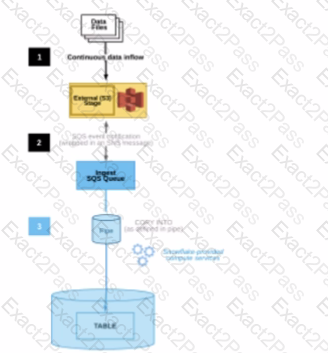
The diagram shows the process flow for Snowpipe auto-ingest with Amazon Simple Notification Service (SNS) with the following steps:

Step 1: Data files are loaded in a stage.

Step 2: An Amazon S3 event notification, published by SNS, informs Snowpipe — by way of Amazon Simple Queue Service (SQS) - that files are ready to load. Snowpipe copies the files into a queue.

Step 3: A Snowflake-provided virtual warehouse loads data from the queued files into the target table based on parameters defined in the specified pipe.
If an AWS Administrator accidentally deletes the SQS subscription to the SNS topic in Step 2, what will happen to the pipe that references the topic to receive event messages from Amazon S3?

A.

The pipe will continue to receive the messages as Snowflake will automatically restore the subscription to the same SNS topic and will recreate the pipe by specifying the same SNS topic name in the pipe definition.

B.

The pipe will no longer be able to receive the messages and the user must wait for 24 hours from the time when the SNS topic subscription was deleted. Pipe recreation is not required as the pipe will reuse the same subscription to the existing SNS topic after 24 hours.

C.

The pipe will continue to receive the messages as Snowflake will automatically restore the subscription by creating a new SNS topic. Snowflake will then recreate the pipe by specifying the new SNS topic name in the pipe definition.

D.

The pipe will no longer be able to receive the messages. To restore the system immediately, the user needs to manually create a new SNS topic with a different name and then recreate the pipe by specifying the new SNS topic name in the pipe definition.

Question # 28

A company has an external vendor who puts data into Google Cloud Storage. The company ' s Snowflake account is set up in Azure.

What would be the MOST efficient way to load data from the vendor into Snowflake?

A.

Ask the vendor to create a Snowflake account, load the data into Snowflake and create a data share.

B.

Create an external stage on Google Cloud Storage and use the external table to load the data into Snowflake.

C.

Copy the data from Google Cloud Storage to Azure Blob storage using external tools and load data from Blob storage to Snowflake.

D.

Create a Snowflake Account in the Google Cloud Platform (GCP), ingest data into this account and use data replication to move the data from GCP to Azure.

Question # 29

Database DB1 has schema S1 which has one table, T1.

DB1 -- > S1 -- > T1

The retention period of EG1 is set to 10 days.

The retention period of s: is set to 20 days.

The retention period of t: Is set to 30 days.

The user runs the following command:

Drop Database DB1;

What will the Time Travel retention period be for T1?

A.

10 days

B.

20 days

C.

30 days

D.

37 days

Question # 30

A company is designing high availability and disaster recovery plans and needs to maximize redundancy and minimize recovery time objectives for their critical application processes. Cost is not a concern as long as the solution is the best available. The plan so far consists of the following steps:

1. Deployment of Snowflake accounts on two different cloud providers.

2. Selection of cloud provider regions that are geographically far apart.

3. The Snowflake deployment will replicate the databases and account data between both cloud provider accounts.

4. Implementation of Snowflake client redirect.

What is the MOST cost-effective way to provide the HIGHEST uptime and LEAST application disruption if there is a service event?


A.

Connect the applications using the < organization_name > - < connection_name > URL. Use the Business Critical Snowflake edition.

B.

Connect the applications using the < organization_name > - < connection_name > URL. Use the Virtual Private Snowflake (VPS) edition.

C.

Connect the applications using the < organization_name > - < accountLocator > URL. Use the Enterprise Snowflake edition.

D.

Connect the applications using the < organization_name > - < accountLocator > URL. Use the Business Critical Snowflake edition.

Go to page: