Summer Sale Special Limited Time 70% Discount Offer - Ends in 0d 00h 00m 00s - Coupon code: buysanta

Exact2Pass Menu

FCP - FortiAuthenticator 6.5 Administrator

Last Update 17 hours ago Total Questions : 30

The FCP - FortiAuthenticator 6.5 Administrator content is now fully updated, with all current exam questions added 17 hours ago. Deciding to include FCP_FAC_AD-6.5 practice exam questions in your study plan goes far beyond basic test preparation.

You'll find that our FCP_FAC_AD-6.5 exam questions frequently feature detailed scenarios and practical problem-solving exercises that directly mirror industry challenges. Engaging with these FCP_FAC_AD-6.5 sample sets allows you to effectively manage your time and pace yourself, giving you the ability to finish any FCP - FortiAuthenticator 6.5 Administrator practice test comfortably within the allotted time.

Question # 1

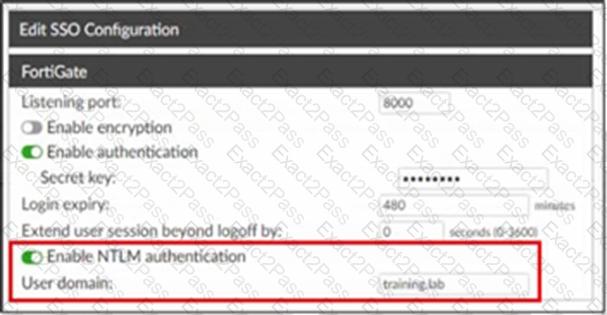
Refer to the exhibit.

Which functionality does the Enable NTLM option provide?

A.

It allows FortiAuthenticator to message end users using the FortiClient for SSO.

B.

It forces FortiClient users to use two-factor authentication when using FortiClient for SSO.

C.

It prevents users from authenticating to an unauthorized AD server.

D.

It enables tracking and recording all authentications performed through FortiClient.

Question # 2

Which two behaviors do certificate revocation lists (CRLs) on FortiAuthenticator exhibit? (Choose two.)

A.

CRLs can be distributed only through the SCEP server

B.

Revoked certificates are automatically placed on the CRL

C.

All local CAs share the same CRLs

D.

CRLs contain the serial number of the certificate that has been revoked

Question # 3

Refer to the exhibits.

Event Log

Event Detail
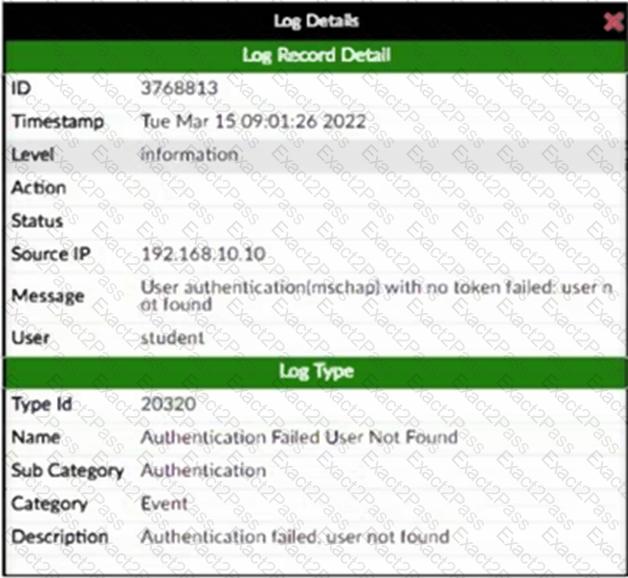
An administrator has configured several wireless APs to use FortiAuthenticator as their RADIUS server. One user is unable to successfully authenticate. The user record exists in the system, but the FortiAuthenticator log shows Authentication failed, user not found.

What is the most likely cause of the problem?

A.

The RADIUS traffic is being sourced from an IP address not listed as NAS.

B.

No client entry exists for the authenticating AP.

C.

The RADIUS secret is incorrect.

D.

RADIUS authentication is not enabled for the user.

Question # 4

Which FortiAuthenticator feature allows users to authenticate against different back-end databases when using a single RADIUS policy?

A.

RADIUS attributes

B.

LDAP services

C.

User Groups

D.

Realms

Question # 5

You are the administrator of a large network that includes a large local user database on the current FortiAuthenticator. You want to import all the local users into a new FortiAuthenticator device.

Which method should you use to migrate the local users?

A.

Import users using RADIUS accounting updates

B.

Import the current directory structure.

C.

Import users from RADIUS

D.

Import users using a CSV file.

Question # 6

You have implemented two-factor authentication to enhance security to sensitive enterprise systems.

How could you bypass the need for two-factor authentication for users accessing form specific secured networks?

A.

Enable Adaptive Authentication in the portal policy.

B.

Specify the appropriate RADIUS clients in the authentication policy.

C.

Create an admin realm in the authentication policy.

D.

Enable the Resolve user geolocation from their IP address option in the authentication policy

Question # 7

What are three key features of FortiAuthenticator? (Choose three.)

A.

Identity management device

B.

Portal services

C.

Certificate authority

D.

Log server

E.

RSSO server

Question # 8

Which option correctly describes an SP-initiated SSO SAML packet flow for a host without a SAML assertion?

A.

Principal contacts identity provider and authenticates, identity provider relays principal to service provider after valid authentication

B.

Service provider contacts identity provider, identity provider validates principal for service provider, service provider establishes communication with principal

C.

Principal contacts identity provider and is redirected to service provider, principal establishes connection with service provider, service provider validates authentication with identity provider

D.

Principal contacts service provider, service provider redirects principal to identity provider, after successful authentication identity provider redirects principal to service provider

Question # 9

Which FSSO discovery method transparently detects logged off users without having to rely on external features such as WMI polling?


A.

RADIUS accounting

B.

FortiClient SSO mobility agent

C.

DC polling

D.

Windows AD polling