Summer Sale Special Limited Time 70% Discount Offer - Ends in 0d 00h 00m 00s - Coupon code: buysanta

Exact2Pass Menu

Fortinet NSE 7 - Secure Networking 7.6 Architect

Last Update 21 hours ago Total Questions : 146

The Fortinet NSE 7 - Secure Networking 7.6 Architect content is now fully updated, with all current exam questions added 21 hours ago. Deciding to include NSE7_FSN_AR-7.6 practice exam questions in your study plan goes far beyond basic test preparation.

You'll find that our NSE7_FSN_AR-7.6 exam questions frequently feature detailed scenarios and practical problem-solving exercises that directly mirror industry challenges. Engaging with these NSE7_FSN_AR-7.6 sample sets allows you to effectively manage your time and pace yourself, giving you the ability to finish any Fortinet NSE 7 - Secure Networking 7.6 Architect practice test comfortably within the allotted time.

Question # 1

Refer to the exhibit, which shows a truncated output of a real-time LDAP debug.

What two conclusions can you draw from the output? (Choose two.)

A.

The name of the configured LDAP server is Lab.

B.

The user is authenticating using CN=John Smith.

C.

FortiOS is able to locate the user in step 3 (Bind Request) of the LDAP authentication process.

D.

FortiOS is performing the second step (Search Request) in the LDAP authentication process.

Question # 2

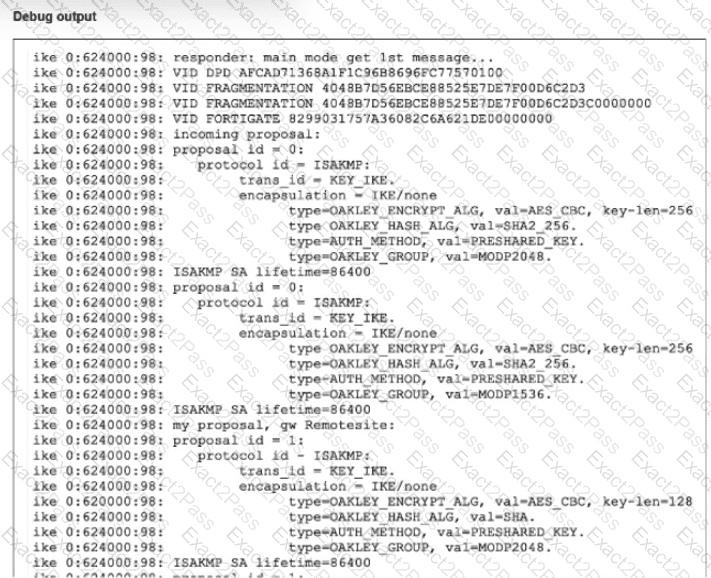
Refer to the exhibit.

A partial output from an IKE real-time debug is shown

The administrator does not have access to (he remote gateway

Based on the debug output, which two conclusions can you draw? (Choose two.)

A.

The remote peer is the initiating peer.

B.

This is a phase1 negotiation.

C.

There is a Diffie-Hellman group mismatch.

D.

This is a phase2 negotiation

Question # 3

Which two statements about an auxiliary session ate true? (Choose two.)

A.

With the auxiliary session selling disabled, only auxiliary sessions are offloaded.

B.

With the auxiliary session setting enabled. ECMP traffic is accelerated to the NP6 processor.

C.

With the auxiliary session setting enabled. Iwo sessions are created in case of routing change.

D.

With the auxiliary session setting disabled, for each traffic path. FortiGate uses the same auxiliary session.

Question # 4

Refer to the exhibit, which shows the output of the command get router info bgp neighbors 100.64.2.254 advertised-routes.
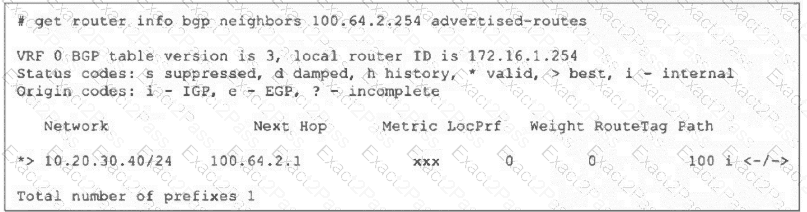
What can you conclude from the output?

A.

The BGP state of the two BGP participants is OpenConfirm.

B.

The router ID of the neighbor is 100.64.2.254.

C.

The BGP neighbor is advertising the 10.20.30.40/24 network to the local router.

D.

The local router is advertising the 10.20.30.40/24 network to its BGP neighbor.

Question # 5

What is an accurate description of LDAP authentication using the regular bind type?

A.

The regular bind requires the client to send the full distinguished name (ON).

B.

The regular bind type is the easiest bind type to configure on ForbOS.

C.

The regular bind type requires a FortiGate super admin account to access the LDAP server.

D.

It is not often used as a bind type

Question # 6

Which three common FortiGate-to-collector-agent connectivity issues can you identify using the FSSO real-time debug? (Choose three.)

A.

Log is full on the collector agent.

B.

Inability to reach IP address of the collector agent.

C.

Refused connection. Potential mismatch of TCP port.

D.

Mismatched pre-shared password.

E.

Incompatible collector agent software version.

Question # 7

What can cause an IKEv2 tunnel to go down after it was initially brought up successfully?

A.

A mismatched proposal was detected during the IKE_AUTH exchange.

B.

A mismatched Diffie-Hellman group was detected during the IKE_SA_INIT exchange.

C.

A mismatched pre-shared key was detected during the IKE_AUTH exchange.

D.

Mismatched quick-mode selectors were detected during the CREATE_CHILD_SA exchange.

Question # 8

Which statement about protocol options is true?

A.

Protocol options allow administrators to configure a maximum number of sessions for each configured protocol.

B.

Protocol options give administrators a streamlined method to instruct FortiGate to block all sessions corresponding to disabled protocols.

C.

Protocol options allow administrators to configure the Any setting for all enabled protocols, which provides the most efficient use of system resources.

D.

Protocol options allow administrators to configure which Layer 4 port numbers map to upper-layer protocols, such as HTTP, SMTP, FTP, and so on.

Question # 9

Refer to the exhibit, which shows the output of diagnose sys session list.
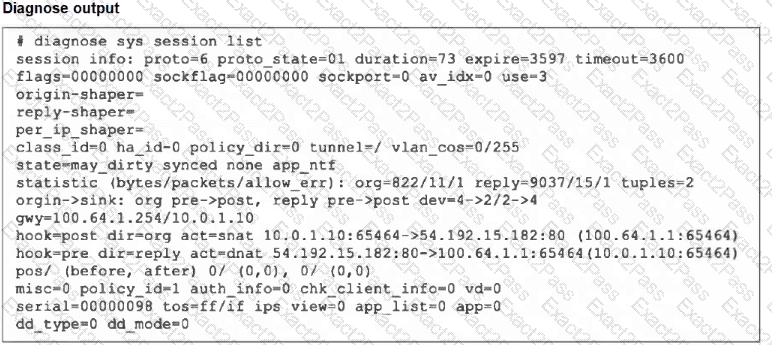
If the HA ID for the primary device is 0, what happens if the primary fails and the secondary becomes the primary?

A.

The secondary device has this session synchronized; however, because application control is applied, the session is marked dirty and has to be re-evaluated after failover.

B.

Traffic for this session continues to be permitted on the new primary device after failover, without requiring the client to restart the session with the server.

C.

The session will be removed from the session table of the secondary device because of the presence of allowed error packets, which will force the client to restart the session with the server.

D.

The session state is preserved but the kernel will need to re-evaluate the session because NAT was applied.

Question # 10

In a Security Fabric environment which three actions must you take to ensure successful communication among the nodes? (Choose three.)


A.

You must ensure that TCP port 8013 is not blocked along the way.

B.

You must ensure that the port for Neighbor Discovery has been changed.

C.

You must configure FortiGate in transparent mode.

D.

You must authorize the downstream FortiGate on the root FortiGate.

E.

You must enable FortiTelemetry on the receiving interlace of the upstream FortiGate.

Go to page: