Exact2Pass

Last Update 16 hours ago Total Questions : 103
The HCIA-Datacom V2.0 content is now fully updated, with all current exam questions added 16 hours ago. Deciding to include H12-811_V2.0 practice exam questions in your study plan goes far beyond basic test preparation.
You'll find that our H12-811_V2.0 exam questions frequently feature detailed scenarios and practical problem-solving exercises that directly mirror industry challenges. Engaging with these H12-811_V2.0 sample sets allows you to effectively manage your time and pace yourself, giving you the ability to finish any HCIA-Datacom V2.0 practice test comfortably within the allotted time.
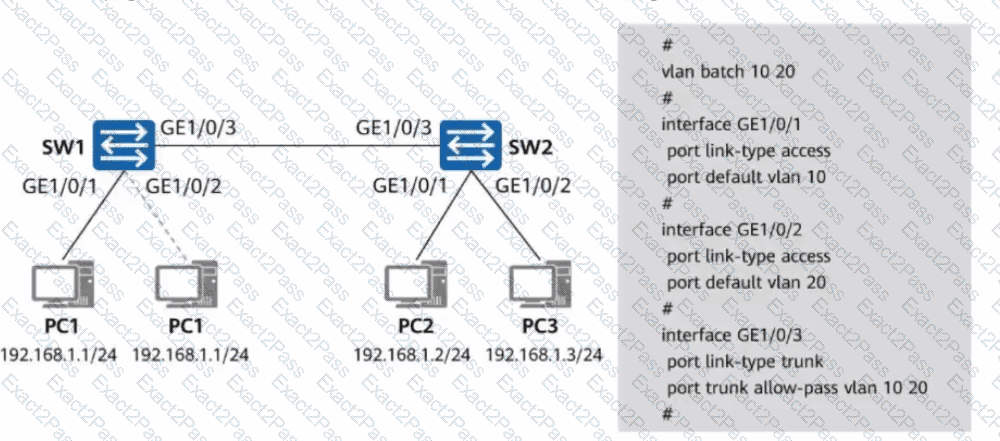
The administrator performs the configuration shown in the figure on SW1 and SW2. Initially, PC1 is connected to GE1/0/1 of SW1. After the network is stable, the administrator pings the IP addresses of PC2 and PC3 from PC1. Later, the administrator connects PC1 to GE1/0/2 of SW1. After the network is stable, the administrator pings the IP addresses of PC2 and PC3 from PC1. Which of the following statements is false about this scenario?
Which of the following IPv6 addresses is a link-local address ?
Enterprise data center (DC) services are no longer carried by physical machines or provided only for internal users. Instead, cloud platforms integrate resources in a unified manner and provide services for external users. Continuous service innovation requires the DC construction mode to evolve from single-DC to multi-site multi-DC.
R1 has two equal-cost routes to 10.0.12.0/24 after the following commands are configured.
[R1] ip route-static 10.0.12.0 24 10.0.12.2 preference 60
[R1] ip route-static 10.0.12.0 24 10.0.21.2 preference 60

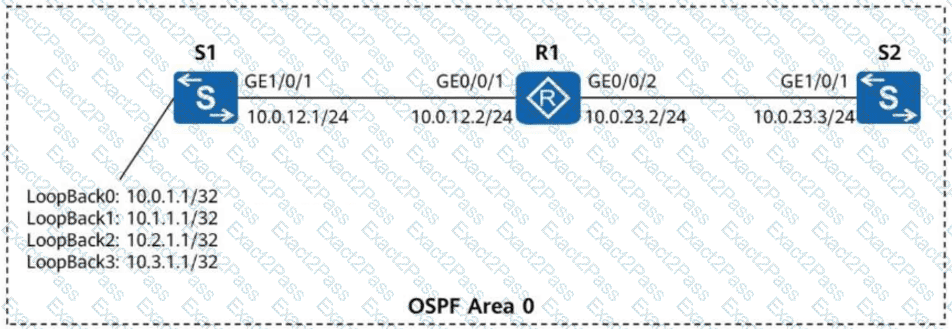
On the OSPF network shown in the figure, all IP addresses can communicate with each other. Then the following configurations are added on R1:
Which IP address of S1 can successfully ping 10.2.23.3?
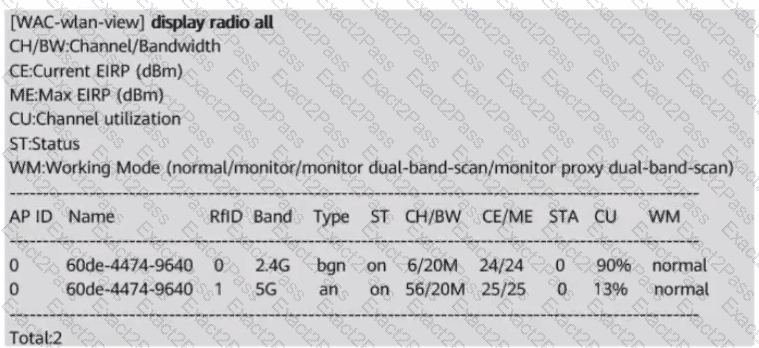
An enterprise has deployed a Huawei WLAN, but some STAs cannot associate with wireless signals. To troubleshoot this issue, you log in to the WAC and run related commands. The command output is as follows. According to the command output, which of the following is the possible cause of the STA association failure?
If a network device has both a static route and a direct route to network 10.1.1.0/24, it uses the direct route preferentially.
DAD enables a node to detect whether an IPv6 address is already in use by another node before assigning it to an interface. This ensures that duplicate unicast addresses do not exist on a network. Which of the following packets are used for DAD? (Select all that apply)
R1 has four static routes, each of which has a reachable next hop. Given this static route configuration, what is the next hop of the route to 20.0.0.0/30 in R1’s routing table?

Which of the following commands can be used to check OSPF routes in the global routing table?

