Summer Sale Special Limited Time 70% Discount Offer - Ends in 0d 00h 00m 00s - Coupon code: buysanta

Exact2Pass Menu

Aruba Certified Campus Access Associate Exam

Last Update 16 hours ago Total Questions : 103

The Aruba Certified Campus Access Associate Exam content is now fully updated, with all current exam questions added 16 hours ago. Deciding to include HPE6-A85 practice exam questions in your study plan goes far beyond basic test preparation.

You'll find that our HPE6-A85 exam questions frequently feature detailed scenarios and practical problem-solving exercises that directly mirror industry challenges. Engaging with these HPE6-A85 sample sets allows you to effectively manage your time and pace yourself, giving you the ability to finish any Aruba Certified Campus Access Associate Exam practice test comfortably within the allotted time.

Question # 1

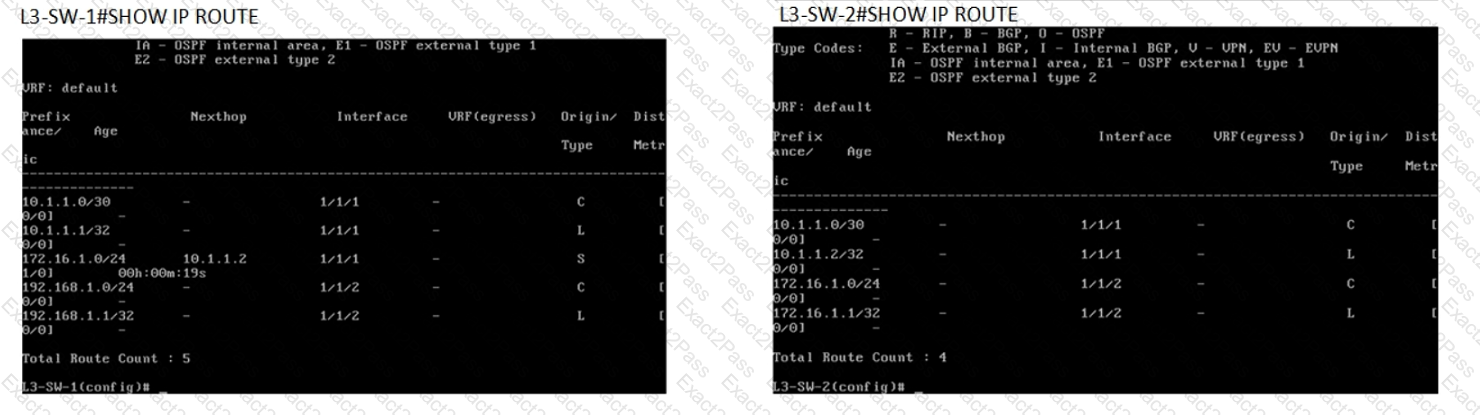
You have been asked to troubleshoot failed connectivity between a local subnet in the HQ Office and a remote subnet in the Branch Office. PC1 is unable to ping PC2.

Use the provided topology and show command output to identify the reason for the failure:
A.

On Branch Office - L3-SW-2- There is no Layer 3 SVI configured in the correct subnet.

B.

On HQ Office L3-SW-1 - There is no route to the Branch Office.

C.

On HQ Office L3-SW-1 - The switch does not have a static default route to the internet.

D.

On Branch Office L3-SW-2- The switch does not have a static route to the HQ Office Local Subnet.

Question # 2

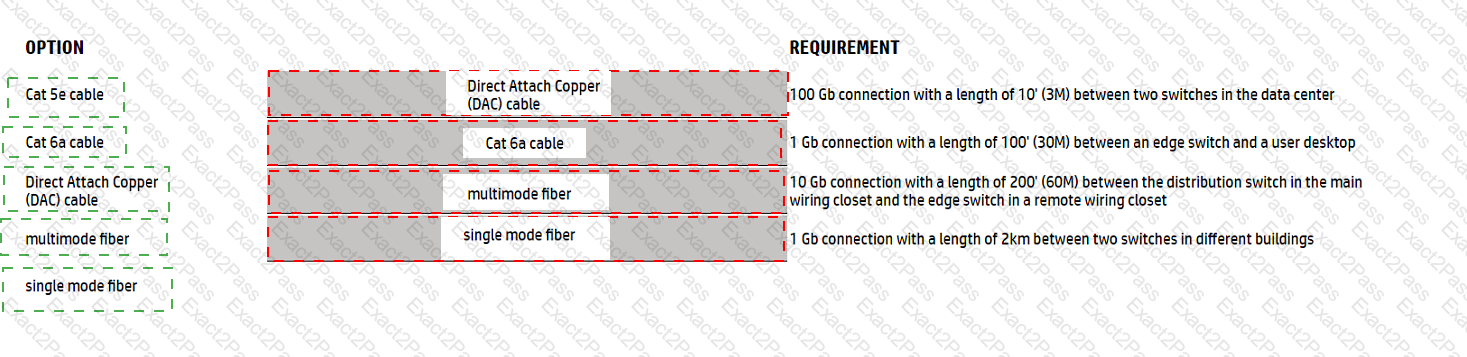
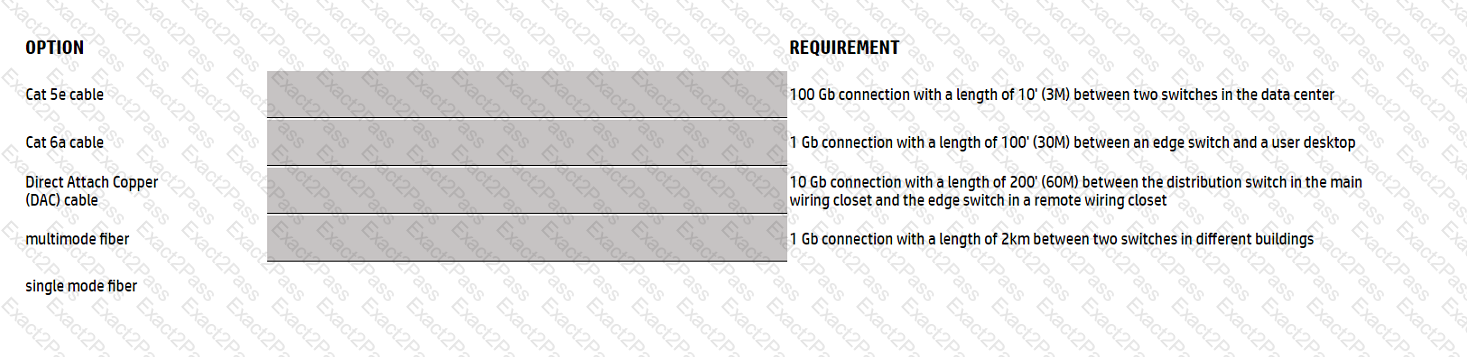
Match the most cost-effective option for cabling each requirement. (All lengths indicate total cable length including patch cable(s), service loops, etc. where used.)
Question # 3

What does the status of "ALFOE" mean when checking LACP with "show lacp interfaces'"?

A.

The interface on the local switch is configured as static-LAG

B.

LACP is not configured on the peer side

C.

LACP is in a synchronizing process

D.

LACP is working fine with no problems

Question # 4

What does a wireless client do first when its countdown timer reaches zero and it receives a Transmit Opportunity (TXOP)?

A.

It immediately sends its Data Frames and receives an ACK from the AP.

B.

It sends a CTS-to-self announcement to the ESP gateway.

C.

It sends a CTS-to-self announcement to the AP and all other clients.

D.

It sends a reassociation request frame to the AP and sends its Data Frames.

Question # 5

Based on the "snow ip route" output on an AruDaCX 8400. what type of route is "10.1 20 0/24, vrf default via 10.1.12.2. [1/0]"?

A.

local

B.

static

C.

OSPF

D.

connected

Question # 6

What can be done to dynamically set the PoE Priority on a switch port when deploying IP cameras APs. and other PoE devices?

A.

Enable Quick PoE on the switch modules

B.

Enable profiling for device provisioning

C.

Configure PoE power management to Class-based Mode

D.

Configure PoE power management to Dynamic Mode

Question # 7

After having configured the edge switch uplink as requested your colleague says that they have failed to ping the core You ask your colleague to verify the connection is plugged in and the switch is powered on They confirm that both are correct You attempt to ping the core switch and confirm that the ping is failing.

Knowing the nature of this deployment, what commands might you use to troubleshoot this issued

A.

Ping 10.11 1 - ping the core to attempt to verify connectivity Show trunk - to verify if the LAG interface was correctly added to the switch Show spanning tree - to check for spanning-tree blocked states Show port-access clients interface all - to view any port-access blocking states or failed authentication attempts on all interfaces Show run interface vlan20 - to double check the layer 3 svi configuration is correct for l_3 connectivity S

B.

diagnostic diag cable-diag 1/1/51 diag cable-diag 1/1/52 - to view diagnostic information for the physical link to get a status on any interruptions to Layer 1 connectivity, show ip route - to verify that the default gateway is present in the routing table show ip ospf - to check whether there is a layer 3 routing protocol enabled show ip dns - to view whether there is a valid dns source

C.

Ping 10.1.1.1 - ping the core to attempt to verify connectivity show lacp agg - to verify which link aggregations are currently configured using which physical ports show lacp int - to verify the LACP status and whether any links are blocking in your topology show lldp neighors - to verify whether you are able to see the Core as an L2 neighbor to verify if the correct links are plugged in to the correct ports show run interface 1/1/51.1/1/5

D.

Show run - to view the running configuration of the switch Show run | begin 20 "vlan 20" - to ensure VLAN 20 was correctly added to the database show run | begin 20 'interface vlan 20' - to view the L3 SVI configuration Show run interface 1/1/51.1/1/52 - to ensure the physical interfaces are no shut and were added as members of LAG 1 Show run int lag 1 - to verify LACP mode active was configured to eliminate LACP blocking states

Question # 8

What is an advantage of using Layer 2 MAC authentication?

A.

MAC allow lists are easily maintained over time.

B.

No setup is required on the client.

C.

It matches user names to MAC address.

D.

MAC identifiers are hard to spoof.

Question # 9

A network technician is using Aruba Central to troubleshoot network issues Which dashboard can be used to view and acknowledge issues when beginning the troubleshooting process?

A.

the Alerts and Events dashboard

B.

the Audit Trail dashboard

C.

the Reports dashboard

D.

the Tools dashboard

Question # 10

A customer has just implemented user and device certificates via a company-wide Group Based Policy (GPO) Which EAP method requires client certificates when authenticating to the network?


A.

EAP-TTLS

B.

EAP-TLS

C.

EAP-TEAP

D.

PEAP

Go to page: