Exact2Pass

Last Update 1 hour ago Total Questions : 75
The HPE Network Security Expert Written Exam content is now fully updated, with all current exam questions added 1 hour ago. Deciding to include HPE7-A10 practice exam questions in your study plan goes far beyond basic test preparation.
You'll find that our HPE7-A10 exam questions frequently feature detailed scenarios and practical problem-solving exercises that directly mirror industry challenges. Engaging with these HPE7-A10 sample sets allows you to effectively manage your time and pace yourself, giving you the ability to finish any HPE Network Security Expert Written Exam practice test comfortably within the allotted time.
A financial institution must authenticate managers of HPE Aruba Networking Mobility Controllers (MCs) and HPE Aruba Networking Mobility Conductors through ClearPass Policy Manager (CPPM). The institution’s security policies require strong encryption for manager-authentication communications between the HPE Aruba Networking devices and CPPM.
What is a valid solution?
Refer to the exhibit.
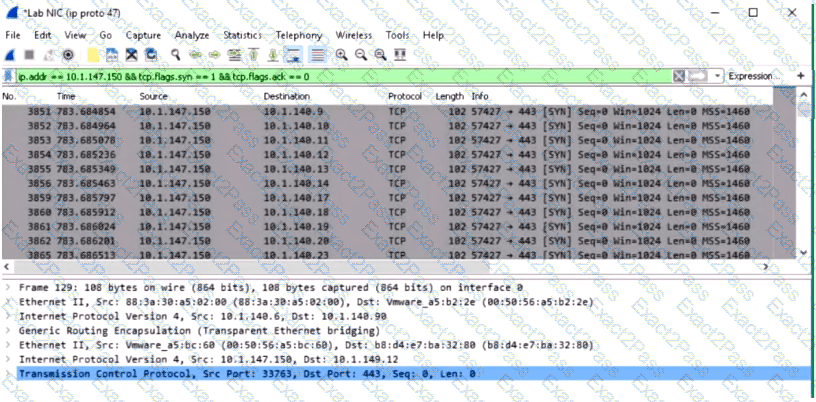
An administrator has configured a remote mirror between an AOS-CX switch and a station running a protocol analyzer. The exhibit displays a sample of the packet capture.
Packet trace details:
Source: 10.1.147.150 - > Destination: 10.1.140.9 TCP 57427 - > 443 [SYN] Seq=0 Len=0
Source: 10.1.147.150 - > Destination: 10.1.140.10 TCP 57427 - > 443 [SYN] Seq=0 Len=0
Source: 10.1.147.150 - > Destination: 10.1.140.11 TCP 57427 - > 443 [SYN] Seq=0 Len=0
Source: 10.1.147.150 - > Destination: 10.1.140.12 TCP 57427 - > 443 [SYN] Seq=0 Len=0
Source: 10.1.147.150 - > Destination: 10.1.140.13 TCP 57427 - > 443 [SYN] Seq=0 Len=0
Packet encapsulation tree shows Generic Routing Encapsulation (Transparent Ethernet bridging).
Which characteristic is suspicious?
When should BPDU protection be implemented on an AOS-CX switch port rather than BPDU filtering?
You are configuring gateway IDS/IPS settings in HPE Aruba Networking Central.
Why would you set the Fail Strategy to Bypass?
A customer has an HPE Aruba Networking ClearPass cluster that uses the Intune extension. ClearPass Policy Manager (CPPM) has a service called myservice; as part of authorization, this service queries the ClearPass Intune extension.
What is recommended for high availability?
Refer to the exhibit.
Field: Subject
Value: .acnsxtest.com, ACNSX Test...
Field: Subject Alternative Name
Value: DNS Name=.acnsxtest.com
Field: Enhanced Key Usage
Value: Server Authentication (1.3.6.1.5.5.7.3.1)
You have received this certificate to install on an HPE Aruba Networking ClearPass server for RADIUS/EAP and RadSec use. What is one issue?

A customer requires you to configure Aruba ClearPass Policy Manager (CPPM) to authenticate domain users on domain computers. Domain users, domain computers, and domain controllers obtain certificates from a Windows CA. CPPM must validate these certificates and confirm that the users and computers have accounts in Windows AD. The customer requires encrypted communication for all traffic between CPPM and the domain controllers.
You have imported the Windows CA root certificate into the ClearPass CA Trust list.
Based on these requirements, which usages should be added to it?
This customer enforces 802.1X on AOS-CX switches using HPE Aruba Networking ClearPass Policy Manager (CPPM). The customer wants the switches to download role settings from CPPM. The reception-domain role must have these settings:
* Assign clients to VLAN 14 on switch 1, VLAN 24 on switch 2, and so on.
* Filter client traffic as follows:
* Clients are allowed full access to 10.1.5.0/24 and the Internet.
* Clients are denied access to 10.1.0.0/16.
Refer to the scenario.
Where should you configure rules that allow clients to access the appropriate IP addresses?
A customer is migrating from on-premises AD to Microsoft Entra ID (Azure AD) as its only domain solution. The customer also manages wired and wireless devices with Microsoft Endpoint Manager (Intune).
The customer wants to strengthen security at the network edge. You are assisting with the design of an HPE Aruba Networking ClearPass deployment for this purpose. HPE Aruba Networking devices will authenticate wired and wireless clients to a ClearPass Policy Manager (CPPM) cluster that uses version 6.10.
The customer has several authentication requirements. Clients must pass EAP-TLS authentication only when a Microsoft Entra ID (Azure AD) query confirms that they have Microsoft Entra ID (Azure AD) accounts. To further refine client privileges, ClearPass must also use information gathered by Intune to make access-control decisions.
Refer to the scenario.
Assume that the Microsoft Entra ID (Azure AD) deployment has the required prerequisites in place.
You are planning the CPPM authentication source that you will use as the authentication source in 802.1X services. How should you configure this authentication source?
Refer to the scenario.

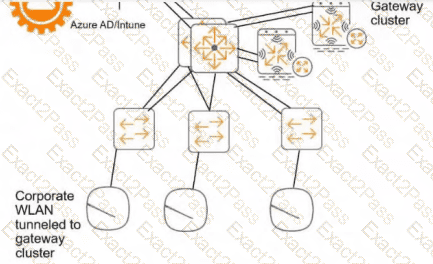
You must configure HPE Aruba Networking ClearPass Onboard to issue client certificates for Azure AD-joined devices. Which step is required to accomplish this objective?