Exact2Pass

Last Update 20 hours ago Total Questions : 249
The Certified Function Point Specialist content is now fully updated, with all current exam questions added 20 hours ago. Deciding to include I40-420 practice exam questions in your study plan goes far beyond basic test preparation.
You'll find that our I40-420 exam questions frequently feature detailed scenarios and practical problem-solving exercises that directly mirror industry challenges. Engaging with these I40-420 sample sets allows you to effectively manage your time and pace yourself, giving you the ability to finish any Certified Function Point Specialist practice test comfortably within the allotted time.
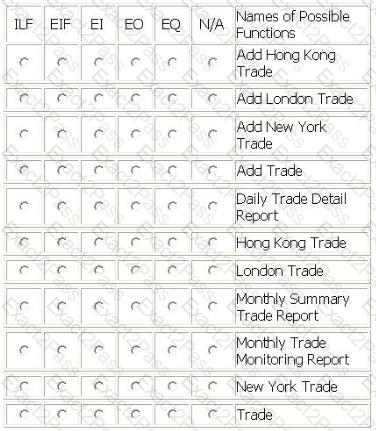
The Foreign Exchange System (FXS) allows banking operations to monitor trades processed from different foreign exchange trading systems which are located in London, New York and Hong Kong.
The Trade logical file is maintained using a series of batch jobs which copy each of the three foreign exchange data sets into FXS usable format. Once processed, the Add Trade batch function loads the data Into the Trade logical file and adds a date/time stamp.
A Daily Trade Detail report is produced listing all trades monitored. This report is sorted by trading location.
Two monthly reports are produced. A Monthly Summary Trade report is produced that contains summary trade numbers by trading location. A Monthly Trade Monitoring report is produced that lists all trades monitored, is sorted by trade date and contains a consolidated trade value.
From the Names of Possible Functions listed identify the base functional components for the FXS application. Select N/A if a Name of Possible Function Type does not apply.
Identify the functions used:
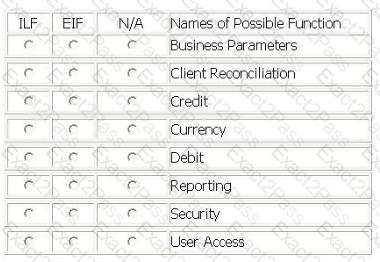
The Account Reconciliation Application (ARA) is used by banking operations to match credit (in) and debit (out) transactions within client accounts. Both credit and debit transactions are received from several other applications and stored as the Client Reconciliation logical file. ARA is capable of automatically matching transactions based on the Business Parameters logical file which is maintained by users in the ARA.
Access permissions in the User Access logical file are maintained by users in the ARA, and contain online user account permissions and approval levels.
The users can maintain their own report forms in the Reporting logical file. All reports use the Currency logical file, which is maintained by an external application, to convert the local payment currency to Euros.
From the Names of Possible Functions listed identify the data functions for the ARA. Select N/A if a Name of Possible Function does not apply.
Identify the functions used:
TAX APPLICATION
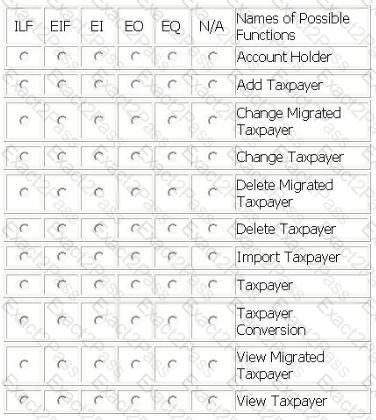
For the TAX application the user required the migration of existing taxpayer information (name, tax identification number, location name) to the TAX application. A conversion file with taxpayer data was created and imported into the Taxpayer logical file in the TAX application. The source of the data was the Account Holder logical file.
The user required the ability to Add, Change and Delete the taxpayer information in the Taxpayer logical file.
The user required the ability to View the taxpayer information prior to changing or deleting information.
From the Names of Possible Functions listed identify the base functional components for the TAX application baseline. Select N/A if a Name of Possible Functions does not apply.
Identify the functions used:
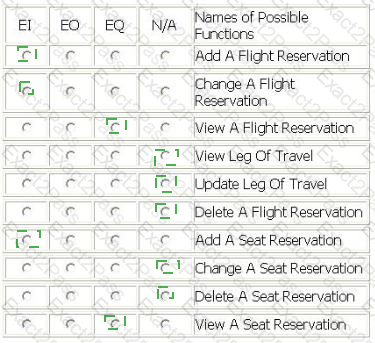
A Flight Reservation application has the ability to make a reservation and reserve a seat.
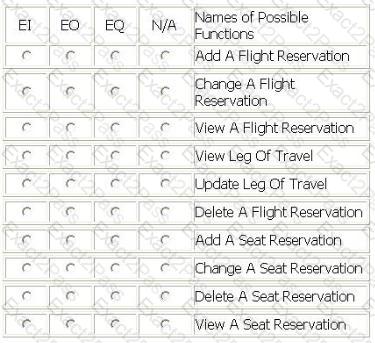
A passenger calls to make a reservation. The booking agent adds the information into the Flight Reservation logical file.
At a later time the passenger can make a change to the reservation through the booking agent.
The booking agent views the flight reservation record before changing it.
The booking agent can also reserve a seat for the passenger for each leg of his travel, but cannot change or delete the seat reservation once made. Seat reservations are stored in the Seat Reservation logical file.
The booking agent can view the seat reservation record.
From the Names of Possible Functions listed identify the transactional functions for the Flight Reservation application. Select N/A if a Name of Possible Functions does not apply.
Identify the functions used:
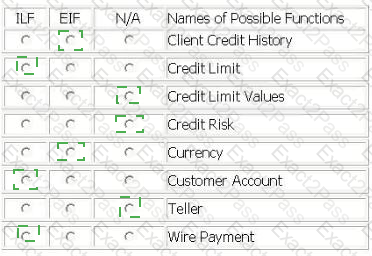
A baseline count is to be conducted for the Payment Information Application (PIA).
Client Credit History logical file is made available to the teller while processing a customer ' s wire payment. The Client Credit History logical file is retrieved from the Credit Master Application (CMA).
PIA also receives an end-of-day import file of wire payments from the Foreign Banking (FB) application. PIA maintains all customer wire payments in the Wire Payment logical file. During the processing of the wire payments, the currency is converted from the customer ' s local currency to PIA ' s currency using the FB application Currency logical file.
The teller must review the client credit history, and then update the Credit Limit logical file in the PIA before processing the wire payment.
Tellers maintain the Customer Account logical file using the maintain customer account function within PIA.
From the Names of Possible Functions listed identify the data functions for the PIA. Select N/A if a Name of Possible Function does not apply.
Identify the data functions used:

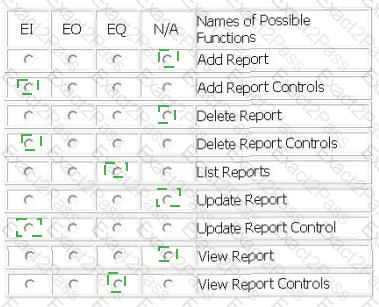
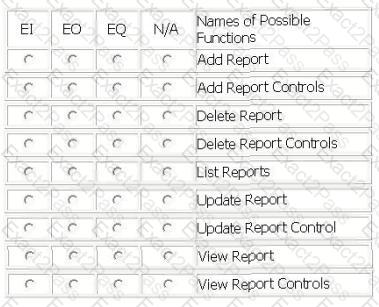
The Procurement application user requires the ability to control how and when reports are printed. The following list shows the specific user requirements for generating reports:
Display a list of reports that are available to be printed.
The user selects a report to be printed. If report control information exists for the r e quested report, the report control is displayed from the Report Control logical file.
If report control information has not been specified for the requested report, the user may add the following report controls:
report id
sort sequence
printer port
whether or not to generate a microfiche copy
whether or not to generate a paper copy
If report control information exists for the requested report, the user may update or delete the report controls.
From the Names of Possible Functions listed identify the transactional functions for the Procurement application. Select N/A if a Name of Possible Function does not apply.
Identify the functions used:
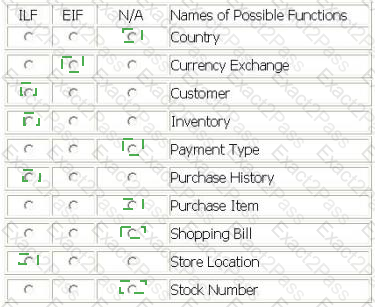
Several data functions are described in the scenario for the Internet Application (IA):
The user may query store locations where an order can be picked up. The Store Location logical file is updated in the IA as new locations open
The user may pay their internet shopping bill using the purchase item option. This option updates the Customer logical file with the date of purchase, the Inventory logical file with stock number and quantity, and Purchase History logical file with date, stock number, price and discounts applied.
Prior to the completion of the purchase item option the purchase amount is converted from US dollars into the user ' s local currency. The currency conversion requires reference data from the Currency Exchange logical file, which Is maintained through the Financial application. The Currency Exchange file is updated daily. The payment code is used to determine how the payment will be made.
If this is the user ' s first purchase, customer Information is added to the Customer logical file. As part of adding customer information the Country file is referenced in order to store country code in the Customer logical file rather than country name.
From the Names of Possible Functions listed identify the data functions for the IA. Select N/A if a Name of Possible Function does not apply.
Identify the data functions used:

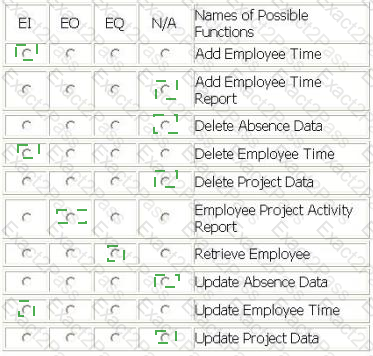
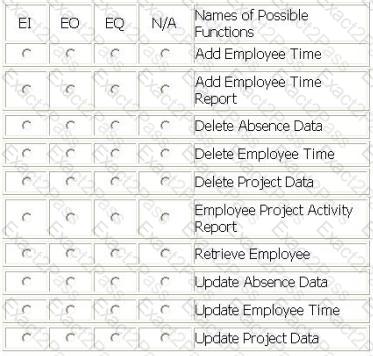
PAYROLL APPLICATION - MAINTAIN EMPLOYEE TIME SCREEN
Employees can Add or Update their weekly hours information by entering the project and absence data on the Maintain Employee Time screen. Data is saved to the Employee Payroll ILF.
To begin the Add or Update from the Maintain Employee Time screen, the employee enters his/her employee badge number presses the Retrieve button. Retrieve will fill in the employee name and supervisor badge number from the Employee Master ILF, and will display the current pay period start date and end date from the Payroll Master ILF.
Employees can Delete existing weekly hours information by entering his/her employee badge number and pressing the delete button on the Maintain Employee Time screen. When the employee presses the delete button the current pay period hours will be removed from the Employee Payroll ILF.
PAYROLL APPLICATION - EMPLOYEE PROJECT ACTIVITY REPORT
The Employee Project Activity report is produced for each employee and routed electronically to that employee ' s email address. Each employee ' s project task hours for the current pay period are read from the Employee Payroll ILF. The report calculates and displays both daily and weekly total hours for the current pay period.
From the Names of Possible Functions listed identify the transactional functions for the Payroll application. Select N/A if a Name of Possible Functions does not apply.
Identify the functions used.
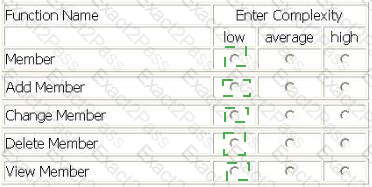
Determine the complexity of the data and/or transactions identified in the following scenario:
The Library Information System (LIS) user Adds new member information by entering the member code, the member name, the telephone number, the address and the starting membership date. Information is stored and maintained in the Member logical file.
The LIS user Changes some member information or Deletes it, by entering the member code. The LIS retrieves all the information related to the member code and displays it on the screen. Then, the LIS user Changes all the data displayed, with the exception of the member code, or completely Deletes the member information. If the member code is not found in the Member logical file, then an error message is displayed to the user.
The LIS user Views member information by entering the member code and/or the member name on the screen. All the member data is retrieved and displayed in the search results. If the member code and/or the member name is not found in the Member logical file, then an error message is displayed to the user.
All functions are activated by pressing the OK button.
Determine the complexity for the following functions:
Select the complexity for each function:

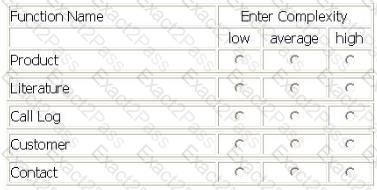
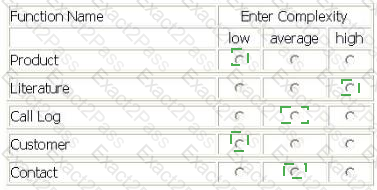
A Call Center (CC) application is being enhanced to track two new pieces of Information. The CC will reference the two new DETs in five modified data functions.
Productlogical file prior to the enhancement had 2 RETs and 25 DETs, the CC application had previously referenced 12 of those DETs.
Literaturelogical file previously referenced 5 RETs and 19 DETs. The two new DETs are being added to another RET NOT previously referenced.
Call Log logical file prior to the enhancement had 2 RETs and 19 DETs, the CC previously referenced all the DETs.
Customerlogical file prior to the enhancement had 1 RET and 36 DETs, the CC previously referenced only 25 of the DETs.
Contactlogical file prior to the enhancement had 1 RET and 68 DETs, the CC previously referenced all DETs.
Determine the complexity of the following functions:
Select the complexity for each function: