Exact2Pass

Last Update 19 hours ago Total Questions : 249
The Certified Function Point Specialist content is now fully updated, with all current exam questions added 19 hours ago. Deciding to include I40-420 practice exam questions in your study plan goes far beyond basic test preparation.
You'll find that our I40-420 exam questions frequently feature detailed scenarios and practical problem-solving exercises that directly mirror industry challenges. Engaging with these I40-420 sample sets allows you to effectively manage your time and pace yourself, giving you the ability to finish any Certified Function Point Specialist practice test comfortably within the allotted time.
The Robot Automation Program (RAP) is an application which allows factory technicians to create and edit the weld placement programs for various robots on the assembly line. Both transactions maintain the Weld Specification and Robot logical files.

The use may select and view reboot details:

The user may print individual welding program details:

From the Names of Possible Functions listed identify the transactional functions for the RAP application. Select N/A if a Name of Possible Functions does not apply.
Identify the functions used:

An enhancement project involves both the Human Resource (HR) application and the Mail Distribution (MD) application.
The HR application maintains all data elements in the Employee logical file. The users of the HR application require validations for employee pay grade and employee job title in the Employee logical file. The employee pay grade will be validated against the Pay Grade logical file which is maintained by the Finance application. The employee job title will be validated against the Job Title logical file which is maintained by the Compensation application.
The MD application maintains two data elements in the Employee logical file. The users of the MD application require additional validations for building and floor within the employee mailing address. The building and floor will be validated against the Building logical file which is a new file being developed by this project.
The users will use the MD application to maintain the Building logical file. The users of the MD application also maintain building and floor in the Employee logical file.
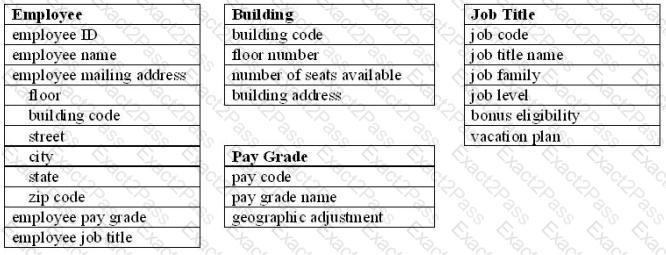
From the Names of Possible Functions listed identify the data functions for the HR application and the MD application. Select N/A if a Name of Possible Function does not apply.
Identify the data functions used:
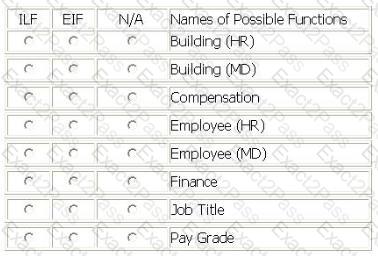
CORPORATE INFORMATION SYSTEM (CIS) - EMPLOYEE DATA TRANSFER
From the CIS main menu, the CIS user selects the Transfer Employee Data option.
The Transfer Employee Data option creates a transaction file of CIS Employee logical file records that have a status flag equal to Add or Change. Each record in the transaction file contains employee badge number, first name, last name, phone number, facility, s u pervisor badge number, organization, job code, and status flag.
The CIS transaction file is written to the Financial System (FS) server ' s temporary file work area. This data transfer is a user requirement for both applications.
From the FS main menu, the FS user selects the Load Employee Data option.
The Load Employee Data option accesses the CIS transaction file from the FS server ' s temporary file work area. The Load Employee Data option processes the input records according to the status flag, initiating different processing logic for Add and Change. The Load Employee Data option loads all attributes from each record to the FS, except the status flag.
As part of the same elementary process, when an employee is being Added or Changed to the FS Employee logical file it also saves the employee ' s pay grade code, retrieved from the Payroll System.
Both applications have a requirement to access a version of the Employee logical file.
Determine the complexity for the functions listed.
Select the complexity for each function:
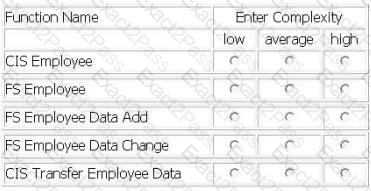
The Stock Purchasing (SP) and Point of Sale (POS) applications have the following requirements.
The POS application maintains details of customer purchases in the Item Purchases log i cal file.
The SP application is used to place orders with suppliers based on daily inventory levels.
The SP application is used to maintain supplier information. The Supplier Information logical file contains descriptions of items the supplier stocks and supplier contact info r mation.
The Inventory logical file is maintained by the SP application through a daily batch process which references the Item Purchases logical file.
When the batch process is complete, the SP application displays a list of items that are below 20% of normal inventory levels. The user selects items to be ordered and specifies the supplier. The SP application then generates a purchase order for each supplier. The purchase orders are sent electronically to each supplier and stored in the Order logical file.
From the Names of Possible Functions listed identify the data function both the SP and POS applications. Select N/A if a Name of Possible Function does not apply.
Identify the functions used:

LIBRARY INFORMATION SYSTEM (LIS) - REGISTER A TEXT
The LIS user Adds data related to a new text in the Library, by entering ISBN code, title, author, publisher, series, typology, publishing date and acquisition date on the screen and pressing the OK button. All data entered is maintained in the Text logical file. The ISBN code and the publisher are validated against the Publishers Guide logical file.
The LIS user Views data related to an existing text in the Library by entering the ISBN code, title, author or publisher on a selection screen.
If only one text matches the selection criteria, the View Text screen is displayed. ISBN code, title, author, publisher, series, typology, publishing date and acquisition date are displayed.
If a record in the Text logical file does not match the criteria entered, an error message is displayed to the user.
If more than one record matches the criteria, the Multiple Text List List is displayed. For each of the texts that matches the criteria the following attributes are shown: ISBN code, title, author, publishing date and the percentage match to the criteria. The LIS user can display the View Text screen by selecting a single text and pressing the OK button.
The LIS user Changes Text text data by changing any values on the View Text screen with the exception of the ISBN code and pressing the Change button. If the publisher is changed it is validated against the Publishers Guide logical file.
The user Deletes text data from the Text logical file by entering on the screen the ISBN code of the text and pressing the Delete button.
Determine the complexity of the following functions:
Select the complexity for each function:

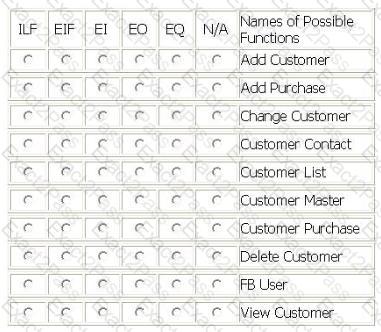
The High Point grocery store has implemented a frequent buyer program. Discounts on various products will be provided as an incentive for customers to register in the program. The Frequent Buyer (FB) application is being built to collect and store the customer information and to keep track of the purchasing patterns of the customers.
The customers will fill out a form providing their contact information and other demographic information
FB users will use the Customer screen to Add Customer information in the Customer Master logical file.
FB users also use the Customer screen to View Customer information and Change Customer Information.
The Customer List report lists all customers and is available for display by selecting the Customer List report option from the Main Menu.
From the Names of Possible Functions listed identify the base functional components for the FB application. Select N/A if a Name of Possible Function Type does not apply.
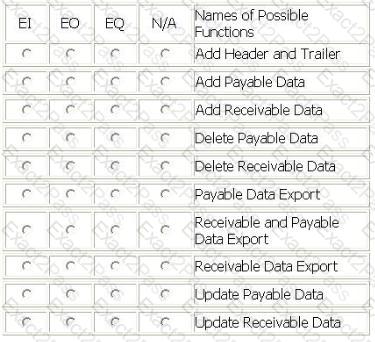
A Corporate Finance application is being developed.
The application adds or updates the Receivable logical file and the Payable logical file. The user requires that this information is sent to the Accounts application to keep accounting records consistent. The combined receivable and payable data is sent to the Accounts application daily at 8:00 PM.
When implementing a solution to send the receivable and payable information, it was decided to include a header and trailer record with the accounts information. These records are used by the Corporate Finance user to ensure that everything was technically correct when transmitting the file.
From the Names of Possible Functions listed identify the transactional functions for the Corporate Finance application. Select N/A if a Name of Possible Function does not apply.
Identify the functions used:
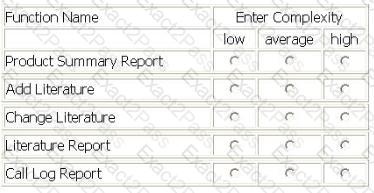
A Call Center (CC) application is being enhanced to maintain and display 2 new pieces of information. The CC will add the 2 new DETs to all 5 of the modified transactional functions.
The Product Summary Report had 2 FTRs and 12 DETs.
Add Literature and Change Literature had 4 FTRs and 19 DETs.
The Literature Report (no calculations or derived data) had 4 FTRs and 19 DETs.
The Call Log Report (no calculations or derived data) had 1 FTRs and 19 DETs.
What is the complexity of the transactional functions after the enhancement?
Select the complexity for each function:
LIBRARY INFORMATION SYSTEM (LIS) - REPORTS
LIS produces five reports:
• Text Out On Loan
References Customer logical file
References Text logical file
Displays 8 fields
• Text Overdue
References Customer logical file
References Text logical file
Displays 4 fields
• Text With Multiple Hold Requests
References Text logical file
References Publisher Guide logical file
References Customer logical file
Displays 25 fields
• Inventory List
References Inventory logical file
Displays 12 fields including 1 calculated field
• Text On Order
References Order logical file
References Publisher Guide logical file
References Text logical file
References Employee logical file
Displays 15 fields including 2 calculated fields
Determine the complexity of the following functions.
Select the complexity for each function:

Which of the following functions is (are) counted for a development project FP count?




