
Spring Sale Special Limited Time 70% Discount Offer - Ends in 0d 00h 00m 00s - Coupon code: buysanta

Exact2Pass Menu

Magento 2 Certified Associate Developer Exam

Last Update 3 hours ago Total Questions : 103

The Magento 2 Certified Associate Developer Exam content is now fully updated, with all current exam questions added 3 hours ago. Deciding to include Magento-2-Certified-Associate-Developer practice exam questions in your study plan goes far beyond basic test preparation.

You'll find that our Magento-2-Certified-Associate-Developer exam questions frequently feature detailed scenarios and practical problem-solving exercises that directly mirror industry challenges. Engaging with these Magento-2-Certified-Associate-Developer sample sets allows you to effectively manage your time and pace yourself, giving you the ability to finish any Magento 2 Certified Associate Developer Exam practice test comfortably within the allotted time.

Question # 21

In layout files you can change al element’s order on a page. This can be done using one of the following:

    < move > instruction

    before and after element attributes?

How are two methods different?

A.

They are the same, both provide access to the same functionality

B.

Elements are renamed by default when using the move instruction

C.

The move instruction allows altering an element’s parent node

D.

Before and after attributes can only be used with referenceContainer and referenceBlock

Question # 22

You want to remove a column introduced by a third-party extension via declarative schema.

How do you do that?

A.

Create the etc/db_schema.xml file and specify disable=”true” on the column

B.

Modify the original etc/db_schema.xml file and remove the column from there

C.

Create a SchemaPatch file and remove the column programmatically

D.

Copy the etc/db_schema.xml file into your module and remove the column from your copy

Question # 23

You are adding an entry to the backend menu. To do so you open a core etc/adminhtml/menu.xml file as a reference. In the file you see the node:
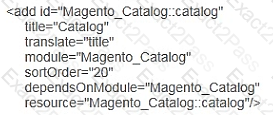
What is the result of specifying resource=”Magento_Catalog::catalog”?

A.

The menu item will only be visible to users who are assigned to a role with access to the matching ACL resource

B.

The menu item will only be visible if the class method specified by the resource returns a true value

C.

The last selected menu item for a user is stored in the DB so the previously visited page can be restored on the next login

D.

The resource is used to locate the correct translation for the attributes listed in title=”…”

Question # 24

The module MyCompany_MyModule will add a new page to the admin interface at the URL path admin/mycompany/entity_grid.

How do you name the file containing the action controller class so the admin router matches the path to the class?

A.

Controller/Adminhtml/Entity/Grid/Index.php

B.

Controller/Adminhtml/Mycompany/Entity/Grid.php

C.

Controller/Adminhtml/Entity/Grid.php

D.

Controller/Adminhtml/Mycompany/Entity_Grid.php

Question # 25

You need to add a new text attribute to all products in the Magento store. When this attribute is displayed on the product page, its values must be different depending on the selected language.

Keeping simplicity in mind, how do you add this attribute?

A.

Use the Magento CLI to create a new custom attribute, then generate dictionaries for all supported languages

B.

Use a Data Patch to create a new EAV attribute

C.

Add a new column to the catalog_product_entity table using declarative schema

D.

Use the admin panel to create a new extension attribute

Question # 26

A merchant tasks you to keep sales managers out of the system configuration backend pages.

How do you do that using the admin interface?

A.

You remove access to the restricted pages from each user’s ACL settings

B.

You create a role with limited permissions and assign all sales manager users to the new role

C.

This is not possible in a native Magento instance and requires customization

D.

You create a role with access to the system configuration pages and assign it to all users except the sales managers

Question # 27

In a custom module you are adding a new field to the store configuration. The field will set the value for the configuration path mycompany/mymodule/myoption.

How do you supply the default value for that configuration option?

A.

In the config/default/mycompany/mymodule/myoption node in the etc/config.xml file

B.

In the system/mycompany/group/mymodule/field/myoption node in the etc/system.xml file

C.

In the menu/default/section/group/field node in the file etc/adminhtml/menu.xml

D.

In the system/section/group/field/value node in the etc/adminhtml/system.xml file

Question # 28

You have to install a new module on the production environment. All the module is adding a new product attribute. You enabled maintenance mode, copied the module code, run bin/magento setup:upgrade and disabled maintenance mode.

What two risks does this process pose? (Choose two.)

A.

It will clean all caches which will cause a performance degradation

B.

The new attribute will be invisible on the storefront until the cache is cleaned manually

C.

It will void all active sessions

D.

It will clean static assets from the pub/static folder

Question # 29

How do you set the custom block MyCompany\MyModule\Block\A as a child for the block named product.info using layout XML?

A.

Option A

B.

Option B

C.

Option C

D.

Option D

Question # 30

You are developing a module and need to add another column to a table introduced by another module MyCompany_MyModule via db schema.

How do you do that?

A.

Create a etc/db_schema.xml file in your module, add the column and run bin/magento setup:upgrade

B.

Create a etc/db.xml file in your module, add the column and run bin/magento setup:db-schema:upgrade

C.

Run a command: bin/magento setup:db-schema:upgrade < table > < column definition >

D.

Create a etc/db_schema_whitelist.json file in your module, add the column and run bin/magento setup:upgrade

Go to page:
