Spring Sale Special Limited Time 70% Discount Offer - Ends in 0d 00h 00m 00s - Coupon code: buysanta

Exact2Pass Menu

MuleSoft Certified Developer - Level 2 (Mule 4)

Last Update 2 hours ago Total Questions : 60

The MuleSoft Certified Developer - Level 2 (Mule 4) content is now fully updated, with all current exam questions added 2 hours ago. Deciding to include MCD-Level-2 practice exam questions in your study plan goes far beyond basic test preparation.

You'll find that our MCD-Level-2 exam questions frequently feature detailed scenarios and practical problem-solving exercises that directly mirror industry challenges. Engaging with these MCD-Level-2 sample sets allows you to effectively manage your time and pace yourself, giving you the ability to finish any MuleSoft Certified Developer - Level 2 (Mule 4) practice test comfortably within the allotted time.

Question # 11

A new Mule project has been created in Anypoint Studio with the default settings.

Which file inside the Mule project must be modified before using Maven to successfully deploy the application?

A.

Settings.xml

B.

Config.yaml

C.

Pom.xml

D.

Mule.artificact.json

Question # 12

An API has been developed and deployed to CloudHub Among the policies applied to this API is an allowlist of IP addresses. A developer wants to run a test in Anypoint Studio and does not want any policies applied because their workstation is not included in the allowlist.

What must the developer do in order to run this test locally without the policies applied?

A.

Create a properties file specifically for local development and set the API instance ID to a value that is not used in API Manager

B.

Pass in the runtime parameter ‘’-Danpow.platform.gatekeeper=disabled’’

C.

Deactivate the API in API Manager so the Autodiscovery element will not find the application when it runs in Studio

D.

Run the test as-s, with no changes because the Studio runtime will not attempt to connect to API Manager

Question # 13

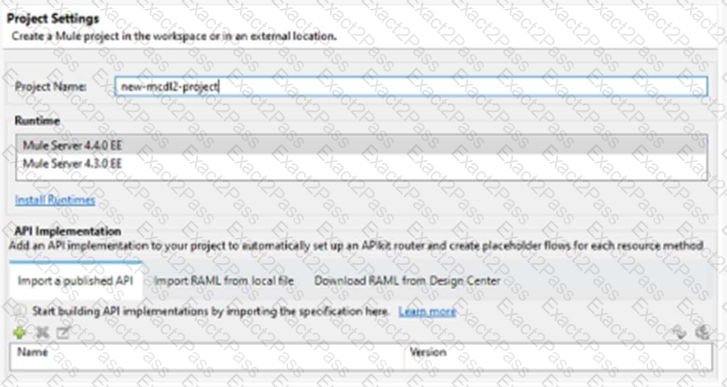
Refer to the exhibit.

When creating a new project, which API implementation allows for selecting the correct API version and scaffolding the flows from the API specification?

A.

Import a published API

B.

Generate a local RAML from anypoint Studio

C.

Download RAML from Design Center

D.

Import RAML from local file

Question # 14

Refer to the exhibits.

Bioinfo System API is implemented and published to Anypoint Exchange. A developer wants to invoke this API using its REST Connector.

What should be added to the POM?

A)

B)
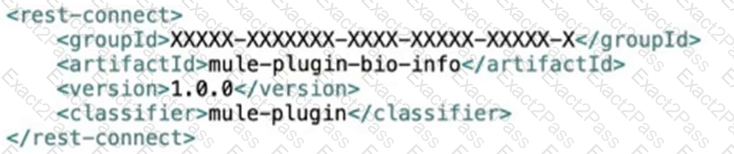
C)
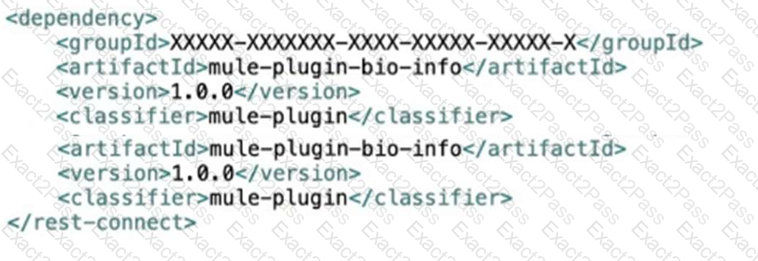
D)
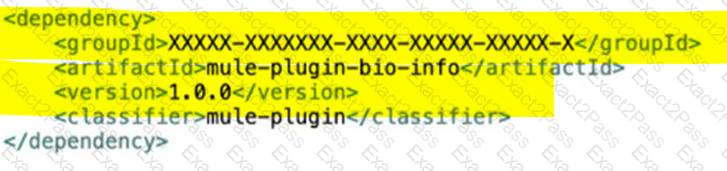
E)
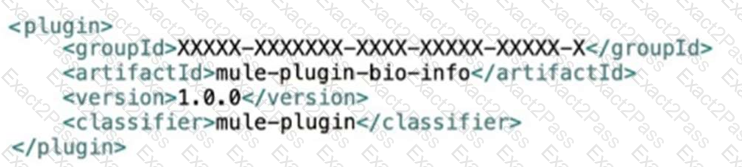
A.

Option A

B.

Option B

C.

Option C

D.

Option D

E.

Option E

Question # 15

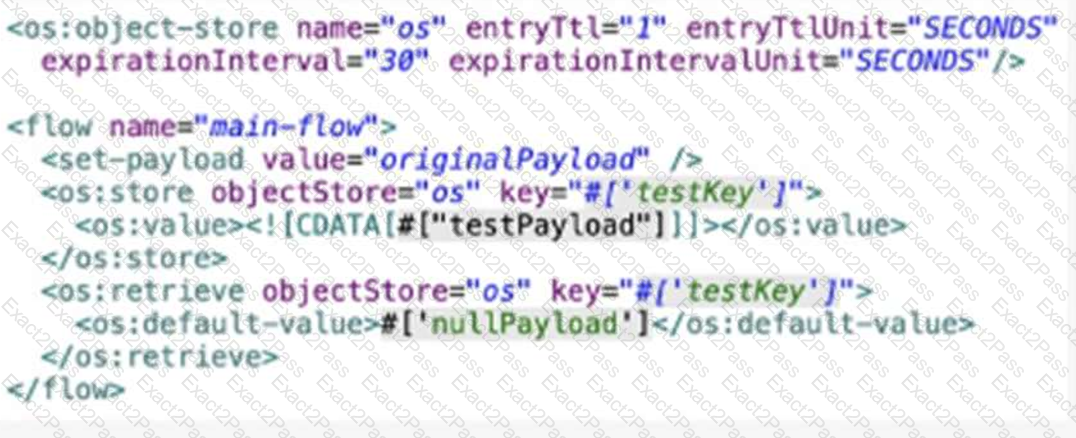
Refer to the exhibit.

A Mute Object Store is configured with an entry TTL of one second and an expiration interval of 30 seconds.

What is the result of the flow if processing between os’store and os:retrieve takes 10 seconds?
A.

nullPayload

B.

originalPayload

C.

OS:KEY_NOT_FOUND

D.

testPayload

Question # 16

A Mule implementation uses a HTTP Request within an Unit Successful scope to connect to an API.

How should a permanent error response like HTTP:UNAUTHORIZED be handle inside Until Successful to reduce latency?

A.

Configure retrying until a MULERETRY_EXHAUSTED error is raised or the API responds back with a successful response.

B.

In Until Successful configuration, set the retry count to 1 for error type HTTP: UNAUTHORIZED.

C.

Put the HTTP Request inside a try scope in Unit Successful.

In the error handler, use On Error Continue to catch permanent errors like HTTP UNAUTHORIZED.

D.

Put the HTTP Request inside a try scope in Unit Successful.

In the error handler, use On Error Propagate to catch permanent errors like HTTP UNAUTHORIZED.

Question # 17

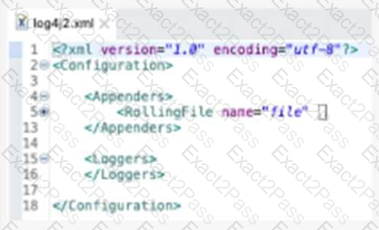
Refer to the exhibit.

What action must be performed to log all the errors raised by the VM Connector?
A.

Add < AsyncLOgger name=’orgroute.extensions vm’ level=ERROR’I > inside the Logger tag

B.

Add < AsyncLOgger name=’orgroute.extensions vm’ level=ERROR’/ > inside the Appenders tag

C.

Configure < Logger level-‘ERROR’/ > inside the VM Connector configuration

D.

Nothing, as error-level events are automatically logged

Question # 18

Which pattern should be used to invoke multiple HTTP APIs in parallel and roll back failed requests in sequence?


A.

A database as a transactional outbox and an Until Successful router to retry any requests

B.

A Parallel for Each scope with each HTTP request wrapped in a Try scope

C.

Scatter-Gather as central Saga orchestrator for all API request with compensating actions for failing routes

D.

VM queues as a reliability pattern with error handlers to roll back any requests

Go to page: