Exact2Pass

Last Update 10 hours ago Total Questions : 106
The Nutanix Certified Professional - Network and Security (NCP-NS) 7.5 content is now fully updated, with all current exam questions added 10 hours ago. Deciding to include NCP-NS-7.5 practice exam questions in your study plan goes far beyond basic test preparation.
You'll find that our NCP-NS-7.5 exam questions frequently feature detailed scenarios and practical problem-solving exercises that directly mirror industry challenges. Engaging with these NCP-NS-7.5 sample sets allows you to effectively manage your time and pace yourself, giving you the ability to finish any Nutanix Certified Professional - Network and Security (NCP-NS) 7.5 practice test comfortably within the allotted time.
An administrator uses Nutanix Flow to secure a three-tier application (Web, App, and Database tiers). After observing the traffic, they find that: The Web tier communicates with the App tier over HTTP (port 80) The App tier communicates with the Database tier over TCP port 1433 The Database tier does not initiate connections The Web tier receives inbound HTTP traffic from the corporate DMZ on port 8080 No other traffic should be allowed What should the administrator do to document and then securely apply these flows in Nutanix Flow?
What entity is automatically created on the cluster hosting Prism Central when Microsegmentation is enabled?
An administrator plans to upgrade the Network Controller in a Flow Virtual Networking deployment. The environment includes multiple AHV clusters managed by Prism Central. Which prerequisite must be verified before upgrading the Network Controller?
Refer to Exhibit:
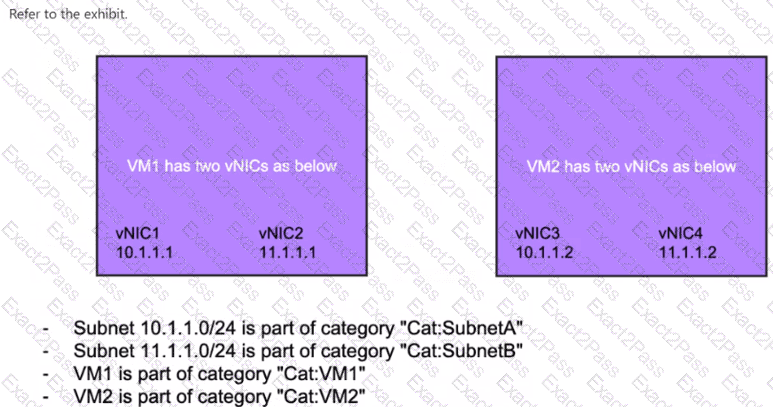
How should an Application Policy be created whose rules apply only to vNIC1 of VM1?
Refer to Exhibit:
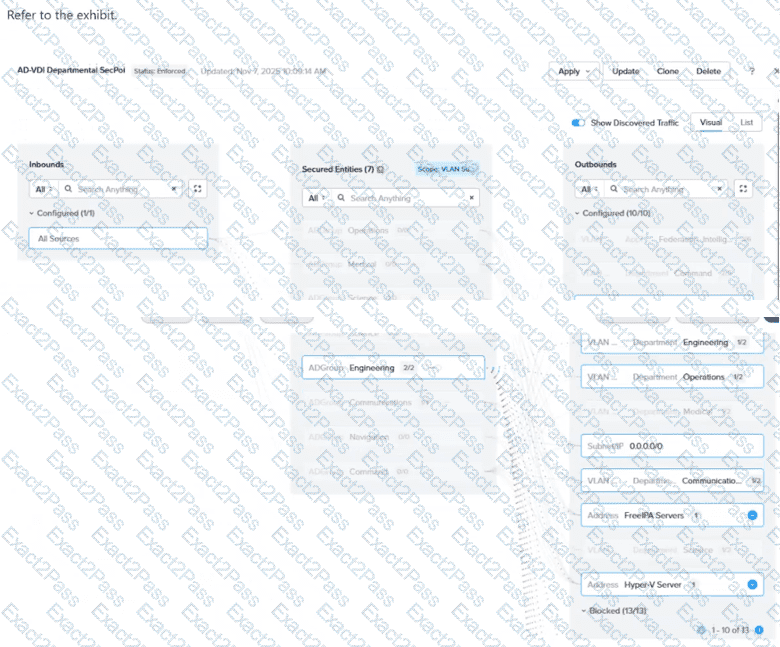
In the AD-VDI Departmental SecPol policy shown in the exhibit, ADGroup: Engineering is configured as a secured entity in a VDI Security Policy. Prism Central shows 2 / 2 active sessions under this group, but the administrator confirms that three Engineering users are currently logged in to persistent VDI desktops. The third user's VM shows no ADGroup assignment in its VM details in Prism Central, even after the user has successfully logged in. All three users are members of the same AD group, and the Domain Controller event logs confirm a successful interactive login for the third user. Which condition explains why the third user's VM is not being assigned the ADGroup: Engineering category?
An administrator plans to upgrade a Nutanix cluster running AHV and Prism Central. The current cluster is on AOS 6.10, and the administrator wants to move to AOS 7.3 while ensuring all components remain compatible. What is the correct upgrade order to minimize downtime and maintain cluster functionality?
While configuring third-party services (Service Insertion) in Flow Network Security Next-Gen, an administrator notices dropped packets when redirecting traffic through a network function. Which configuration change would address this issue?

