Exact2Pass

Last Update 10 hours ago Total Questions : 100
The Musculoskeletal Ultrasound Certification in Rheumatology content is now fully updated, with all current exam questions added 10 hours ago. Deciding to include RhMSUS practice exam questions in your study plan goes far beyond basic test preparation.
You'll find that our RhMSUS exam questions frequently feature detailed scenarios and practical problem-solving exercises that directly mirror industry challenges. Engaging with these RhMSUS sample sets allows you to effectively manage your time and pace yourself, giving you the ability to finish any Musculoskeletal Ultrasound Certification in Rheumatology practice test comfortably within the allotted time.
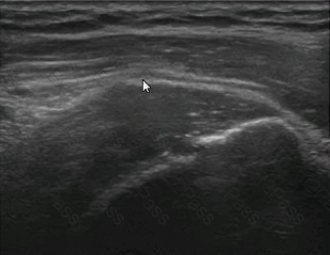
The orthogonal images of a supraspinatus tendon shown here are MOST consistent with which of the following?
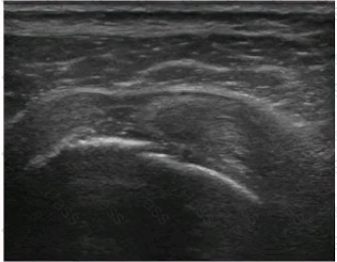
A practitioner is counseling a patient with suspected rotator cuff tendinopathy on imaging options. Which of the following is CORRECT regarding diagnostic ultrasound examination?
Which of the following statements is CORRECT with regard to the use of ultrasound equipment for children?" followed by four answer choices:
Which of the following is the MOST appropriate next step to confirm the presence of pathology in this metacarpophalangeal joint?
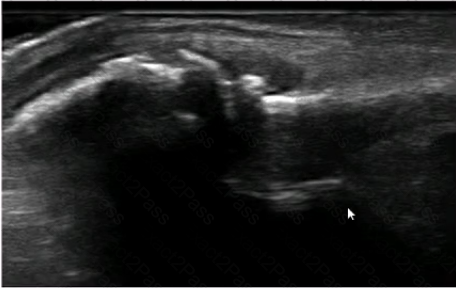
Which carpal bone is visualized medially to the ulnar nerve on a transverse scan of the wrist at the level of the distal wrist crease?
How is the dynamic evaluation for subacromial impingement and adhesive capsulitis performed?
Which of the following is MOST accurate regarding high-level disinfection of a probe?
Which statement is TRUE regarding the techniques that can minimize infection during ultrasound-guided procedures?
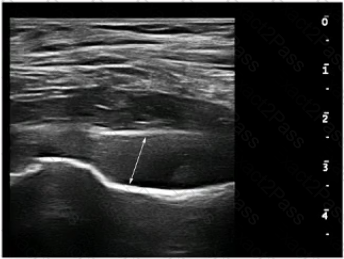
What is the MAXIMUM normal dimension of the structure indicated by the line in this image?
A practitioner wants to assess the structure marked with an asterisk (*).
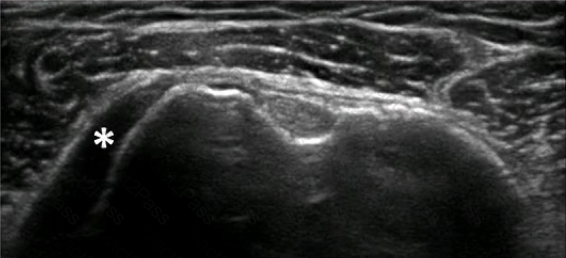
What maneuver should the practitioner instruct the patient to perform of the examined joint?

