Exact2Pass

Last Update 9 hours ago Total Questions : 115
The Registry Examination for Advanced Pulmonary Function Technologists content is now fully updated, with all current exam questions added 9 hours ago. Deciding to include RPFT practice exam questions in your study plan goes far beyond basic test preparation.
You'll find that our RPFT exam questions frequently feature detailed scenarios and practical problem-solving exercises that directly mirror industry challenges. Engaging with these RPFT sample sets allows you to effectively manage your time and pace yourself, giving you the ability to finish any Registry Examination for Advanced Pulmonary Function Technologists practice test comfortably within the allotted time.
A body plethysmograph box pressure transducer fails the electronic calibration check after multiple attempts. Which of the following should a pulmonary function technologist do?
1. Perform a biologic control test
2. Inspect the door seal.
3. Re-zero the box pressure transducer.
4. Perform a physical pressure calibration.
The following data are obtained for a 60-year-old male undergoing an exercise (stress) test on an ergometer:
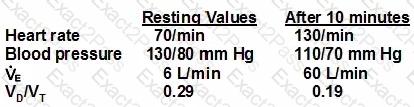
A pulmonary function technologist should
Which of the following spirometry results is most characteristic of a restrictive lung disease?
Prior to performing a multiple-breath U2 washout test, a pulmonary function technologist is unable to zero the H2 gas analyzer. Which of the following may be responsible?
A pulmonary function technologist is performing an exercise study on a patient with sarcoidosis. Which of the following end-tidal CO 2 values should the technologist expect at rest, if the test is performed appropriately?
Which of the following is the most reliable indicator that a patient has achieved his maximum exercise capacity during a progressive exercise (stress) test?
A pulmonary function technologist is reviewing an asthma action plan. The patient takes a low-dose inhaled corticosteroid and a long-acting beta2-agonist twice daily. The patient's personal best peak flow is 600 L/min. Which of the following instructions should be given to the patient when the peak flow drops to 500 L/min?
Which of the following thresholds for a clinically significant change in lung function from the beginning to the end of a methacholine challenge test is significant?
A patient with severe airflow limitation pants too rapidly ( > 3 breaths/second) against a closed shutter in a body plethysmograph. Which of the following will occur?
In which of the following patients would an end-tidal CO 2 most likely produce values that are inconsistent with PaCO 2 ?

