Exact2Pass

Last Update 9 hours ago Total Questions : 115
The Registry Examination for Advanced Pulmonary Function Technologists content is now fully updated, with all current exam questions added 9 hours ago. Deciding to include RPFT practice exam questions in your study plan goes far beyond basic test preparation.
You'll find that our RPFT exam questions frequently feature detailed scenarios and practical problem-solving exercises that directly mirror industry challenges. Engaging with these RPFT sample sets allows you to effectively manage your time and pace yourself, giving you the ability to finish any Registry Examination for Advanced Pulmonary Function Technologists practice test comfortably within the allotted time.
A treadmill belt stops for a fraction of a second each time the patient takes a step. A pulmonary function technologist should
The following biologic control data ranges were established:
The following additional data were obtained when assessing the equipment:
Which of the following should a pulmonary function technologist do?
When performing quality control in a body plethysmograph using a 5-L isothermal bottle, the V TG at shutter closure are as follows:

A pulmonary function technologist should
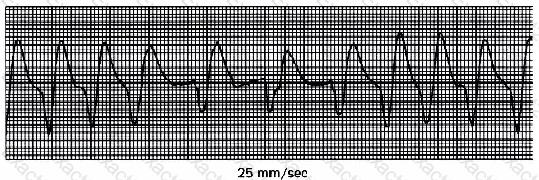
The ECG above is recorded during the recovery phase immediately following termination of an ergo meter exercise study. A pulmonary function technologist should
The following values are reported at maximum effort for a 50-year-old, 70-kg (154-lb) male with significant coronary artery disease during ergometer stress testing. Which of the following is most likely an error?
The following values are obtained using a 3-liter calibration syringe during volume calibration of a dry-rolling spirometer:
2.80 L
2.79 L
2.82 L
The performance of this spirometer is best described as
A 35-year-old healthy male is performing a maximal stress test as part of an annual physical. The following data are observed:
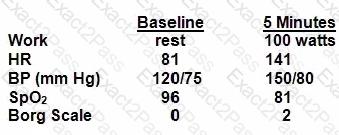
The patient denies any symptoms. Which of the following should a pulmonary function technologist do first?
While performing a plethysmographic lung volume test, a technologist observes that the patient's breathing efforts do not produce consistent pressure fluctuations in the box. Which of the following is the most likely reason for this issue?
During daily quality control procedures on an infrared CO 2 analyzer, a pulmonary function technologist is unable to adjust the gain to the calibration gas concentration. Which of the following is the most likely explanation?
Which of the following is correct regarding smoking cessation?

