Exact2Pass

Last Update 18 hours ago Total Questions : 64
The ISTQB-BCS Certified Tester Advanced Level- Test Manager (2012) content is now fully updated, with all current exam questions added 18 hours ago. Deciding to include TM12 practice exam questions in your study plan goes far beyond basic test preparation.
You'll find that our TM12 exam questions frequently feature detailed scenarios and practical problem-solving exercises that directly mirror industry challenges. Engaging with these TM12 sample sets allows you to effectively manage your time and pace yourself, giving you the ability to finish any ISTQB-BCS Certified Tester Advanced Level- Test Manager (2012) practice test comfortably within the allotted time.
Improving the Testing Process
Which of the following statements about the STEP test process improvement model is true?
Number of correct responses: 1
K2 1 credit
Improving the Testing Process
Which of the following statements about the TMMi test process improvement model is true?
Number of correct responses: 1
K2 1 credit
Improving the Testing Process
Consider the following statements describing the importance of improving the test process:
I. Test process improvement is important because being focused only on the test process it can provide recommendations to improve the test process itself, but it can’t indicate or suggest improvement to areas of the development process
II. Test process improvement is important because it is much more effective than software process improvement to improve the quality of a software system
III. Test process improvement is important because several process improvement models (STEP, TPI Next, TMMi) have been developed over the years
IV. Test process improvement is important because every organization, regardless of the context, should always achieve the maximum level of maturity of testing described in the test improvement models such as TMMi
Which of the following answers is correct?
Number of correct responses: 1
K2 1 credit
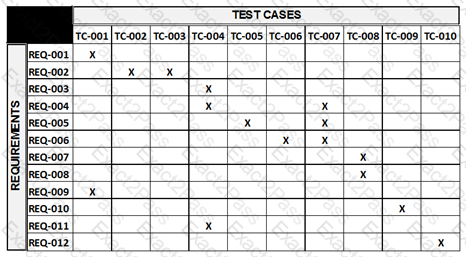
Assume that the following test cases have been executed at the end of the first week of test execution: TC-001, TC-002 and TC-007. All these tests are ‘passes’.
What is the MINIMUM number of the remaining test cases that must be successfully executed to fulfill the EX1 exit criteria?
Number of correct responses: 1
K3 2 credits
Testing Process
The following are the exit criteria described in the test plan of a software product:
EX1. The test suite for the product must ensure that at least each quality risk item is covered by at least one test case (a quality risk item can be covered by more test cases).
EX2. All test cases in the test suite must be run during the execution phase.
EX3. Defects are classified into two categories: “C” (critical defect) and “NC” (non-critical defect). No known C defects shall exist in the product at the end of the test execution phase.
Which of the following information is useless when the specified exit criteria is evaluated?
Number of correct responses: 1
K2 1 credit
Testing Process
Consider an information system of a Pay-Tv company based on a SOA architecture.
The integrated system currently consists of three core systems:
- a CRM (Customer Relationship Management) system
- a BRM (Billing and Revenue Management) system
- a CAS (Conditional Access System) system
all of them communicating with SOA Middleware.
You have been asked to manage the testing activities for the integration of two additional off-the-shelf systems from two different vendors: a SMS (Short Message Service) server and an IVR (Interactive Voice Response) system.
Assume that there is a high likelihood that the two off-the-shelf systems will be low-quality and that you have a clear proof that the testing performed by the two vendors on their systems has been unsystematic and unprofessional. This obviously leads to higher quality risk for the overall integrated system.
You are the Test Manager of this project. Your main goal is to plan for testing activities to mitigate this risk.
Which of the following answers best describes the test activities (assuming it is possible to perform all of them) you should plan for?
Number of correct responses: 1
K4 3 credits
Defect Management
During the system testing phase a tester from your test team observes a failure in the system under test and he/she decides to create an incident report. The incident report is currently in a “new” state, indicating it needs to be investigated.
Which THREE of the following information items can’t yet be present in the incident report?
Number of correct responses: 3
K3 2 credits (2 credits out of 3 credits correct, 1 credit point)
Defect Management
Assume you are working on a defect management process to be used by a software organization to track the current status of the defects reports for several projects.
When a defect is found for investigation a defect report is created in “Opened” state that is the unique initial state. The defect report status has also a unique finale state that is the “Closed” state.
The following state transition diagram describes the states of this defect management process:

where only the initial (“Opened”) and final (“Closed”) states are indicated while the remaining states (V, W, X, Y, Z) have yet to be named.
Which of the following assignments would you expect to best complete the defect management process?
Number of correct responses: 1
K3 2 credits
Defect Management
Which of the following information would you expect to be the most useful to perform a defect clustering analysis?
Number of correct responses: 1
K2 1 credit

