
Ticking Clock Black Friday Special: 75% Off! Apply coupon code below to save on all exam bundles! - Ends in 0d 00h 00m 00s - Coupon code: 75epass

Exact2Pass Menu

UiPath Agentic Automation Professional Exam

Last Update 8 hours ago Total Questions : 105

The UiPath Agentic Automation Professional Exam content is now fully updated, with all current exam questions added 8 hours ago. Deciding to include UiPath-AAPv1 practice exam questions in your study plan goes far beyond basic test preparation.

You'll find that our UiPath-AAPv1 exam questions frequently feature detailed scenarios and practical problem-solving exercises that directly mirror industry challenges. Engaging with these UiPath-AAPv1 sample sets allows you to effectively manage your time and pace yourself, giving you the ability to finish any UiPath Agentic Automation Professional Exam practice test comfortably within the allotted time.

Question # 21

Which of the following is a properly structured system prompt based on best practices?
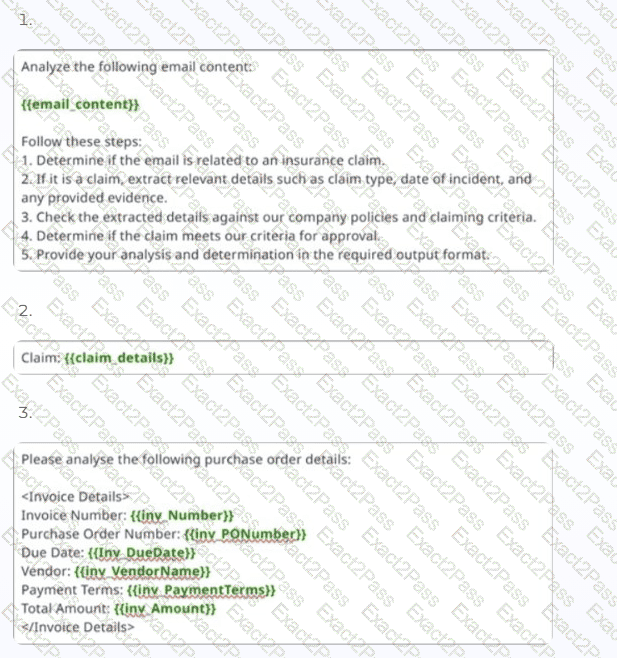
Original exhibit — Question 6, part 1
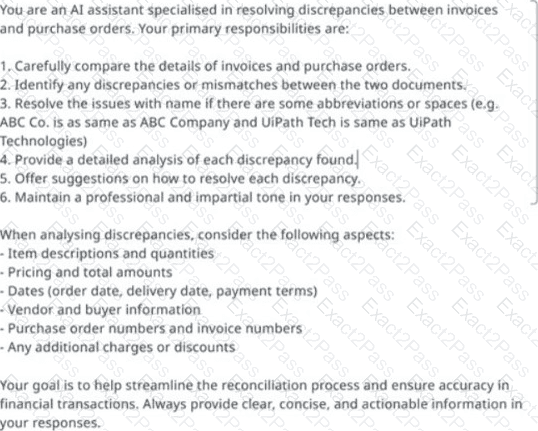
Original exhibit — Question 6, part 2

A.

1

B.

2 and 4

C.

3

D.

4

Question # 22

When designing indexes for Context Grounding in UiPath, which approach is most effective for managing content updates?

A.

Create a new index in Orchestrator when content changes significantly and update the agent definition accordingly.

B.

Use static indexes with descriptive naming conventions to track changes, minimizing effort spent on updates.

C.

Sync existing indexes periodically without creating new indexes, regarding if the content changes significantly or not.

D.

Group content into a single index to simplify index management and avoid complexity.

Question # 23

An organization is designing a customer-facing service agent using the agent story blueprint format.

To align with UiPath agent components, which story structure best reflects proper instruction and interaction design?

A.

Specify the agent department and reporting line, define desired customer outcomes, reference historical feedback as context, integrate chat interfaces, and measure performance using satisfaction surveys alone.

B.

Specify the agent role and operating environment, define explicit behavioral instructions in the prompt, identify relevant contextual sources, integrate appropriate tools, and define measurable success criteria with escalation paths.

C.

Specify the automation goal and system owner, define high-level service objectives, reference general organizational policies as context, integrate notification channels, and measure performance using system uptime metrics.

D.

Specify the process category and compliance scope, define expected efficiency targets, reference archived cases as context, integrate analytics dashboards, and measure performance using quarterly audit reviews.

Question # 24

Which monitoring setup is appropriate for proactively tracking index updates and catching errors early?

A.

Create an "Index Update Finished" alert since it fires after every successful retrieval

B.

Turn on a daily tenant health email that lists all index retrievals and sync failures

C.

Filter by Last queried in the Indexes table to generate automatic alerts when usage changes

D.

Subscribe to Context Grounding notification events such as Ingestion Job Completed, Started, or Failed

Question # 25

During iterative optimization, which of the following changes is most likely to improve an agent’s performance without adding latency?

A.

Adding more tools to the agent's configuration

B.

Switching from LLM-as-a-Judge to exact match evaluators

C.

Increasing the number of evaluation sets beyond 10

D.

Refining the prompt to reduce ambiguity and improve reasoning clarity

Question # 26

In the illustrated insurance-claim automation, the agent analyzes incoming emails and escalates uncertain cases for confirmation before proceeding.

When configuring Human-in-the-Loop for this process, which configuration best ensures accurate claim identification while maintaining automation efficiency?
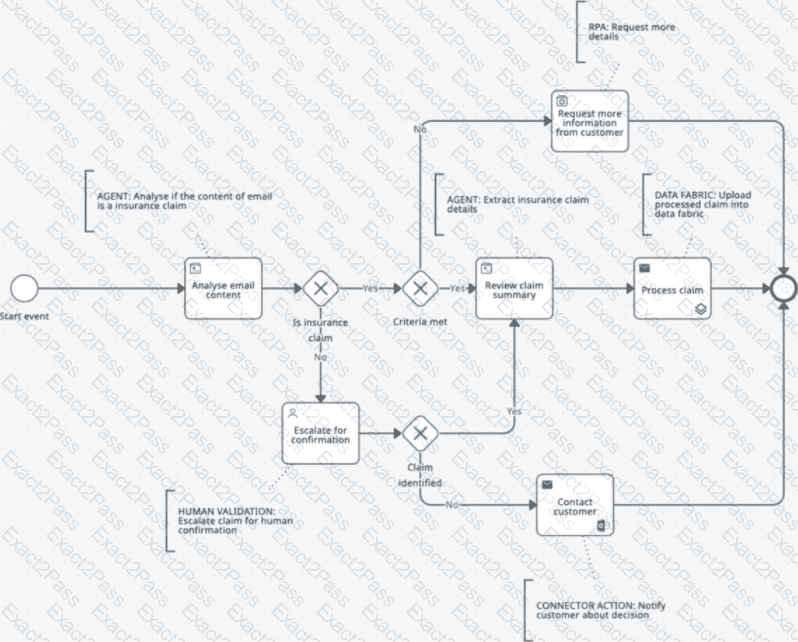
Original exhibit — Question 2

A.

Configure human approval before notifying the customer of the final claim decision, regardless of how the claim was classified.

B.

Configure human validation for a subset of processed claims selected based on predefined business priority categories.

C.

Configure escalation to a human reviewer when the agent can't confidently confirm the email is an insurance claim.

D.

Configure human review after the claim summary is generated to validate extracted details prior to uploading the processed claim into the data fabric.

Question # 27

A team wants to compare several model and temperature combinations side by side using the same evaluation scenarios and expected outputs.

What action creates a separate evaluation run for each configuration?

A.

Add multiple evaluator types to the same set where each evaluator creates a separate run for scoring the models.

B.

Add multiple model and temperature combinations in Evaluation settings so each combination creates a separate run.

C.

Generate multiple evaluation sets so each of the sets creates a separate run for the same input cases.

D.

Import multiple JSON files so each imported file creates a separate run for the same evaluations.

Question # 28

Why is it important to balance the threshold and number of results when optimizing agent context retrieval?

A.

Because lowering both settings ensures the agent uses only the most recent context regardless of relevance.

B.

Because it ensures relevant high-signal context is provided without returning too many unrelated results.

C.

Because setting both to their maximum always produces the best performance by including all possible context.

D.

Because balance is required to determine which schema fields are mandatory versus optional during context retrieval.

Question # 29

While designing an agent story for invoice processing, the team identifies multiple decision points where different systems are used.

How should the agent design reflect these decision points?

A.

Minimize explicit decision modeling in the agent and instead trigger system automations sequentially, allowing system responses to implicitly determine the next step.

B.

Decompose each decision point into independent micro-agents aligned to individual systems, without maintaining centralized orchestration logic.

C.

Represent decisions as structured conditional branches within the agent, mapping them to the specific system tools required while preserving traceability and outcome alignment.

D.

Abstract decision points into a generalized reasoning layer within the agent and rely on downstream systems to enforce detailed validation and routing logic.

Question # 30

What approach is recommended when designing evaluations for agents with strictly defined, deterministic output requirements?


A.

Trajectory evaluators are best suited for deterministic outputs as they assess run history and behavioral patterns for exact matching.

B.

Use the LLM-as-a-Judge evaluator by default because of its ability to adapt to deterministic output requirements in addition to flexible outputs.

C.

Use any evaluator type interchangeably, as all evaluators produce equally reliable results for deterministic outputs.

D.

Use Exact match or JSON similarity evaluators for highly structured outputs, such as exact strings, numerical values, Boolean responses, or arrays of primitives.

Go to page: