
Spring Sale Special Limited Time 70% Discount Offer - Ends in 0d 00h 00m 00s - Coupon code: buysanta

Exact2Pass Menu

UiPath Automation Solution Architect Professional v1.0 Exam

Last Update 17 hours ago Total Questions : 151

The UiPath Automation Solution Architect Professional v1.0 Exam content is now fully updated, with all current exam questions added 17 hours ago. Deciding to include UiPath-ASAPv1 practice exam questions in your study plan goes far beyond basic test preparation.

You'll find that our UiPath-ASAPv1 exam questions frequently feature detailed scenarios and practical problem-solving exercises that directly mirror industry challenges. Engaging with these UiPath-ASAPv1 sample sets allows you to effectively manage your time and pace yourself, giving you the ability to finish any UiPath Automation Solution Architect Professional v1.0 Exam practice test comfortably within the allotted time.

Question # 11

What does the UiPath Automation Suite include?

A.

All Server Products, Shared Suite Capabilities for integration with enterprise systems, a common end-user portal, and a Kubernetes-based infrastructure with cluster management and monitoring tools optimized for UiPath.

B.

All Server Products, Shared Suite Capabilities for integration with external systems only, a common end-user portal, and Kubernetes infrastructure with cluster management and monitoring tools supported by third-party vendors.

C.

All Server Products, individual management for each server product, a common end-user portal, and a Kubernetes-based infrastructure for cluster management and monitoring tools supported by third-party vendors.

D.

All Cloud-based Products, Shared Suite Capabilities for integration with enterprise systems, a separate end-user portal for each product, an and a Kubernetes-based infrastructure for cluster management and monitoring tools.

Question # 12

What is a critical security and compliance check performed by the Solution Architect during code reviews?

A.

Check client geographic datastore requirements.

B.

Check for Personally Identifiable Information written as clear text in logs.

C.

Check for workflows invoked with Isolated option.

D.

Check the applications used by the automation.

Question # 13

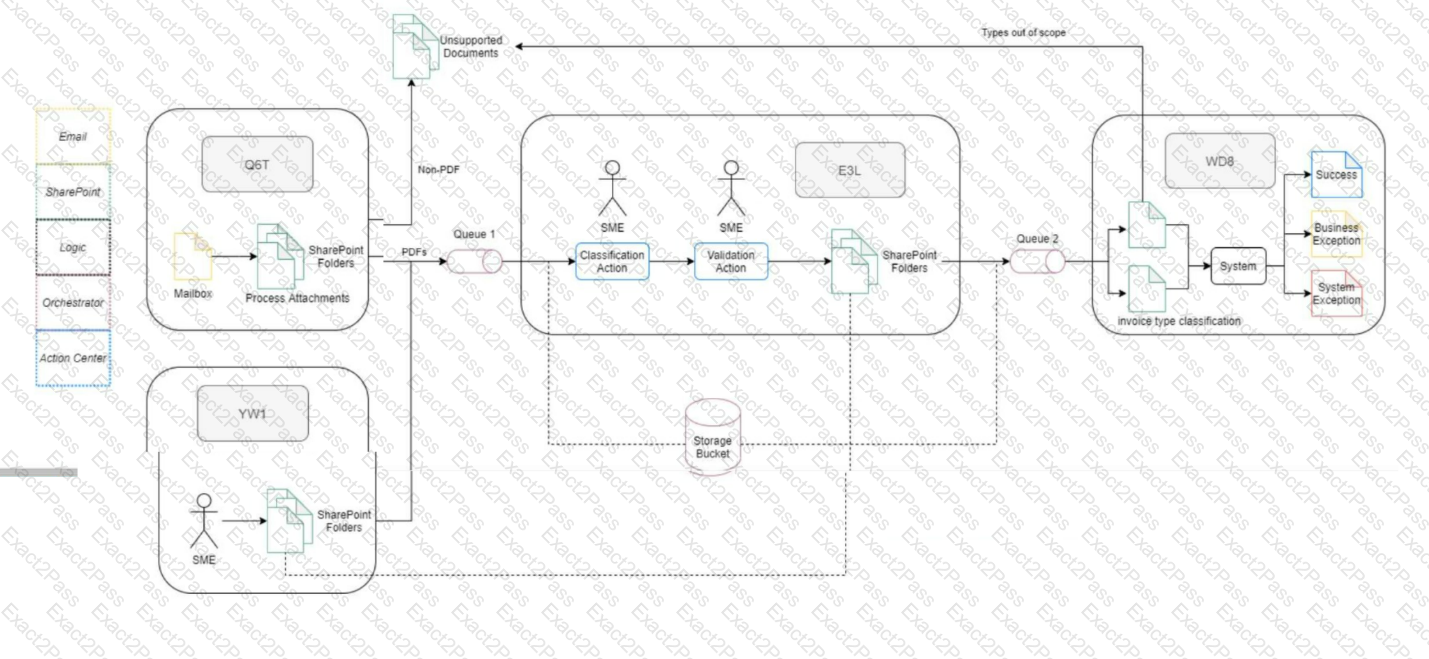
What is the use case of the following diagram?
A.

Credit Note Processing

B.

Invoice Processing

C.

Natural Language Processing

D.

Human Action Processing

Question # 14

In UiPath Data Service, what does an " Entity " represent?

A.

A process orchestration component.

B.

A data visualization tool.

C.

A data transformation method.

D.

A table or data structure.

Question # 15

Which feature of UiPath Apps allows a user to create forms and components for user interfaces in applications?

A.

UiPath Studio

B.

UiPath Orchestrator

C.

Data Service

D.

App Builder

Question # 16

In regards to UiPath Automation Cloud licensing- what happens when the Trail plan’s evaluation period ends?

A.

After the trial expires; your organization will be changed for the pro plan unless you downgrade manually.

B.

You need to manually choose a plan, or your UiPath cloud account will be suspended.

C.

After the trial expires; your organization is automatically downgraded to the free plan.

D.

The pro Trial plan will automatically renew itself for another 60 days

Question # 17

What is the role of the business analyst in the creation of a process definition Document (PDD)?

A.

As a subject matter expert the responds to question when they arise while creating the PDD.

B.

Leads this task by compiling all the information in preparation for the review and approval by the client.

C.

Overseas this process and provides guidance and direction.

D.

Ensures that the client’s logo is placed in the header and the process name in he footer.

Question # 18

Which of the following is listed under the use cases of Al Center for handling unstructured data?

A.

Image Classification

B.

Inventory Forecasts

C.

Language Translation

D.

Loan Defaults

Question # 19

What is the purpose of UiPath Solution Accelerators?

A.

They are plug-and-play solutions that instantly automate and process without any customization needed.

B.

They are a collection of pre-designed templates and models without any reusable components or connectors.

C.

They are pre-built automation frameworks exclusively for the Finance department, focusing on Level 3 business Use Cases only.

D.

They are pre-built modular automation that quick time-to-value with common use cases, having connectors for widely used system and applications.

Question # 20

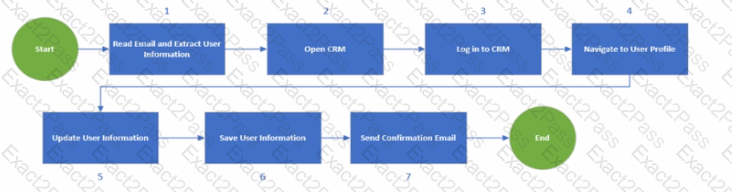
Given the blowing Diagram, what is the biggest issue from the perspective of the stops?
A.

Steps 5 and 6 should be merged.

B.

There are no decision points and no explanations on how to handle each situation

C.

Start and End should not be pan of the diagram

D.

Step 7 should not be captured in the high-level Diagram

Go to page:

