
Spring Sale Special Limited Time 70% Discount Offer - Ends in 0d 00h 00m 00s - Coupon code: buysanta

Exact2Pass Menu

CIW v5 Database Design Specialist

Last Update 4 hours ago Total Questions : 124

The CIW v5 Database Design Specialist content is now fully updated, with all current exam questions added 4 hours ago. Deciding to include 1D0-541 practice exam questions in your study plan goes far beyond basic test preparation.

You'll find that our 1D0-541 exam questions frequently feature detailed scenarios and practical problem-solving exercises that directly mirror industry challenges. Engaging with these 1D0-541 sample sets allows you to effectively manage your time and pace yourself, giving you the ability to finish any CIW v5 Database Design Specialist practice test comfortably within the allotted time.

Question # 21

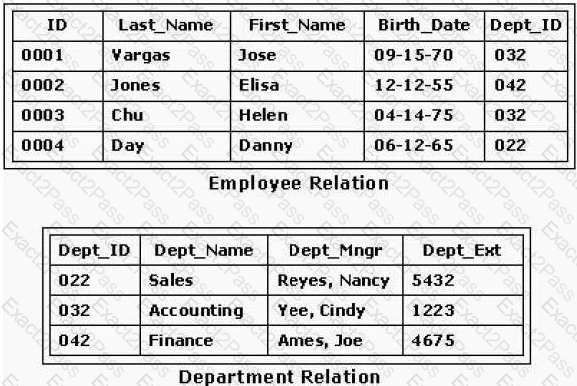
Consider the Employee relation shown in the exhibit. A database manager wants to set up a view called Emp_Dept that allows users to find employees and their department ID numbers. Which SQL statement will accomplish this?
A.

CREATE VIEW Emp_Dept AS SELECT

Last_Name, First_Name, Dept_ID FROM

Employee;

B.

UPDATE VIEW Emp_Dept

AS SELECT * FROM

Employee;

C.

UPDATE VIEW Emp_Dept AS SELECT

Last_Name, First_Name, Dept_ID FROM

Employee;

D.

CREATE VIEW Emp_Dept

AS SELECT * FROM

Employee WHERE ID = 0001

AND ID = 0002 AND ID =

0003 AND ID = 0004;

Question # 22

Which of the following best describes the ON DELETE CASCADE referential integrity constraint?

A.

If a parent key is deleted, any child keys referenced by the parent key are automatically deleted.

B.

If any child key references a parent key, the record containing the parent key cannot be deleted.

C.

If a parent key is deleted, all child keys are automatically set to a specified value.

D.

If a parent key is deleted, no test is made for referential integrity.

Question # 23

Which concurrency control method should be used only when conflicts between transactions rarely occur?

A.

Locking

B.

Time stamps

C.

Optimistic

D.

Serialization

Question # 24

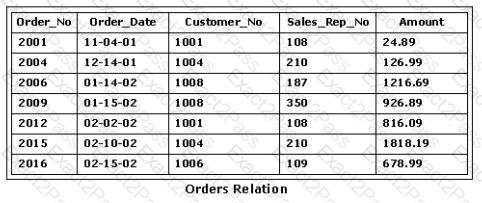
Consider the Orders relation shown in the exhibit. Which of the following SQL statements would return all complete tuples for order dates in 2002, arranged by amount from lowest to highest?
A.

SELECT *

FROM Orders

WHERE Order_Date LIKE _02

ORDER BY Amount;

B.

SELECT (Order_Date, Amount)

FROM Orders

WHERE Order_Date LIKE %02

ORDER BY Amount;

C.

SELECT *

FROM Orders

WHERE Order_Date LIKE _02

ORDER BY Order_No;

D.

SELECT *

FROM Orders

WHERE Order_Date LIKE %02

ORDER BY Amount;

Question # 25

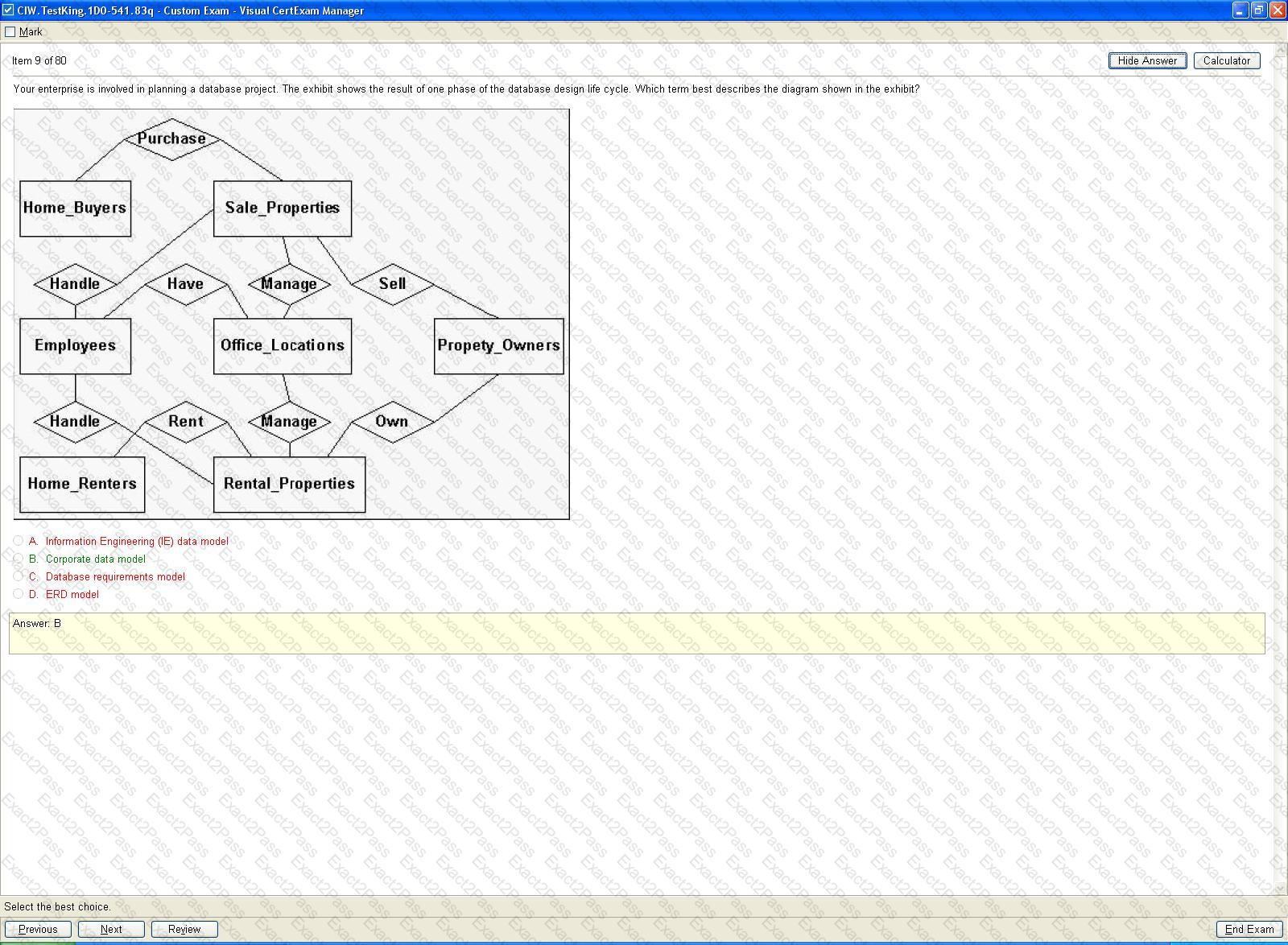
Your enterprise is involved in planning a database project. The exhibit shows the result of one phase of the database design life cycle. Which term best describes the diagram shown in the exhibit?
A.

Information Engineering (IE) data model

B.

Corporate data model

C.

Database requirements model

D.

ERD model

Question # 26

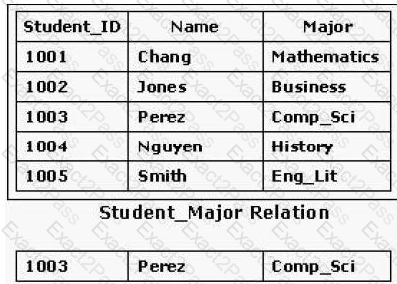
Consider the table shown in the exhibit. Which relational algebraic operation would return Row 3?
A.

Union

B.

Selection

C.

Projection

D.

Difference

Question # 27

Consider the entity-relationship (ER) diagram shown in the exhibit. What do the characters at the ends of the connecting line indicate?
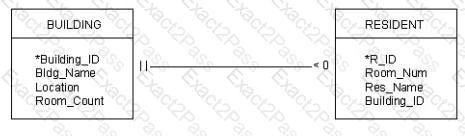
A.

Degree of a relation

B.

Cardinality of a relation

C.

Primary key of a relation

D.

Determinant of a relation

Question # 28

Which of the following best describes the information contained in the data dictionary (or system catalog)?

A.

Metadata

B.

Data model

C.

Table data

D.

Metafile

Question # 29

Consider the relation shown in the exhibit. Which of the following SQL statements would properly add information for a new employee?

A.

INSERT INTO Employee

VALUES(0005, Tim, Bogart, 03-15-77);

B.

INSERT INTO Employee(Emp_ID, First_Name, Last_Name, Birth_Date)

VALUES(0004, Tim, Bogart, 03-15-77);

C.

INSERT INTO Employee(Emp_ID, First_Name, Last_Name, Birth_Date)

VALUES(0005, Tim, Bogart, 03-05-77);

D.

INSERT INTO Employee(Emp_ID, First_Name, Last_Name, Birth_Date)

VALUES(0005, Tim, Bogart, 03-05-77);

Question # 30

Which characteristic is an advantage of a database management system?

A.

Data files are owned and maintained by the users.

B.

Database administration is simplified.

C.

A standard method can be used to access the database.

D.

Data is decentralized.

Go to page:
