Spring Sale Special Limited Time 70% Discount Offer - Ends in 0d 00h 00m 00s - Coupon code: buysanta

Exact2Pass Menu

Oracle E-Business Suite R12 Project Essentials Exam

Last Update 17 hours ago Total Questions : 70

The Oracle E-Business Suite R12 Project Essentials Exam content is now fully updated, with all current exam questions added 17 hours ago. Deciding to include 1z0-511 practice exam questions in your study plan goes far beyond basic test preparation.

You'll find that our 1z0-511 exam questions frequently feature detailed scenarios and practical problem-solving exercises that directly mirror industry challenges. Engaging with these 1z0-511 sample sets allows you to effectively manage your time and pace yourself, giving you the ability to finish any Oracle E-Business Suite R12 Project Essentials Exam practice test comfortably within the allotted time.

Question # 11

An organization has specific departments that manage capital projects. How would you ensure that only these departments own capital projects?

A.

Use the transaction control Functionality at the project level.

B.

Use the settings in "Additional Details" of the Project/Task owning organization classification.

C.

Remove the asset definition options from the templates used by departments that are not managing capital projects.

D.

Use the Project/Task owning organization hierarchy in the implementation options.

E.

Set up a separate organization hierarchy for the departments that are managing capital projects.

Question # 12

Which three types of People Resources does Oracle Projects support?

A.

Team Roles

B.

Straight Time

C.

Jobs

D.

Item

E.

Named Person

Question # 13

An organization uses Oracle Projects and has fully installed Oracle Human Resources. Which statement does not apply to this scenario?

A.

Employees can be entered and maintained in Oracle Projects.

B.

Jobs can be set up in Oracle Projects.

C.

Organizations can be defined In Oracle Projects.

D.

Organization Hierarchies can be defined in Oracle Projects.

E.

Worker Assignments can be viewed in Oracle Projects.

Question # 14

A customer is using Oracle Payables and Oracle Projects. The customer has two suppliers set up with names X and Y, respectively. Supplier Y has been merged with Supplier X. The Supplier Merge Program is run from the Supplier Merge option in Oracle Payables and you have chosen to merge all transactions. What will happen to the supplier references on transactions related to Supplier Y that are already interfaced to Oracle Projects?

A.

The Supplier Merge Program does not impact any supplier transactions that are already interfaced to Oracle Projects.

B.

The Supplier Merge Program completes with error, the merge is not possible because transactions related to Supplier Y are already interfaced to Oracle Projects.

C.

The supplier references to Supplier Y will be modified to Supplier X for all transactions existing in Oracle Projects.

D.

The transactions related to Supplier X and Y will be deleted from Oracle Projects.

E.

The transactions related to Supplier Y will be deleted from Oracle Projects.

Question # 15

You are setting up an AutoAccounting rule and trying to use "Class Code" as the parameter for that rule. Which setup must exist in order to use "Class Code" as one of the parameters?

A.

Enable AutoAccounting for one Class Code of a Class Category.

B.

Enable AutoAccounting for all the Class Codes of a Class Category.

C.

Enable AutoAccounting for the Class Category.

D.

Enable AutoAccounting for both Class Category and Class Code.

Question # 16

A project is undertaken for a customer where all labor costs are non-billable, and Non-Labor costs are billable if the accumulated costs incurred are greater than $10k.

How can Oracle Projects be implemented to support this?

A.

Use transaction controls to restrict billing to Non-Labor elements and to calculate the bill amounts on Non-Labor.

B.

Use transaction controls to billing Non-Labor elements, capture the value on the project, and then use the Non-Labor billing extension to calculate when an activity is billable.

C.

Create an agreement and funding for $10k only, and fund only those tasks on a project where you estimate to incur costs of $10k or more.

D.

Use the cost-to-cost billing extension to build billing rules to meet the requirement.

E.

Use the cost accrual extension.

Question # 17

In which two circumstances would it be appropriate to deselect the "Interface Revenue to GL" option in System Implementation Options, before you run the Interface to GC?

A.

During data migration if Revenue is already in General Ledger

B.

When Revenue is handled in Accounts Receivable

C.

When AutoAccounting is incorrect and the Revenue interfacing to General Ledger needs to be put on hold.

D.

When Finance wants to reconcile Unbilled Receivables/Unearned Revenue

E.

When Revenue was generated in error for all projects in Released status, and needs to be corrected.

Question # 18

A customer has provided a purchase order for $100k. The customer issues an additional $20k to the original purchase order. How would you invoice the total amount of $120k on only one invoice as per the terms of the contract?

A.

Create a separate agreement and funding for $20k.

B.

Update the existing agreement value to $120k and add an additional funding line against the project for $20k.

C.

Update the cost budget to $l20k.

D.

Create a manual invoice in Accounts Receivable for the additional value.

E.

Update any existing transactions to allow billing to the new amount.

Question # 19

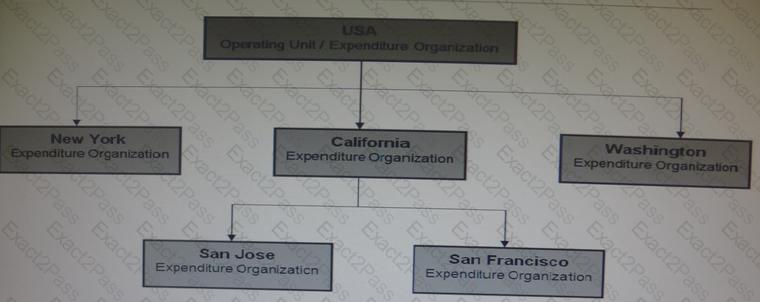
Refer to the exhibit.

In your company's Expenditure/Event Organization Hierarchy, organization labor costing rules are assigned to all organizations except San Jose. What happens when you run the "PRC: Distribute labor costs" program for a timecard transaction entered by an employee from the San Jose organization?

A.

The rule assigned for San Francisco takes precedence and the transaction will he successfully a distributed.

B.

The rule assigned for USA takes precedence and the transaction will he successfully cost distributed.

C.

The rule assigned for California takes precedence and the transaction will be successfully cost distributed.

D.

The program ignores this transaction, because no labor costing rule is assigned for San Jose. and completes normally.

E.

The program completes normally. However, the output will have this transaction under the exceptions section with a message "No Labor costing rule assigned for organization."

Question # 20

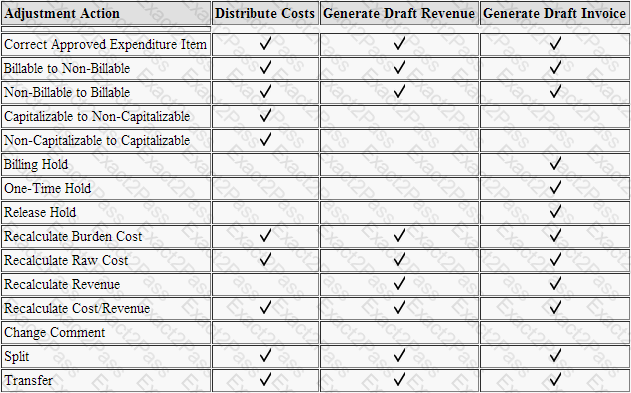
Identify three adjustment actions that require submission of Distribute costs program to process the adjustments?


A.

Change Comment

B.

Release Hold

C.

Split

D.

Transfer

E.

Recalculate Revenue

F.

Capitalizable to Non-Capitalizable

Go to page: