Summer Sale Special Limited Time 70% Discount Offer - Ends in 0d 00h 00m 00s - Coupon code: buysanta

Exact2Pass Menu

Oracle E-Business Suite R12 Project Essentials Exam

Last Update 19 hours ago Total Questions : 70

The Oracle E-Business Suite R12 Project Essentials Exam content is now fully updated, with all current exam questions added 19 hours ago. Deciding to include 1z0-511 practice exam questions in your study plan goes far beyond basic test preparation.

You'll find that our 1z0-511 exam questions frequently feature detailed scenarios and practical problem-solving exercises that directly mirror industry challenges. Engaging with these 1z0-511 sample sets allows you to effectively manage your time and pace yourself, giving you the ability to finish any Oracle E-Business Suite R12 Project Essentials Exam practice test comfortably within the allotted time.

Question # 1

A customer enables transaction controls at the Project level. Oracle Project Costing checks the control when the customer ________.

A.

transfers an expenditure item to another task of the same project

B.

runs the PRC: Distribute Labor Costs concurrent program

C.

runs the PRC: Transaction Import concurrent program

D.

enters a project-related invoice distribution in Oracle Payables

E.

enters an online or preapproved expenditure item

Question # 2

A project is enabled for Burdening by setting up a burden schedule at the project type level. A

Miscellaneous expenditure Item Is charged to the project with a raw cost of $100 and expenditure type "Overhead." The "Overheads" expenditure type is excluded from all cost bases in the burden structure.

What happens when the "PRC: Distribute usage and Miscellaneous Costs" program is run for this project?

A.

The program errors with the message "Missing Expenditure type."

B.

The program completes successfully; Raw Cost = $100, Burden Cost= $0, Total Burdened cost = $100.

C.

The program completes successfully; Raw Cost = $100, Burden Cost= $100, Total Burdened cost = $100.

D.

The program completes successfully; Raw Cost = $100, Burden Cost= $0, Total Burdened cost = $0.

Question # 3

A customer has two operating units: US and Ireland. A project that is set in the Ireland operating unit requires the services of employees from the US operating unit.

Identify three mandatory steps that must be completed for the employees in the US to enter their time on the project and for costs to be successfully distributed.

A.

Set up Internal Billing Implementation options in US and Ireland.

B.

Define provider controls in US and receiver controls in Ireland.

C.

Set up a new transaction source to receive Intercompany transactions in Ireland.

D.

For the project in Ireland, select "Allow Cross Charges to all Operating Units within Legal Entity".

E.

For the project in Ireland, set up transaction controls to allow charges from other operating units.

Question # 4

A customer is planning to upgrade from 11/to R12 to use Subledger Accounting (SLA). Identify the three options available to the customer.

A.

Configure SLA without using the existing AutoAccounting setup. SLA generates accounting combinations without AutoAccounting.

B.

Continue to use the existing AutoAccounting setup. SLA uses the default flexfield values generated by AutoAccounting.

C.

Define alternative accounting rules in SLA to overwrite the default values provided by AutoAccounting.

D.

Use the existing AutoAccounting setup at the point of upgrade. Evaluate the benefits of SLA and migrate to SLA when and if beneficial.

E.

Use the existing AutoAccounting setup only. SLA is not applicable to Projects because Oracle Projects has AutoAccounting.

Question # 5

Your customer has set up a contract project with a distribution rule Work/Work. Identify three setup options to:

    Charge labor transactions revenue and all other nonlabor transactions revenue to separate accounts

    Generate separate invoice line amounts for labor and nonlabor transactions

A.

Set up revenue categories as required.

B.

Define revenue accounts at the revenue category setup level.

C.

Define AutoAccounting rules to derive revenue account based on revenue category.

D.

Define grouping option by revenue category on the invoice format and attach the invoice format at the project type level.

E.

Define grouping option by revenue category on the project type.

Question # 6

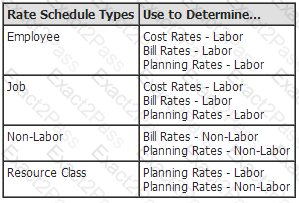
Which types of rate schedules should be defined to allow rates to be used to generate financial plans?

A.

Job Labor Rates Schedule Non Labor Rate Schedule

B.

Resource Class Schedule Planning Rate Schedule Labor Rates Schedule

C.

Resource Class Schedule Labor Rates Schedule Non Labor Rate Schedule

D.

Resource Class Schedule Planning Rate Schedule Non Labor Rates Schedule

Question # 7

An organization wants to consolidate work based billing across multiple projects (produce one invoice for a single customer based on multiple contract projects).

Which two methods will help them accomplish this?

A.

Create draft Invoices against individual projects, and consolidate them in Receivables.

B.

Create a program. All costs will roll up to the program level and the program can be billed.

C.

Run the invoice consolidation concurrent request to produce a single invoice.

D.

Carry out billing against top tasks across any projects with the same Service Type.

E.

Use inter-project billing so that individual contract projects invoice a single project which, in turn, bills the customer.

Question # 8

Identify the four different levels where transaction controls are defined.

A.

Expenditure Categories

B.

Expenditure Organization

C.

Employee

D.

Project Organization

E.

Expenditure Type

F.

Person Type

Question # 9

You have imported Labor transactions into Oracle Projects from Oracle Time and Labor by running the "PRC: Transaction Import" program.

What is the correct sequence to run the concurrent programs listed below to transfer the cost and accounting entries of these transactions to General Ledger?

1. PRC: Distribute Labor Cost

2.PRC: Transfer Journal Entries to GL

3.PRC: Create Accounting (with the Transfer to GL option set to "No")

4.PRC: Interface Labor Costs to GL

5.PRC: Generate Cost Accounting Events

6.PRC: Distribute and Interface tabor costs to GL

A.

1, 3, 6

B.

1, 5, 3, 4

C.

1, 5, 3, 2

D.

1, 2

E.

3, 6

Question # 10

A project manager wants to create a revenue budget based on the project agreement and allocated funding. How can this be achieved?


A.

by manually creating a revenue budget

B.

by selecting Funding revaluation in the system implementation options.

C.

by selecting the "baseline project without budget" option, which will create a revenue budget automatically based on project funding

D.

by selecting Invoice at top task for the project

E.

by setting transaction controls

Go to page: