Exact2Pass

Last Update 14 hours ago Total Questions : 107
The VMware vSphere 8.x Professional content is now fully updated, with all current exam questions added 14 hours ago. Deciding to include 2V0-21.23 practice exam questions in your study plan goes far beyond basic test preparation.
You'll find that our 2V0-21.23 exam questions frequently feature detailed scenarios and practical problem-solving exercises that directly mirror industry challenges. Engaging with these 2V0-21.23 sample sets allows you to effectively manage your time and pace yourself, giving you the ability to finish any VMware vSphere 8.x Professional practice test comfortably within the allotted time.
Refer to Exhibit:
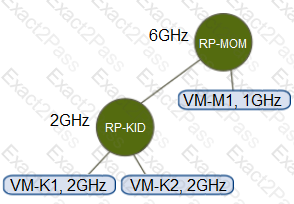
An environment has the following configuration:
• Resource Pool “RP-MOM? has a reservation of 6GHz and one running virtual machine (VM) " VM-M1? with 1 GHz reserved
• Resource Pool ^RP-KID? has a reservation of 2GHz, and expandable reservations is activated
The administrator creates two VMs, “VM-K1? and ' VM-K2?, in the ' ' RP-KID? resource pool with 2GHz reserved for each, and turns on “VM-M1 ?
Given this scenario, which statement is true?
An administrator has mapped three vSphere zones to three vSphere clusters.
Which two statements are true for this vSphere with Tanzu zonal Supervisor enablement? (Choose two.)
An administrator is tasked with providing users access to objects within an existing VMware vCenter instance. The vCenter inventory has a single data center with one management vSphere cluster and five workload vSphere clusters.
The following requirements must be met for assigning the users access:
• Users must only be able to view all of the inventory objects associated with the management vSphere cluster.
• Users must be able to edit all of the inventory objects associated with the workload vSphere clusters.
The administrator creates a custom role to provide the permissions needed to allow users to edit inventory objects.
Which series of steps should the administrator complete to assign the custom role and provide the required level of access to users?
To keep virtual machines (VMs) up and running at all times in a vSphere cluster, an administrator would like VMs to be migrated automatically when the host hardware health status becomes degraded.
Which cluster feature can be used to meet this requirement?
Which two datastore types store the components of a virtual machine as a set of objects? (Choose two.)
An administrator is planning to upgrade a VMware vCenter instance to version 8. It is currently integrated with the following solutions:
* VMware Aria Automation
* VMware Cloud Director
Which tool can the administrator use to run Interoperability reports before the upgrade process?
An administrator is tasked with looking into the disaster recovery (DR) options for a software-defined data center (SDDC).
The following requirements must be met:
• All virtual machines (VMs) must be protected to a secondary site.
• The source VMs must remain online until the failover.
• When failing over to the secondary site, application downtime is allowed
• The DR failover must be managed from the vSphere Client.
• Costs must remain as low as possible.
How can the administrator accomplish this task?
A group of new virtual machines have been deployed using thin-provisioned disks due to the limited storage space available in an environment. The storage team has expressed concern about extensive use of this type of provisioning.
An administrator is tasked with creating a custom alarm to notify the storage team when thin provisioning reaches a certain capacity threshold.
Where must the administrator define this alarm?
An administrator remotely deploys VMware ESXi using an out of band management connection and now needs to complete the configuration of the management network so that the host is accessible through the vSphere Host Client.
The following information has been provided to complete the configuration:
• Host FQDN esxi01corp.local
• Management VLAN ID: 10 DHCP: No
• Management IP Address: 172.16.10.101/24
• Management IP Gateway: 172.16.10.1
. Corporate DNS Servers: 172 16.10.5, 172.16.10..6
• DNS Domain: corp.local
In addition, all host configurations must also meet the following requirements:
• The management network must use only IPv4 network protocols.
• The management network must be fault tolerant
Which four high level tasks should the administrator complete in the Direct Console User Interface (DCUI) in order to meet the requirements and successfully log into the vSphere Host Client? (Choose four.)
An administrator is tasked with deploying a new on-premises software-defined data center (SDDC) that will contain a total of eight VMware vCenter instances.
The following requirements must be met:
• All vCenter instances should be visible in a single vSphere Client session.
• All vCenter inventory should be searchable from a single vSphere Client session.
• Any administrator must be able to complete operations on any vCenter instance using a single set of credentials.
What should the administrator configure to meet these requirements?

