Exact2Pass

Last Update 12 hours ago Total Questions : 72
The Advanced VMware Cloud Foundation 9.0 Automation content is now fully updated, with all current exam questions added 12 hours ago. Deciding to include 3V0-21.25 practice exam questions in your study plan goes far beyond basic test preparation.
You'll find that our 3V0-21.25 exam questions frequently feature detailed scenarios and practical problem-solving exercises that directly mirror industry challenges. Engaging with these 3V0-21.25 sample sets allows you to effectively manage your time and pace yourself, giving you the ability to finish any Advanced VMware Cloud Foundation 9.0 Automation practice test comfortably within the allotted time.
What are two prerequisites to enable provisioning VMs via kubectl against tenant resources? (Choose two.)
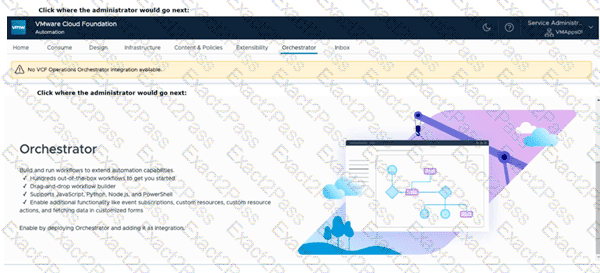
An administrator clicks on Orchestrator to create a workflow in a VM Apps organization as shown.
Where would the administrator go next to enable Orchestrator?
An administrator must initiate the deployment of a new 3-tier application architecture using the VMware Cloud Foundation (VCF) Automation portal. This application includes:
• A web tier (stateless).
• A business logic tier (some local caching).
• A database tier (stateful, PostgreSQL).
• An NSX load balancer fronting the web tier.
• ~99.9% uptime requirement.
• Moderate performance requirements.
Which requirement represents a risk inherent to single-zone deployments?
A development team submits the following requirements to the VMware Cloud Foundation (VCF) Automation administrator:
• Three-tier inventory system (web, application, and database).
• All components deployed as virtual machines (VMs).
• Static IP addresses required.
• NAT and load balancing for external access.
• Network segmentation between DMZ and internal tiers.
• The team requests to use the platform ' s managed PostgreSQL database service instead of maintaining their own database virtual machines.
Which organization type should the administrator configure to meet these requirements with minimal complexity?
A customer created a workflow to execute during machine provisioning in a VMApps Organization within VMware Cloud Foundation (VCF) Automation 9. The workflow includes inputs that interact with the provisioning-payload data. When a machine is requested, provisioning completes successfully, but the workflow does not run. What is the cause of the workflow-execution failure?
An administrator is tasked to implement a GitOps workflow to manage VMware Cloud Foundation (VCF) Automation blueprints and infrastructure deployment.
Which statement describes VCF Automation support for this use case?
A system administrator is tasked to create a region for use within an AIIApps organization. How would the administrator determine which vCenter Servers are available in the infrastructure?
An administrator is tasked with configuring a multi-tenant environment within the organization ' s VMware Cloud Foundation (VCF) deployment. Requirements are:
• isolated network spaces for development and testing.
• dedicated resources.
• role-based access control.
Which of the actions satisfies the requirement?
A customer has a requirement to register a resource with an external service during provisioning in a VMApps Organization. The requirements are:
• the registration cannot cause provisioning to fail.
• the registration or failure will only be logged in the external service.
What two constructs satisfy the requirements? (Choose two.)
The product development team is rolling out several new application stacks and require a self-service option to deploy their applications quickly and consistently. The requirements are:
• Present only approved application configurations.
• No manual configuration within a blueprint.
Which VMware Cloud Foundation (VCF) Automation approach meets these requirements?