Exact2Pass

Last Update 13 hours ago Total Questions : 57
The Advanced Design VMware NSX-T Data Center content is now fully updated, with all current exam questions added 13 hours ago. Deciding to include 3V0-42.20 practice exam questions in your study plan goes far beyond basic test preparation.
You'll find that our 3V0-42.20 exam questions frequently feature detailed scenarios and practical problem-solving exercises that directly mirror industry challenges. Engaging with these 3V0-42.20 sample sets allows you to effectively manage your time and pace yourself, giving you the ability to finish any Advanced Design VMware NSX-T Data Center practice test comfortably within the allotted time.
Which two benefits can be achieved using in-band management of an NSX Bare Metal Edge Node? (Choose two.)
Which three assessment findings are part of a Conceptual Design? (Choose three.)
Which is a family of solutions for data center designs that span compute, storage, networking, and management, serving as a blueprint for a customer’s Software Defined Data Center (SDDC) implementations? (Choose the best answer.)
An architect is helping an organization with the Conceptual Design of an NSX-T Data Center solution.
This information was gathered by the architect during the Discover Task of the Engagement Lifecycle:
There are applications which use IPv6 addressing.
Network administrators are not familiar with NSX-T Data Center solutions.
Hosts can only be configured with two physical NICs.
There is an existing management cluster to deploy the NSX-T components.
Dynamic routing should be configured between the physical and virtual network.
There is a storage array available to deploy NSX-T components.
Which risk was documented by the architect? (Choose the best answer.)
An architect is helping an organization with the Logical Design of an NSX-T Data Center solution. Which two statements should the architect consider as non-technical requirements? (Choose two.)
An architect is helping an organization with the Physical Design of an NSX-T Data Center solution.
This information was gathered during the Assessment Phase:
There is a critical application used by the Finance Team.
The critical application has an availability and recoverability SLA of 99.999%.
The critical application is sensitive to network changes.
Which two selections should an architect include in their design? (Choose two.)
Which three choices are non-functional requirements? (Choose three.)
What is a design justification for a solution with 3 NSX Manager nodes deployed in a 4 ESXi cluster Management Cluster? (Choose the best answer.)
An architect is helping an organization with the Logical Design of an NSX-T Data Center solution. This information was gathered during the Assessment Phase:
NSX-T will span across two sites for disaster recovery.
Public Load Balancer VIP should be accessible from a secondary site.
Distributed Firewall Policies should be available at a secondary site.
Routing capabilities should be maintained after failure.
NAT capabilities are required.
Which two selections should the architect include in their design? (Choose two.)
Refer to the exhibit.
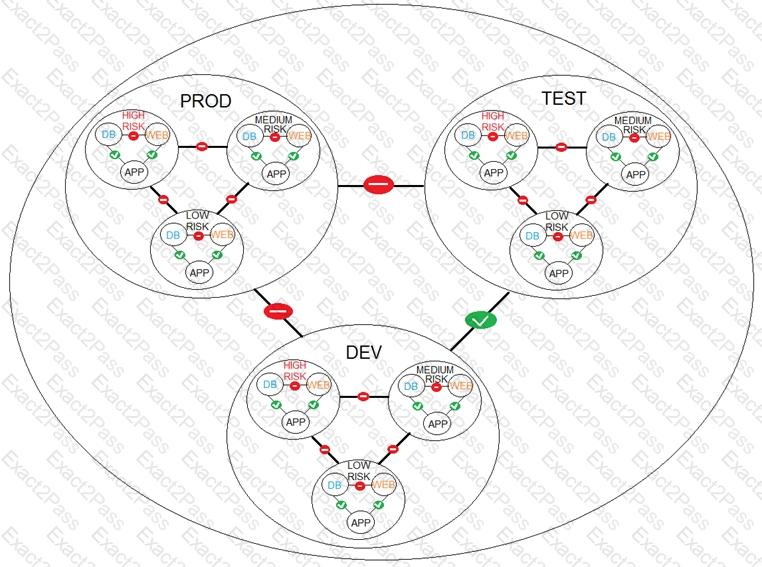
A financial company is adopting micro-services with the intent of simplifying network security. An NSX-T architect is proposing a NSX-T Data Center micro-segmentation logical design. The architect has created a diagram to share with the customer.
How many security levels will be implemented according to this Logical Design? (Choose the best answer.)

