Summer Sale Special Limited Time 70% Discount Offer - Ends in 0d 00h 00m 00s - Coupon code: buysanta

Exact2Pass Menu

Alcatel-Lucent Multi Protocol Label Switching

Last Update 2 hours ago Total Questions : 249

The Alcatel-Lucent Multi Protocol Label Switching content is now fully updated, with all current exam questions added 2 hours ago. Deciding to include 4A0-103 practice exam questions in your study plan goes far beyond basic test preparation.

You'll find that our 4A0-103 exam questions frequently feature detailed scenarios and practical problem-solving exercises that directly mirror industry challenges. Engaging with these 4A0-103 sample sets allows you to effectively manage your time and pace yourself, giving you the ability to finish any Alcatel-Lucent Multi Protocol Label Switching practice test comfortably within the allotted time.

Question # 11

Which of the following describes what happens when facility backup fast reroute is enabled for a LSP? Choose three answers.

A.

Each PLR will signal a bypass tunnel that avoids the next-hop node or link.

B.

When a failure occurs, the PLR will push an additional label onto the label stack and start forwarding traffic onto its bypass tunnel.

C.

The ingress router will include a RRO object in the path message to indicate the routers that should be PLRs and MPs along the protected path.

D.

The ingress router will set the local protection desired flag in the session attribute object of the path message to inform all routers along the protected LSP path to establish bypass tunnels.

E.

When the bypass tunnel is in use, the MP will include the RRO object in its PathErr message, with the local protection in use flag set to notify the ingress router that it is using the bypass tunnel.

Question # 12

When a device receives a labeled packet, which of the following can occur?

A.

The packet can only be forwarded as an unlabeled packet.

B.

The packet can be forwarded as a labeled or unlabeled packet, depending on the received label value.

C.

The packet can be forwarded as a labeled or unlabeled packet, depending on the destination IP address in the payload

D.

The packet can only be forwarded as a labeled packet.

Question # 13

Which of the following best describes downstream on demand label distribution?

A.

An LSR answers requests for label mappings immediately, without waiting for a label mapping from the next-hop.

B.

An LSR advertises label mappings to all peers for which it might be a next-hop for a given FEC.

C.

An LSR distributes a label mapping for a FEC when it has been requested to do so.

D.

An LSR propagates a label mapping downstream for a FEC. only if it has a label mapping for the FEC's next-hop.

Question # 14

On a point-to-point link, two directly connected routers set different interface hello timeout values. Router R1 uses 15 seconds, while router R2 uses 30 seconds. What happens to the LDP adjacency?

A.

The adjacency forms with the lower timeout value

B.

The "show router Idp session" command output displays the adjacency in state "init"

C.

The adjacency forms with the higher timeout value

D.

The adjacency times out after 30 seconds

Question # 15

Which of the following statements regarding RSVP-TE is FALSE?

A.

RSVP-TE operates in a downstream unsolicited label advertisement mode.

B.

RSVP-TE makes use of ordered control mode.

C.

RSVP-TE is an MPLS signaling protocol, based on the resource reservation protocol.

D.

RSVP-TE enables the establishment of explicitly routed LSPs that can be automatically routed away from network failures

E.

RSVP-TE supports explicitly routed LSPs using either loose or strict route definitions.

Question # 16

Which of the following statements best defines an LSP?

A.

An LSP is a bidirectional path across the MPLS domain.

B.

An LSP is a bidirectional path for a particular FEC across the MPLS domain.

C.

An LSP is a unidirectional path across the MPLS domain.

D.

An LSP is a bidirectional path between adjacent LSRs.

E.

An LSP is a unidirectional path between adjacent LSRs.

Question # 17

Click on the exhibit button below.

Under which condition might the peer LDP ID 10.10.10.2:0 entry show state "Nonexistent"?

A.

When the interface to the peer router is down.

B.

When router R1 has no route to the peer address 10.10.10.2.

C.

When the adjacency between the two routers fails.

D.

When the targeted session is not yet configured.

Question # 18

What MPLS function should be performed by a router that receives a data packet containing an MPLS label value of 3?

A.

A router will never receive a packet containing this label value.

B.

Request a new label from the peer that provided this label.

C.

Pop the label.

D.

PUSH an additional label onto the label stack.

E.

Signal a new label to the peer that sent the packet.

Question # 19

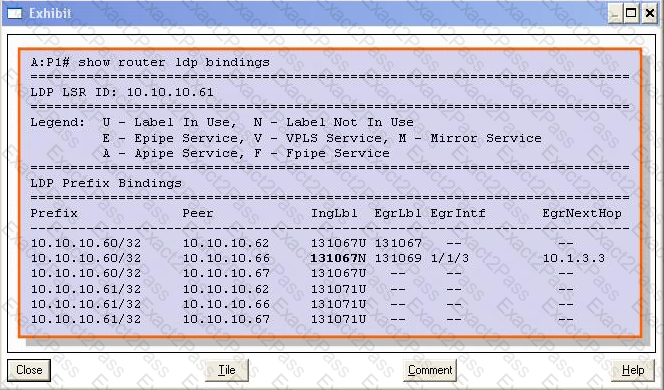
Click on the exhibit button below.

Consider the output shown; why is the label in bold font not in use?

A.

The router cannot do a SWAP of this label.

B.

The label does not match the egress label for the same FEC.

C.

The label is for a FEC for which the next-hop is the peer router

D.

The label was signaled in error.

Question # 20

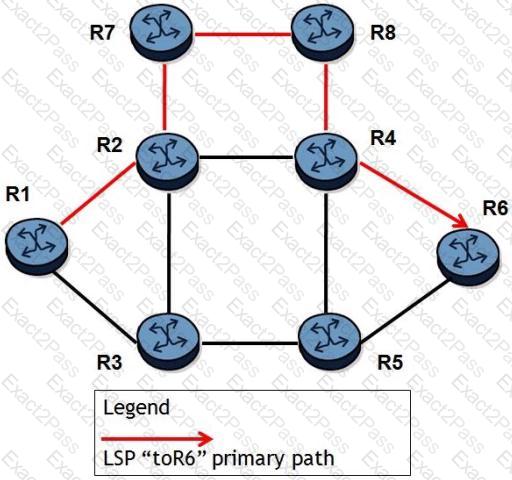
Click on the exhibit.

A fully loose LSP "toR6" is configured. All links have the same cost and all routers are Alcatel-Lucent 7750 SRs. The LSP currently traverses the path R1-R2-R7-R8-R4-R6 and the resignal timer is enabled. Which of the following about this LSP is FALSE?


A.

The LSP will switchover to another path if a failure occurs.

B.

The LSP will switchover to a better path as soon as it is available.

C.

CSPF must be enabled for this LSP to attempt to find a better path.

D.

The LSP will switchover to a better path in a MBB fashion.

Go to page: