Spring Sale Special Limited Time 70% Discount Offer - Ends in 0d 00h 00m 00s - Coupon code: buysanta

Exact2Pass Menu

Alcatel-Lucent Multi Protocol Label Switching

Last Update 22 hours ago Total Questions : 249

The Alcatel-Lucent Multi Protocol Label Switching content is now fully updated, with all current exam questions added 22 hours ago. Deciding to include 4A0-103 practice exam questions in your study plan goes far beyond basic test preparation.

You'll find that our 4A0-103 exam questions frequently feature detailed scenarios and practical problem-solving exercises that directly mirror industry challenges. Engaging with these 4A0-103 sample sets allows you to effectively manage your time and pace yourself, giving you the ability to finish any Alcatel-Lucent Multi Protocol Label Switching practice test comfortably within the allotted time.

Question # 61

Click on the exhibit.

All links are of equal cost. A CSPF-enabled LSP is configured on R1 to R6. Its fully loose primary path is configured with an "include green" statement and the fully loose secondary path is configured with an "include red" statement.

Which paths will be taken by this LSP?

A.

No primary path is established. The secondary path will take R1-R2-R4-R6.

B.

The primary path will take R1-R3-R5-R6. The secondary path will take R1-R2-R4-R6.

C.

The primary path will take R1-R2-R4-R6. No secondary path is established.

D.

The primary path will take R1-R2-R4-R6. The secondary path will take R1-R3-R5-R6.

Question # 62

Which of the following about RSVP-TE LSP configuration in a Alcatel-Lucent 7750 SR is TRUE?

A.

LSPs must always terminate on a system ID.

B.

MPLS and RSVP must be enabled on all LSRs.

C.

CSPF must be enabled.

D.

Path definitions must include at least one hop entry.

Question # 63

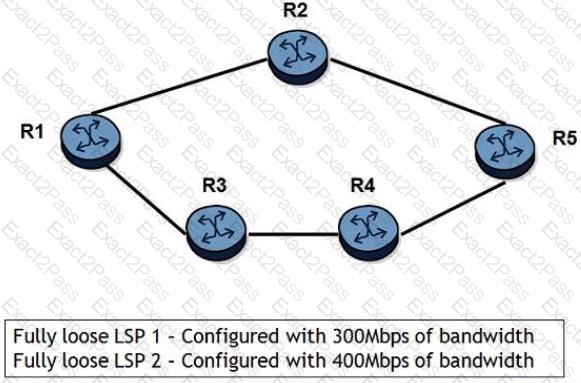
Click on the exhibit.

Initially, all links have 800Mbps of unreserved bandwidth. All links are of equal costs. Shared explicit reservation style is used. LSP 1 is signaled first with a setup and hold priority of 2. Then, LSP 2 is signaled with setup and hold priority of 5. Both LSPs go from R1 to R5. Which of the following is TRUE?

A.

LSP 1 will follow R1-R3-R4-R5. LSP 2 will follow R1-R2-R5.

B.

LSP1 will follow R1-R2-R5. LSP 2 will follow R1-R3-R4-R5.

C.

Both LSP 1 and LSP 2 will follow R1-R2-R5.

D.

Both LSP 1 and LSP 2 will follow R1-R3-R4-R5.

Question # 64

An LSP is configured with a fully loose path and CSPF is not enabled. An LSR receives the first PATH message for this LSP. Which of the following is NOT performed by the LSR?

A.

The LSR regenerates and forwards a new PATH message.

B.

The LSR stores the PATH message in the PSB.

C.

The LSR forwards the PATH message based on the HOP object in the RSB.

D.

The LSR looks up the PATH message's destination IP address in the FIB.

Question # 65

Which of the following best describes downstream unsolicited label distribution?

A.

An LSR may answer requests for label mappings immediately, without waiting for a label mapping from the next-hop.

B.

An LSR may advertise label mappings to all peers for which it might be a next-hop for a given FEC.

C.

An LSR propagates a label mapping downstream for a FEC, only if it has a label mapping for the FEC next-hop.

D.

An LSR will only distribute a label for a FEC when it has been requested to do so.

Question # 66

Which of the following about the use of RRO in fast reroute is FALSE?

A.

RRO is used to report the protection tunnel status to the head-end router.

B.

RRO contains the MP information that is required by a PLR for facility protection.

C.

RRO contains the label information that is expected by an MP for facility protection.

D.

RRO is used to inform downstream routers about the protection type requested.

Question # 67

Which of the following about Fast Reroute node protection tunnels is FALSE?

A.

Node protection tunnels detour around a failed next downstream router.

B.

Node protection tunnels can only be requested for a primary LSP path.

C.

Node protection tunnels are only used by one-to-one Fast Reroute.

D.

Link protection tunnels are established if a router is unable to establish node protection tunnels.

Question # 68

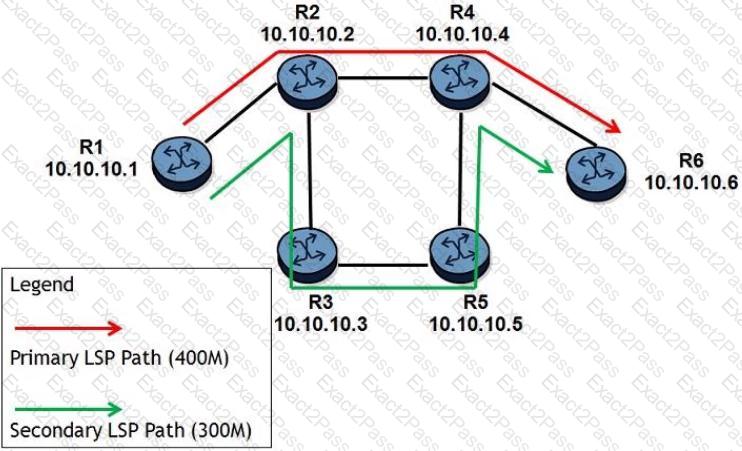
Click on the exhibit.

All links have 1Gbps unreserved bandwidth initially and Shared Explicit reservation style is used. After the LSP's primary and standby secondary paths are signaled, how much unreserved bandwidth is left on the links?

A.

R1-R2 will have 300Mbps left and R2-R4 will have 400Mbps left.

B.

R1-R2 will have 400Mbps left and R2-R4 will have 400Mbps left.

C.

R1-R2 will have 600Mbps left and R2-R4 will have 600Mbps left.

D.

R1-R2 will have 300Mbps left and R2-R4 will have 600Mbps left.

Question # 69

An Alcatel-Lucent 7750 SR has its TE update threshold enabled with the up threshold set to 40%. The maximum reservable bandwidth on the link is 200M and 30M have already been reserved. When will a TE update be sent on this link?

A.

When the reserved bandwidth goes above 80M.

B.

When the reserved bandwidth goes above 40M.

C.

When an additional 80M bandwidth is reserved.

D.

When an additional 40M bandwidth is reserved.

Question # 70

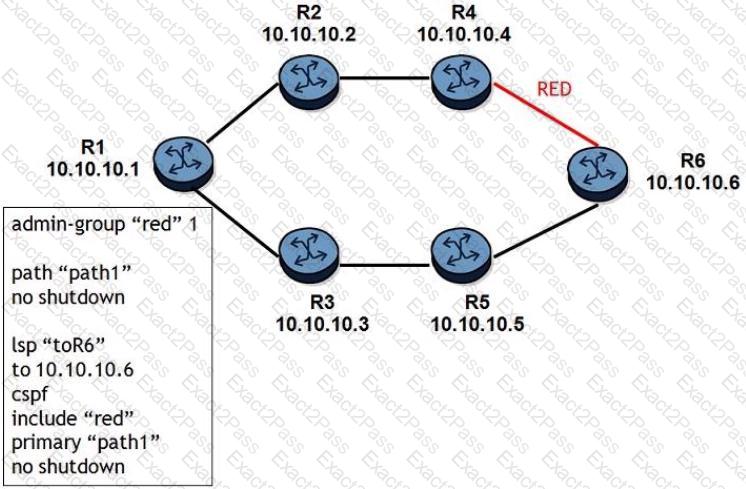
Click on the exhibit.

The link between routers R4 and R6 are configured with an admin group "red". What happens when the LSP is first signaled?


A.

The LSP will go through the path R1-R2-R4-R6.

B.

The LSP will go through the path R1-R3-R5-R6.

C.

The LSP is down because router R1 detects that no path can meet its constraints.

D.

The LSP is down because router R4 detects that no path can meet its constraints.

Go to page: