Spring Sale Special Limited Time 70% Discount Offer - Ends in 0d 00h 00m 00s - Coupon code: buysanta

Exact2Pass Menu

Nokia NRS II Composite Exam

Last Update 6 hours ago Total Questions : 852

The Nokia NRS II Composite Exam content is now fully updated, with all current exam questions added 6 hours ago. Deciding to include 4A0-C01 practice exam questions in your study plan goes far beyond basic test preparation.

You'll find that our 4A0-C01 exam questions frequently feature detailed scenarios and practical problem-solving exercises that directly mirror industry challenges. Engaging with these 4A0-C01 sample sets allows you to effectively manage your time and pace yourself, giving you the ability to finish any Nokia NRS II Composite Exam practice test comfortably within the allotted time.

Question # 141

A router running a link-state protocol sends an update to a neighbor. The neighbor sends an update back.

Why would the neighbor do this?

A.

The neighbor ' s link-state database has newer information than what it received in the update.

B.

The neighbor sends the update as an acknowledgement.

C.

The neighbor ' s update indicates that it has run out of space in its LSDB.

D.

The neighbor ' s update indicates that the sequence number received is the same as the one already in its link-state database.

Question # 142

Click on the exhibit.

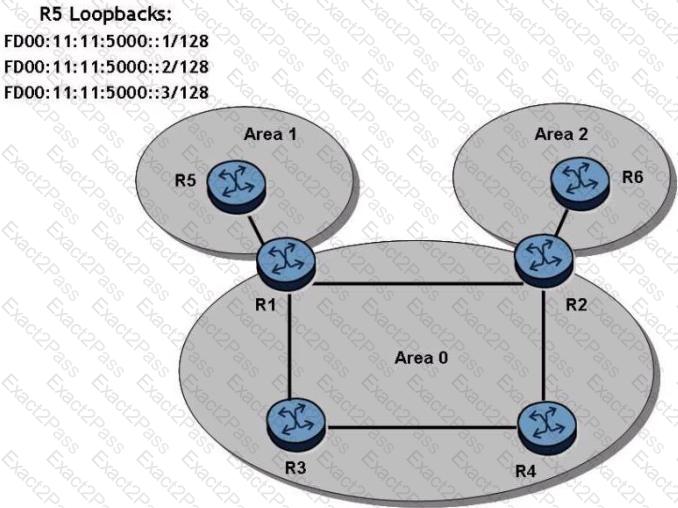
Router R5 is advertising the three loopbacks prefixes shown in OSPFv3. The following command is executed on router R1: R1# configure router ospf3 area 0 area-range FD00:11:11:5000:764.

Which of the following is TRUE regarding the OSPFv3 LSDB on R6?

A.

Router R6 will have a single Router LSA that describes the summary prefix.

B.

Router R6 will have three Router LSAs - one to describe each loopback prefix.

C.

Router R6 will have a single Inter-Area Prefix LSA to describe the summary prefix.

D.

Router R6 will have three Inter-Area Prefix LSAs - one to describe each loopback prefix.

E.

Router R6 will not have any LSAs to describe the loopback prefix or the summarized prefix.

Question # 143

Click on the exhibit.

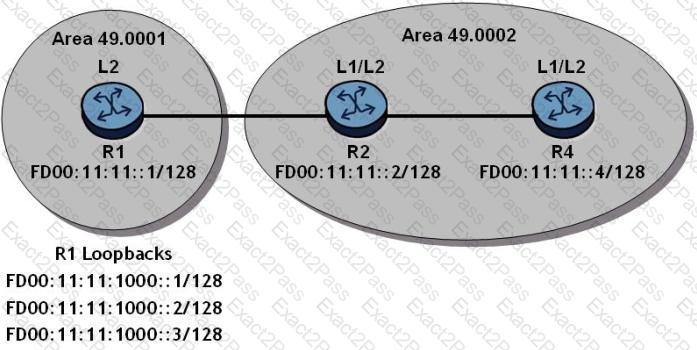
Router R1 distributes its globally routed address and its loopbacks into IS-IS. Routers R2 and R4 have their globally routed addresses in IS-IS.

How many routes will router R4 have in its IPv6 route table?

A.

2

B.

3

C.

4

D.

5

E.

6

F.

7

Question # 144

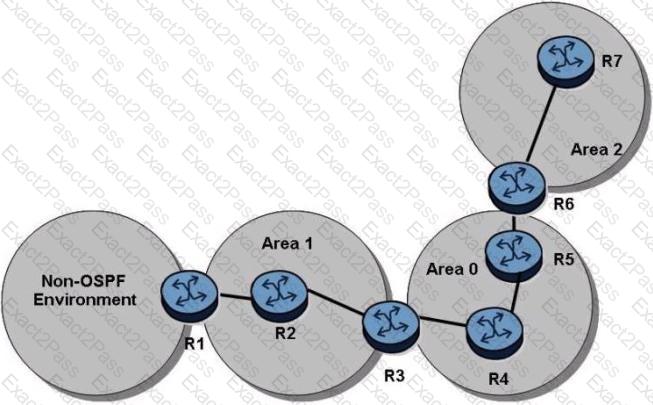
Click on the exhibit.

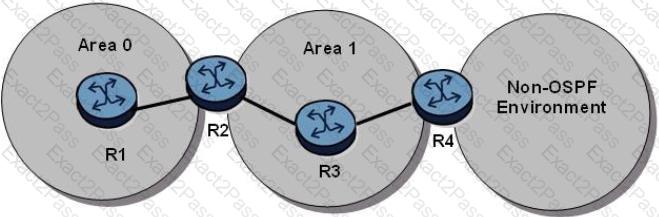
Router R4 is being added to the network and it is connected to a non-OSPF domain.

Which area type should be used for Area 1 to allow the external routes to be advertised into Area 0?

A.

Backbone

B.

NSSA

C.

Stub

D.

Totally stubby

Question # 145

Link-state PDUs include an age field. Which of the following is FALSE?

A.

When link-state information reaches the maximum age on a router, the router will flood that information to its neighbors.

B.

When a router detects that any of its link-state information has reached the maximum age, it will request a new update from the source router.

C.

Aging helps ensure that links, which are no longer part of the topology, will eventually get removed from the LSDB.

D.

The age value is updated as the information is flooded throughout the network and when it is in the LSDB.

Question # 146

What type of packet will cause an OSPF router to respond with a link-state request packet?

A.

Hello

B.

Link-state request

C.

Link-state acknowledgment

D.

Link-state update

E.

Database description

Question # 147

Which of the following describes the purpose of 6over4 tunneling?

A.

To give IPv6 traffic preferential routing over IPv4 routes.

B.

To allow core routers running only IPv6 protocols to carry IPv4 traffic.

C.

To give IPv4 only routers the ability to route based on IPv6 addresses.

D.

To allow IPv6 traffic to pass through an IPv4 network.

Question # 148

Click on the exhibit.

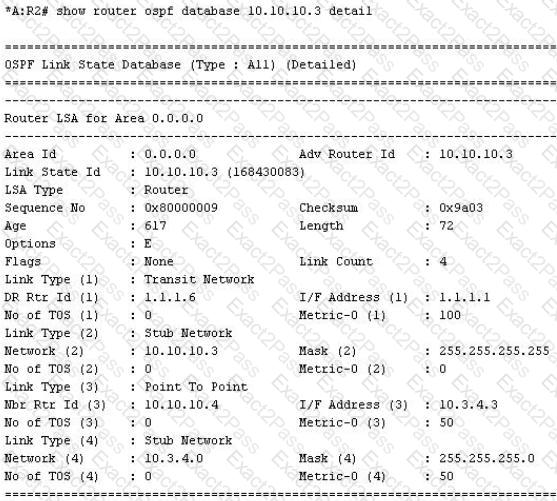
Given the contents of the Router LSA, which of the following best describes the local topology of the router?

A.

The router has a system interface, one point-to-point interface and one virtual link.

B.

The router has a system interface, one passive interface, one point-to-point interface and one virtual link.

C.

The router has a system interface, one point-to-point interface and one broadcast interface.

D.

The router has a system interface, one passive interface, one point-to-point interface and one broadcast interface.

Question # 149

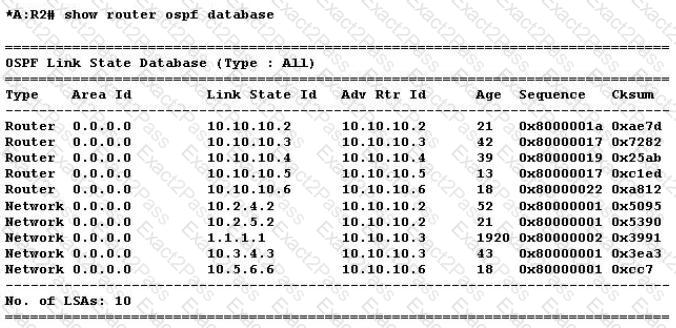
Click on the exhibit.

Given the output, which of the following is the most accurate statement about the network?

A.

There are five broadcast links and there are no point-to-point links.

B.

There are five broadcast links and there are five point-to-point links.

C.

There are five broadcast links. It ' s not possible to say how many point-to-point links there are.

D.

It ' s not possible to say how many broadcast or point-to-point links there are.

Question # 150

Click on the exhibit.

In the topology shown, router R1 is an ASBR configured to export external routes to OSPF. Assuming that there are no stub networks, which of the following statements regarding Type 5 LSA generation is TRUE?

A.

Router R1 generates a Type 5 LSA that is flooded to area 1 only.

B.

Router R1 generates a Type 5 LSA that is flooded to areas 1 and 0. Router R6 generates a Type 5 LSA that is flooded to area 2.

C.

Router R1 generates a Type 5 LSA that is flooded to areas 0.1, and 2.

D.

Router R3 generates a Type 5 LSA that is flooded to areas 0 and 2

E.

Type 5 LSAs are not generated in this network topology.

Question # 151

An OSPF adjacency is stuck in the exstart state. What is the most likely cause?

A.

The MTU does not match on both interfaces.

B.

OSPF is not enabled on one of the routers.

C.

The router ID is the same on both routers.

D.

An OSPF Hello has not been received from the neighbor.

E.

The interfaces are configured as point-to-point on one side and broadcast on the other.

Question # 152

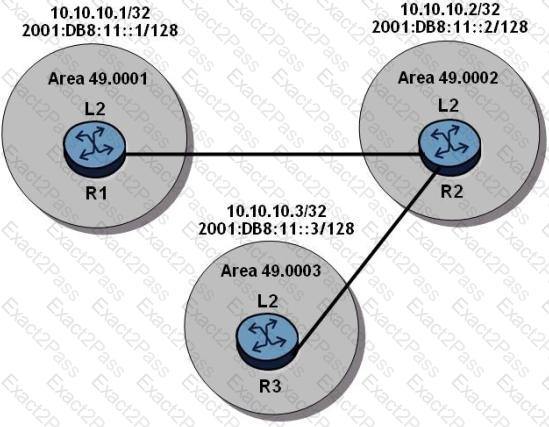
Click on the exhibit.

The routers have an established IS-IS L2 adjacency on which IPv4 system addresses are exchanged. An operator successfully configures multi-topology IS-IS routing so that the IPv6 system addresses are also exchanged between routers.

After IPv6 has been configured, which of the following is TRUE?

A.

Router R2 has two IS-IS-adjacencies and two LSPs.

B.

Router R2 has two IS-IS-adjacencies and four LSPs.

C.

Router R2 has two IS-IS-adjacencies and three LSPs.

D.

Router R2 has four IS-IS-adjacencies and six LSPs.

Question # 153

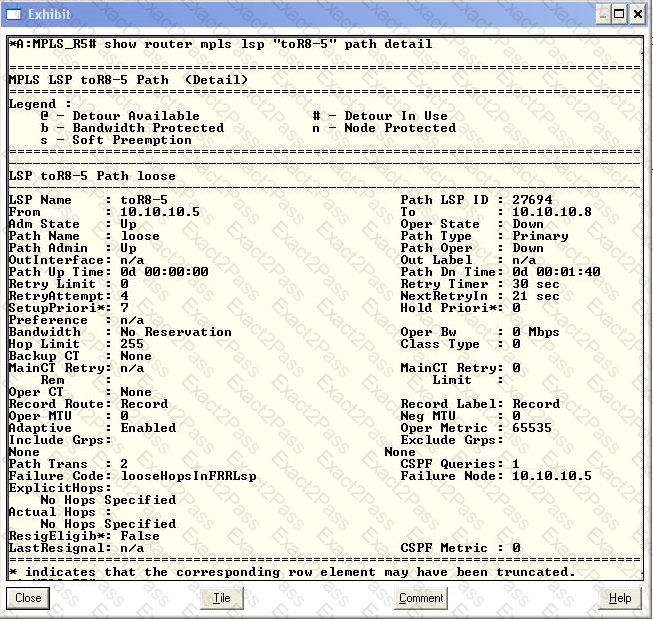
Click on the exhibit button below.

LSP " toR8-5 " requests fast reroute protection on the primary loose path. What could be done to remove the Failure Code shown?

A.

CSPF must be enabled at head-end on fast reroute protected loose path LSPs

B.

Fast reroute must first be enabled on the downstream routers.

C.

CSPF must be enabled on all downstream loose hop routers.

D.

Global revertive path optimization must be enabled so the path will be re-optimized around a failed node.

Question # 154

Which of the following statements is true when the implicit null is implemented?

A.

The penultimate router will POP the top label from the packets.

B.

The eLER will receive packets with a top label value of 3.

C.

The eLER will receive packets with a top label value of 0.

D.

The penultimate router will always receive unlabeled packets.

E.

The penultimate router performs a double lookup on the packet.

Question # 155

Which of the following are the default settings for the Alcatel-Lucent 7750 SR when using LDP?

A.

Ordered control mode; downstream on demand.

B.

Ordered control mode; downstream unsolicited.

C.

Independent control mode; downstream on demand.

D.

Independent control mode; downstream unsolicited.

Question # 156

Which of the following best describes constraint-based routing?

A.

A mechanism that implements opaque LSAs.

B.

A mechanism that computes routes based on defined user requirements.

C.

A mechanism that allows the IGP shortest path to be used.

D.

A mechanism that allows RSVP or LDP signaling to use a route other than the IGP best route to establish a LSP.

Question # 157

Which of the following are features of RSVP-TE? Choose three answers.

A.

It supports IGP-based LSPs.

B.

It supports constrained path LSPs.

C.

It does not support loose explicit path LSPs.

D.

It is recommended for use in Traffic Engineering applications.

E.

It cannot be used with facility backup fast reroute.

Question # 158

Which of the following TLV fields is included in an IS-IS Hello packet on broadcast interfaces but not on point-to-point interfaces?

A.

The area addresses TLV

B.

The intermediate system neighbors TLV

C.

The IP interface address TLV

D.

The authentication information TLV

Question # 159

How does an IS-IS router acknowledge the receipt of an IS-IS LSP on a point-to-point link?

A.

They are explicitly acknowledged by sending a CSNP to the sender identifying the LSP.

B.

They are implicitly acknowledged as a part of the link-state database synchronization and maintenance procedures.

C.

They are explicitly acknowledged by sending a PSNP to the sender identifying the LSP.

D.

They are implicitly acknowledged by the DIS multicast of CSNPs.

Question # 160

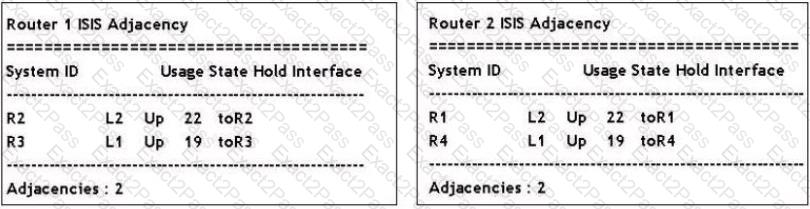
Click on the exhibit.

Assuming point-to-point links, which of the following is TRUE?

A.

Routers R1 and R2 are L2 routers. Routers R3 and R4 are L1/L2 routers.

B.

Routers R1, R2, and R4 are L1/L2 routers Router R3 is an L1 router.

C.

Routers R1, R2, and R3 are L2 routers. Router R4 is an L1 router.

D.

Routers R1 and R2 are L1/L2 routers. Routers R3 and R4 are L1 routers.

Go to page: