
Summer Sale Special Limited Time 70% Discount Offer - Ends in 0d 00h 00m 00s - Coupon code: buysanta

Exact2Pass Menu

SnowPro Advanced: Architect Certification Exam

Last Update 19 hours ago Total Questions : 182

The SnowPro Advanced: Architect Certification Exam content is now fully updated, with all current exam questions added 19 hours ago. Deciding to include ARA-C01 practice exam questions in your study plan goes far beyond basic test preparation.

You'll find that our ARA-C01 exam questions frequently feature detailed scenarios and practical problem-solving exercises that directly mirror industry challenges. Engaging with these ARA-C01 sample sets allows you to effectively manage your time and pace yourself, giving you the ability to finish any SnowPro Advanced: Architect Certification Exam practice test comfortably within the allotted time.

Question # 41

An Architect needs to design a Snowflake account and database strategy to store and analyze large amounts of structured and semi-structured data. There are many business units and departments within the company. The requirements are scalability, security, and cost efficiency.

What design should be used?

A.

Create a single Snowflake account and database for all data storage and analysis needs, regardless of data volume or complexity.

B.

Set up separate Snowflake accounts and databases for each department or business unit, to ensure data isolation and security.

C.

Use Snowflake ' s data lake functionality to store and analyze all data in a central location, without the need for structured schemas or indexes

D.

Use a centralized Snowflake database for core business data, and use separate databases for departmental or project-specific data.

Question # 42

An Architect needs to design a data unloading strategy for Snowflake, that will be used with the COPY INTO < location > command.

Which configuration is valid?

A.

Location of files: Snowflake internal location. File formats: CSV, XML. File encoding: UTF-8. Encryption: 128-bit

B.

Location of files: Amazon S3. File formats: CSV, JSON. File encoding: Latin-1 (ISO-8859). Encryption: 128-bit

C.

Location of files: Google Cloud Storage. File formats: Parquet. File encoding: UTF-8· Compression: gzip

D.

Location of files: Azure ADLS. File formats: JSON, XML, Avro, Parquet, ORC. Compression: bzip2. Encryption: User-supplied key

Question # 43

A user is executing the following command sequentially within a timeframe of 10 minutes from start to finish:

What would be the output of this query?

A.

Table T_SALES_CLONE successfully created.

B.

Time Travel data is not available for table T_SALES.

C.

The offset - > is not a valid clause in the clone operation.

D.

Syntax error line 1 at position 58 unexpected ' at’.

Question # 44

Which data models can be used when modeling tables in a Snowflake environment? (Select THREE).

A.

Graph model

B.

Dimensional/Kimball

C.

Data lake

D.

lnmon/3NF

E.

Bayesian hierarchical model

F.

Data vault

Question # 45

A company’s table, employees, was accidentally replaced with a new version.
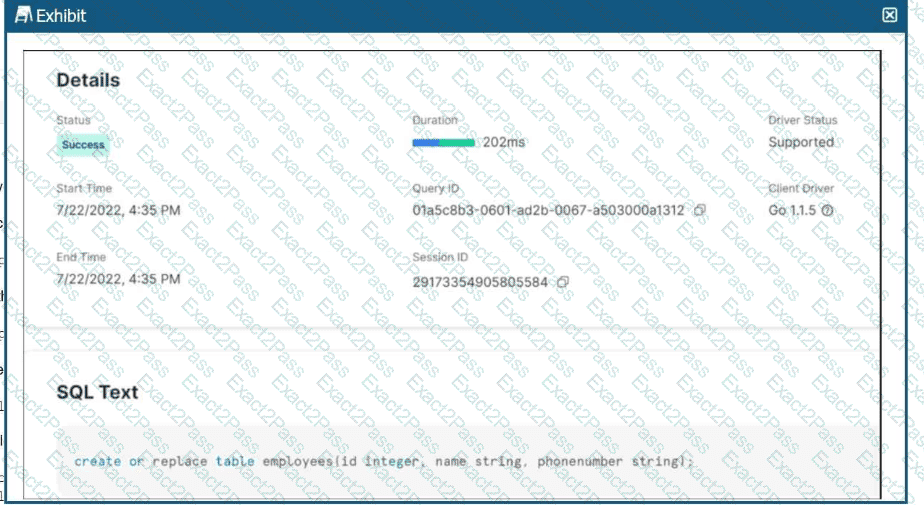
How can the original table be recovered with the LEAST operational overhead ?

A.

Use Time Travel to recover the data using this command:

SELECT *

FROM employees

BEFORE (STATEMENT = > ' 01a5c8b3-0601-ad2b-0067-a503000a1312 ' );

B.

Use Time Travel with a timestamp to recover the data using this command:

SELECT *

FROM employees

AT (TIMESTAMP = > ' 2022-07-22 16:35:00.000 -0700 ' ::TIMESTAMP_TZ);

C.

Revert to the original employees table using this command:

UNDROP TABLE employees;

D.

Rename the new employees table and undrop the original table using these commands:

ALTER TABLE employees RENAME TO employees_bad;

UNDROP TABLE employees;

Question # 46

An Architect is designing partitioned external tables for a Snowflake data lake. The data lake size may grow over time, and partition definitions may need to change in the future.

How can these requirements be met?

A.

Use the PARTITION BY ( < part_col_name > ) clause when creating the external table.

B.

Use partition_type = USER_SPECIFIED when creating the external table.

C.

Set METADATA$EXTERNAL_TABLE_PARTITION = MANUAL.

D.

Alter the table using ADD_PARTITION_COLUMN before defining a new partition column.

Question # 47

A company is designing high availability and disaster recovery plans and needs to maximize redundancy and minimize recovery time objectives for their critical application processes. Cost is not a concern as long as the solution is the best available. The plan so far consists of the following steps:

1. Deployment of Snowflake accounts on two different cloud providers.

2. Selection of cloud provider regions that are geographically far apart.

3. The Snowflake deployment will replicate the databases and account data between both cloud provider accounts.

4. Implementation of Snowflake client redirect.

What is the MOST cost-effective way to provide the HIGHEST uptime and LEAST application disruption if there is a service event?

A.

Connect the applications using the < organization_name > - < connection_name > URL. Use the Business Critical Snowflake edition.

B.

Connect the applications using the < organization_name > - < connection_name > URL. Use the Virtual Private Snowflake (VPS) edition.

C.

Connect the applications using the < organization_name > - < accountLocator > URL. Use the Enterprise Snowflake edition.

D.

Connect the applications using the < organization_name > - < accountLocator > URL. Use the Business Critical Snowflake edition.

Question # 48

There are two databases in an account, named fin_db and hr_db which contain payroll and employee data, respectively. Accountants and Analysts in the company require different permissions on the objects in these databases to perform their jobs. Accountants need read-write access to fin_db but only require read-only access to hr_db because the database is maintained by human resources personnel.

An Architect needs to create a read-only role for certain employees working in the human resources department.

Which permission sets must be granted to this role?

A.

USAGE on database hr_db, USAGE on all schemas in database hr_db, SELECT on all tables in database hr_db

B.

USAGE on database hr_db, SELECT on all schemas in database hr_db, SELECT on all tables in database hr_db

C.

MODIFY on database hr_db, USAGE on all schemas in database hr_db, USAGE on all tables in database hr_db

D.

USAGE on database hr_db, USAGE on all schemas in database hr_db, REFERENCES on all tables in database hr_db

Question # 49

Company A would like to share data in Snowflake with Company B. Company B is not on the same cloud platform as Company A.

What is required to allow data sharing between these two companies?

A.

Create a pipeline to write shared data to a cloud storage location in the target cloud provider.

B.

Ensure that all views are persisted, as views cannot be shared across cloud platforms.

C.

Setup data replication to the region and cloud platform where the consumer resides.

D.

Company A and Company B must agree to use a single cloud platform: Data sharing is only possible if the companies share the same cloud provider.

Question # 50

A company has a source system that provides JSON records for various loT operations. The JSON Is loading directly into a persistent table with a variant field. The data Is quickly growing to 100s of millions of records and performance to becoming an issue. There is a generic access pattern that Is used to filter on the create_date key within the variant field.

What can be done to improve performance?

A.

Alter the target table to Include additional fields pulled from the JSON records. This would Include a create_date field with a datatype of time stamp. When this field Is used in the filter, partition pruning will occur.

B.

Alter the target table to include additional fields pulled from the JSON records. This would include a create_date field with a datatype of varchar. When this field is used in the filter, partition pruning will occur.

C.

Validate the size of the warehouse being used. If the record count is approaching 100s of millions, size XL will be the minimum size required to process this amount of data.

D.

Incorporate the use of multiple tables partitioned by date ranges. When a user or process needs to query a particular date range, ensure the appropriate base table Is used.

Go to page:
