Exact2Pass

Last Update 1 hour ago Total Questions : 132
The ISTQB Certified Tester Advanced Level Test Analyst (CTAL-TA v4.0) content is now fully updated, with all current exam questions added 1 hour ago. Deciding to include CTAL-TA_V4.0 practice exam questions in your study plan goes far beyond basic test preparation.
You'll find that our CTAL-TA_V4.0 exam questions frequently feature detailed scenarios and practical problem-solving exercises that directly mirror industry challenges. Engaging with these CTAL-TA_V4.0 sample sets allows you to effectively manage your time and pace yourself, giving you the ability to finish any ISTQB Certified Tester Advanced Level Test Analyst (CTAL-TA v4.0) practice test comfortably within the allotted time.
During a sprint retrospective it was noted that some test cases were interpreted differently between the Product Owner and the Test Analysts. Which test case quality criteria may need some attention?
How is a Test Analyst involved in an Incremental SDLC model?
A savings bank rewards its customers a £100 bonus when they reach the age of 21, if they have held a savings account for more than 3 years and have at least £2,000 in the account at that time.
Assume that Age is measured in whole years, Account term in whole years and Account Balance to two decimal places (i.e., pounds and pence).
The rule can be expressed as follows:
IF Age = 21 AND Account term > 3 years AND Account balance > £2000.00 THEN Pay £100 bonus
You have a suite of test cases with the following values:
• TC1 Age=21, Account term=3 years, Account balance=£2000.00
• TC2 Age=20, Account term=6 years, Account balance=£500.00
• TC3 Age=20, Account term=2 years, Account balance=£3000.00
Which of the following test cases should you add to the suite to achieve 100% Reliable domain coverage?
In a sequential (V-model) software development lifecycle, at what point does test design and implementation take place?
Which test technique would be most suitable for testing a database application that supports adding and deleting data, and that also controls which users can view the data and which users can update it?
Your company, which specializes in medical software, has designed an application for use on smartphones and tablets, that calculates a person’s BMI (Body Mass Index). How can a test analyst BEST contribute to adaptability testing for this application?
You are designing test cases from the following state-transition diagram.
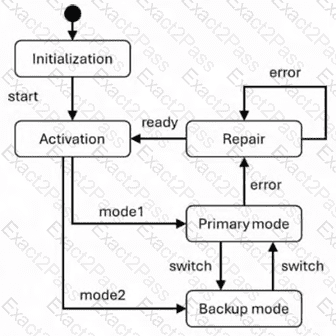
So far, the only test case designed is:
TC1: start, mode1, error, error, ready, mode1, switch, switch, switch, switch.
You use the ROUND-TRIP coverage approach. What round-trip coverage is achieved by this test case?
You are working on a project to replace an old sales and merchandising system with a new system that will be based on modern platforms. The old system is still in production but is poorly documented and expensive to maintain. The new version will be developed using modern technology. The main requirements for the system are that it shall:
1. Load sales data, sent electronically from the stores each evening, into a central database.
2. Produce actual sales reports for the merchandisers, whose job is to manage stock levels in stores.
3. Produce sales forecast reports based on a combination of sales history and forecasting parameters. The parameters will be entered by the merchandisers into a browser-based front end and the reports will be produced overnight. The users will be able to see the reports next day, on screen or in print, by requesting this through the browser.
Requirements 1 and 2 are satisfied by the existing system and will be rewritten with no significant changes. Requirement 3 is new and has been clearly specified.
The entry of forecasting parameters and of requests to see the reports will be low volume, but the Merchandising Manager is concerned about usability because the forecasting parameters are complex.
Which test charter would be BEST for the initial exploratory testing of requirement 3?
A credit risk scoring system accepts two integer inputs, L and E, representing credit scores calculated by two independent systems. The system assesses credit risk using the following business logic:
IF L > = 50 OR E > = 50 THEN the risk is high
IF L < = 49 AND E < = 49 THEN the risk is low
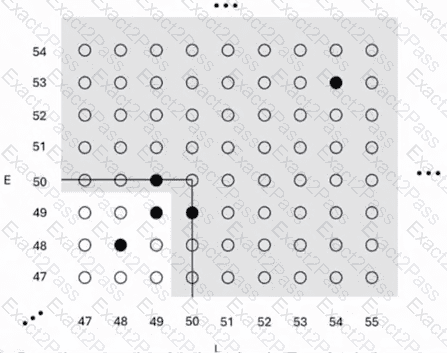
The figure displays a section of the input domain. Points in the gray area are part of the “high risk” equivalence partition, and points outside it are part of the “low risk” equivalence partition. The lines indicate the closed boundary of the “high risk” equivalence partition.
You use domain-based testing to verify the correct implementation of the above requirement. The test set contains the five black points in the figure: (L=48, E=48), (L=49, E=49), (L=49, E=50), (L=50, E=49), and (L=54, E=53).
What level of RELIABLE domain coverage does this set of test points achieve?
You have been working on minimizing a decision table. The full (unminimized) table had a checksum of 16. When you add up the checksum for your minimized table, you get 14 instead. What is the problem?