Exact2Pass

Last Update 1 hour ago Total Questions : 132
The ISTQB Certified Tester Advanced Level Test Analyst (CTAL-TA v4.0) content is now fully updated, with all current exam questions added 1 hour ago. Deciding to include CTAL-TA_V4.0 practice exam questions in your study plan goes far beyond basic test preparation.
You'll find that our CTAL-TA_V4.0 exam questions frequently feature detailed scenarios and practical problem-solving exercises that directly mirror industry challenges. Engaging with these CTAL-TA_V4.0 sample sets allows you to effectively manage your time and pace yourself, giving you the ability to finish any ISTQB Certified Tester Advanced Level Test Analyst (CTAL-TA v4.0) practice test comfortably within the allotted time.
You are testing a mobile application that has limited capabilities but must work in a wide variety of environments and connectivity situations. Which type of testing should you use to get a broad view of how the application will perform in the real world?
A Customer Relationship Management (CRM) system will be developed for a company that runs a chain of hotels. These are some of the requirements relating to staff in the call center.
• R1. High. An operator shall be able to find and see the details of a customer’s booking. The data that may be used for the search include customer name, customer registration number (in the company’s loyalty enrolment scheme) and booking reference.
• R2. High. An operator shall be able to amend a customer’s booking. The data that may be amended include check-in and check-out dates, hotel, room type and tariff (with / without breakfast).
• R3. High. Before a booking amendment is accepted, the system shall display to the operator any difference in price with respect to the original booking. The operator shall confirm that the customer accepts the revised price and then the system shall record the accepted amendment.
• R4. Medium. Details of the amended booking shall be sent to the customer (see requirements for original customer booking for details).
• R5. High. Details of the extra amount payable shall be sent to the billing system for customer invoicing (see requirements for invoicing of the original customer booking for details).
You have been asked to review these requirements using this checklist:
1. Specific - does each requirement deal with only a single aspect of the solution?
2. Clear - is each requirement expressed in an unambiguous way with no possibility of interpretation or uncertainty about its meaning?
3. Complete - does the set of requirements cover all of the stakeholders’ reasonable needs?
4. Unique - does each requirement address something that no other requirement also covers?
Assume that the other requirements referred to by R4 and R5 have been reviewed with a satisfactory outcome. Considering these five requirements, to which checklist items would you answer ‘No’?
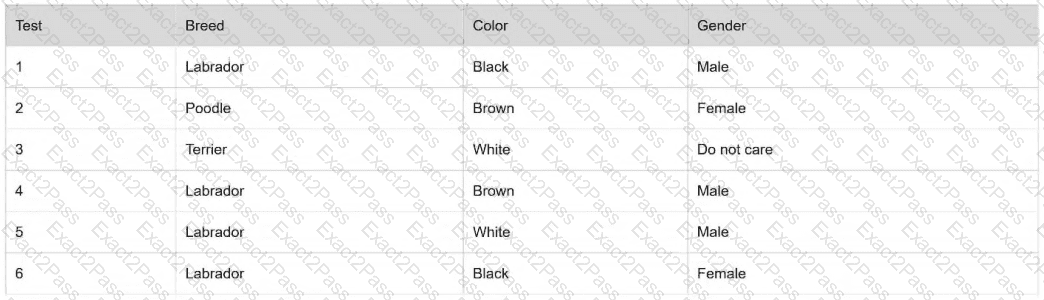
You are testing a website that lets people join a waiting list for a puppy. The following parameters are available:

Research indicates that a black male Labrador is the puppy selected most often. Based on this information, what is the best order of values for the first three test cases using pairwise coverage criteria?
Which category of tools provides traceability between test cases and test-basis elements?
You are testing an ATM application. The existing solution has been in production for several years, and it always required users to return to the menu between transaction types. A new requirement has just been introduced allowing users to go directly from Deposit to Withdraw. You have found the following state diagram in the requirements documentation:
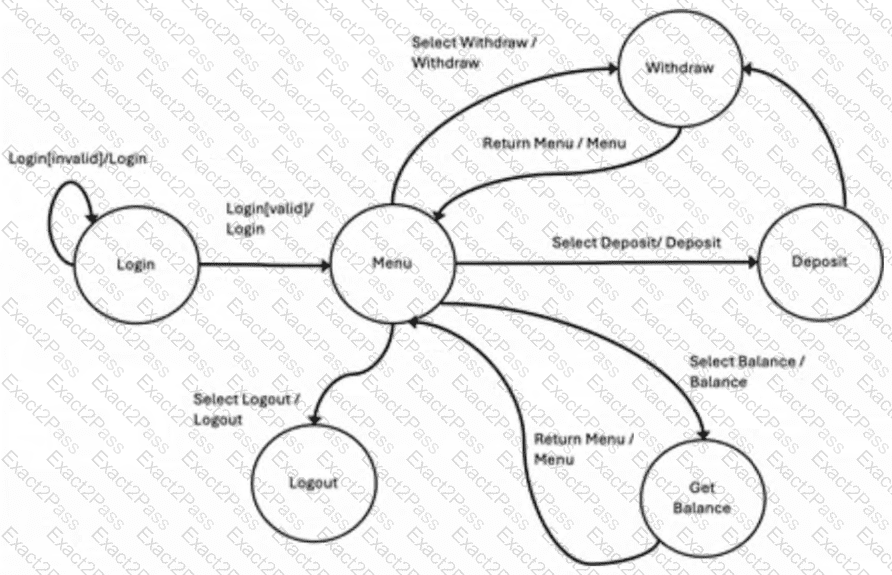
Given this change in requirements, there is an error in the diagram that could lead to an incorrect implementation of the software. What is that error?
You are working on a project to build a purchasing system. The main requirements for the system are that it shall:
1. Allow users to enter details of items that they wish to have purchased and, from these details, create a purchase request.
2. Take each purchase request through a workflow that will allow the requestor’s line manager to approve the request, reject it or return it for clarification / modification.
3. Forward approved requests to the Purchasing Department.
4. Allow purchasers to find the best available supplier for each approved request and place the request on that supplier as a purchase order.
The solution is being developed according to the company’s traditional V-model methodology. The requirements are clearly documented and include a business process model. Operational profiles have been created to guide performance testing.
Initial item entry will involve a check that each item entered exists on the master stock file and that the user is entitled to request it (this depends on user role and grade). Line manager authorization will be assisted by a recommendation made by the system according to relevant business rules, although the manager can override this recommendation. For approved requests, the workflow will continue to support the process through to placing of the purchase order.
Planning has begun for system testing and the Test Manager has asked you, the senior TA, to help with it. What would be the MOST effective techniques for functional testing of this project?
a) Combinatorial testing
b) Random testing
c) CRUD testing
d) State transition testing
e) Scenario-based testing
f) Decision table testing
g) Exploratory testing
A system will be developed to support the administration of table-tennis tournaments. The following requirements for the enrolment of entrants have been provided:
R1. High. The administrator shall be able to enter the entrant ' s name, address, phone number/s (mobile and/or home), email and social media handles. Validation rules for these data items are provided separately.
R2. High. The administrator shall be able to enter the entrant’s current world ranking (up to 250) and their relationship with the tournament sponsors (i.e. clothing / equipment / endorsement).
R3. High. The administrator shall be able to enter the entrant’s attendance history at previous events (i.e. finalist / played / withdrew during event / withdrew before event).
R4. Medium. From the entrant’s address the system shall derive whether or not the entrant lives locally and, on the basis of that combined with other rules that are provided separately, shall suggest how much of the tournament’s overall prize fund should be offered to the entrant as their individual attendance fee.
R5. Low. The administrator should be able to change the suggested attendance fee and the system should then deduct this from the remaining prize fund balance accordingly.
You have been asked to review the requirements using perspective-based reading, from your viewpoint as the TA who will be writing functional correctness system test cases. Assume that the other rules referred to by requirements R1 and R4 have been reviewed and are satisfactorily testable. Which conclusion would you reach?
The test basis for your latest project contains the activity diagram that is shown below. The business architect has confirmed that this model has been reviewed and approved by the stakeholders.
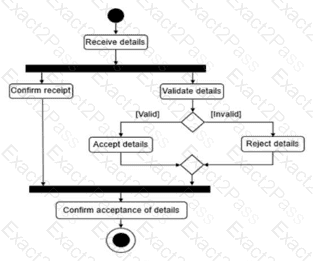
Which of the following conclusions is correct?
You are testing an online banking application. The following features have been implemented and are ready to be tested:
Funds transfer: lets you transfer funds between accounts at the bank.
Transaction history: shows a list of the last 10 transactions.
Account balance: shows the current balance for each account.
Your task, as a test analyst, is to create a test charter for a 2-hour session to assess the functionality of the funds transfer function, with a focus on basic scenarios and usability aspects.
Your test charter currently appears as follows:
> Test the correctness of transfers
> Using the data: account number, account balance, transfer amount
> To discover a potential violation of the rules of correct transfer
> Scope of testing: ...
What would be MOST useful to include as part of the test scope in this test charter?