Exact2Pass

Last Update 50 minutes ago Total Questions : 132
The ISTQB Certified Tester Advanced Level Test Analyst (CTAL-TA v4.0) content is now fully updated, with all current exam questions added 50 minutes ago. Deciding to include CTAL-TA_V4.0 practice exam questions in your study plan goes far beyond basic test preparation.
You'll find that our CTAL-TA_V4.0 exam questions frequently feature detailed scenarios and practical problem-solving exercises that directly mirror industry challenges. Engaging with these CTAL-TA_V4.0 sample sets allows you to effectively manage your time and pace yourself, giving you the ability to finish any ISTQB Certified Tester Advanced Level Test Analyst (CTAL-TA v4.0) practice test comfortably within the allotted time.
Which of the following is not an example of a test analyst’s contribution to defect prevention?
A route-finding application takes a starting point, an ending point, and a map containing information about one-way streets as inputs. It returns the length, in meters, of the shortest possible route.
You want to verify this system’s correctness with metamorphic testing using these two metamorphic relations:
MR1: For a route from point A to point B, changing one or more one-way streets to two-way streets cannot increase the route length.
MR2: For a map and points A, B, and C, the route length from A to C cannot exceed the combined lengths of the routes from A to B and from B to C.
You have two source test cases:
TC1: Start: P1, end: P2, one-way streets: S1, S2, S3. Result: route length = 1680 m.
TC2: Start: P2, end: P3, one-way streets: S1, S2, S3. Result: route length = 400 m.
Which test case exposes a system failure caused by violating metamorphic relation MR1 or MR2?
Why does classifying defects aid root cause analysis?
What is a common problem associated with using a pseudo-oracle in testing?
You intend to test a computer game across several configurations. A configuration includes:
operating system (2 possible values: Windows 10, Windows 11)
browser (3 possible values: Edge, Chrome, Firefox)
RAM type (3 possible values: 16 GB, 32 GB, 64 GB)
You apply pairwise testing. So far, you have designed these test cases:
TC1: Windows 10, Edge, 64 GB -
TC2: Windows 11, Chrome, 32 GB -
TC3: Windows 10, Firefox, 64 GB -
TC4: Windows 10, Firefox, 16 GB -
TC5: Windows 11, Chrome, 64 GB -
TC6: Windows 11, Edge, 32 GB -
What is the MINIMUM number of test cases that must be added to the existing six test cases so that the resulting test set attains 100% pairwise coverage?
Your regression test suite contains five test cases, TC1–TC5. They cover use-case scenarios UC1–UC10 as follows:
TC1 covers UC1, UC2, UC3, UC4, UC5, UC6, UC7, UC8
TC2 covers UC7, UC8
TC3 covers UC2, UC4, UC6, UC7
TC4 covers UC10
TC5 covers UC5, UC8, UC9
The system has three components: C1, C2, and C3.
C1 implements UC1, UC2, UC3, and UC4.
C2 implements UC5, UC6, and UC7.
C3 implements UC8, UC9, and UC10.
The latest project iteration refactored component C3. Your organization follows a scenario-coverage-based regression test-selection strategy.
Because of time constraints, only two regression tests can be run. Which TWO test cases should be executed?
Choose two
Which of the following is a true statement regarding test environments?
You are assigned to an Agile team as a Test Analyst. In most ways, the team seems to be working well. Iteration planning goes smoothly because the user stories are good quality. Most defects that are found by testing are fixed in the same iteration and those that do go live are not causing significant dissatisfaction amongst stakeholders. However, the team is unhappy because the Defect Removal Efficiency rate, measured for each iteration, is less than 80%.
What would be the MOST effective contribution by you as a TA, to improve the situation?
What testing do test analysts carry out when verifying that the system complies with accessibility standards such as WCAG?
You are testing a beverage vending machine. The beverage costs $1. The machine accepts 25c, 50c, and $1 coins. When the total value of inserted coins is equal to or greater than the beverage price, the system dispenses the beverage and returns any change. However, if it cannot dispense change because it lacks coins, or if the user presses Cancel, the system does not dispense the beverage and returns the inserted coins.
You use a keyword-based approach and have the following keywords available.
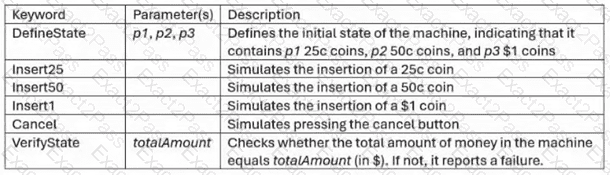
Consider this keyword-based test script used to execute a particular test scenario.
DefineState(1,1,1)
Insert25
Cancel
Insert50
Insert50
Which keyword should end this test script?