Exact2Pass

Last Update 15 hours ago Total Questions : 65
The SnowPro Advanced: Data Analyst Exam content is now fully updated, with all current exam questions added 15 hours ago. Deciding to include DAA-C01 practice exam questions in your study plan goes far beyond basic test preparation.
You'll find that our DAA-C01 exam questions frequently feature detailed scenarios and practical problem-solving exercises that directly mirror industry challenges. Engaging with these DAA-C01 sample sets allows you to effectively manage your time and pace yourself, giving you the ability to finish any SnowPro Advanced: Data Analyst Exam practice test comfortably within the allotted time.
A company is looking for new headquarters and wants to minimize the distances employees have to commute. The company has geographic data on employees ' residences. Through the Snowflake Marketplace, the company obtained geographic data for possible locations of the new headquarters. How can the distance between an employee ' s residence and potential headquarters locations be calculated in meters with the LEAST operational overhead?
What functionalities are available when a Snowflake worksheet is shared with other users? (Select TWO).
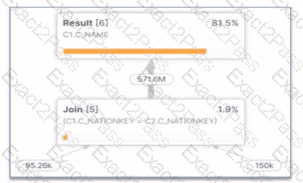
What potential problem can be identified in the Query profile below?
What functions should a Data Analyst use to run descriptive analytics on a data set? (Select TWO).
A Data Analyst created a cost overview dashboard in Snowsight. Management has asked for a system date filter to easily change the time period and refresh the data in all dashboard tiles with a single filter selection.
The system date filter is shown below:
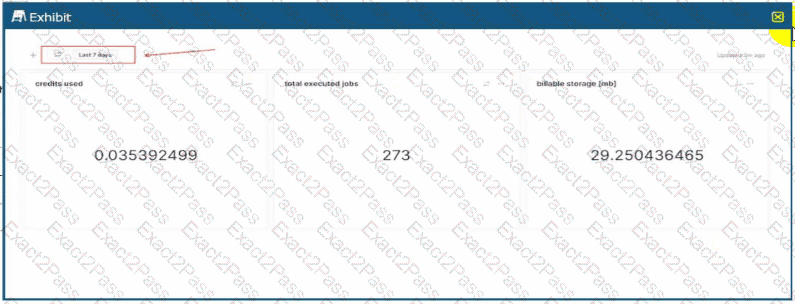
The Analyst wants to apply the filter onto individual dashboard components.
Adding which where clause to the queries will apply the filter as required?
This query is run:
SQL
SELECT
customer.id,
ANY_VALUE(customer.name),
SUM(orders.value)
FROM customer
JOIN orders ON customer.id = orders.customer_id
GROUP BY customer.id;
What is the effect of ANY_VALUE in this syntax?
A Data Analyst for a ride-sharing company needs to assess the relationship between the number of active drivers in a city, and the average waiting time for passengers. Which query will determine if an increase in the number of active drivers is associated with a decrease in the average waiting time?
A single variant data column table RAW_SOURCE has the following JSON records:

A Data Analyst needs to get the value of the " f " field and have it in a consumable, tabular format. Which query should be used to meet this requirement?
While loading data into Snowflake using named file formats, a file format defined in which location has precedence?

