Exact2Pass

Last Update 21 hours ago Total Questions : 61
The Associate – Networking Version 2.0?(DCA) content is now fully updated, with all current exam questions added 21 hours ago. Deciding to include DEA-5TT2 practice exam questions in your study plan goes far beyond basic test preparation.
You'll find that our DEA-5TT2 exam questions frequently feature detailed scenarios and practical problem-solving exercises that directly mirror industry challenges. Engaging with these DEA-5TT2 sample sets allows you to effectively manage your time and pace yourself, giving you the ability to finish any Associate – Networking Version 2.0?(DCA) practice test comfortably within the allotted time.
Which option is used to configure Network Address Translation (NAT) to provide one-to-one mapping between local and global addresses?
On which OSI layers do standard ACL filters operate?
Which type of domains are connected by a Layer 2 switch?
An Ethernet switch receives a frame from a directly connected host. The source MAC address of the frame is not present in the MAC address table for the switch. However, the destination address is present in the MAC address table.
What does the switch do with the frame?
Refer to the exhibit.
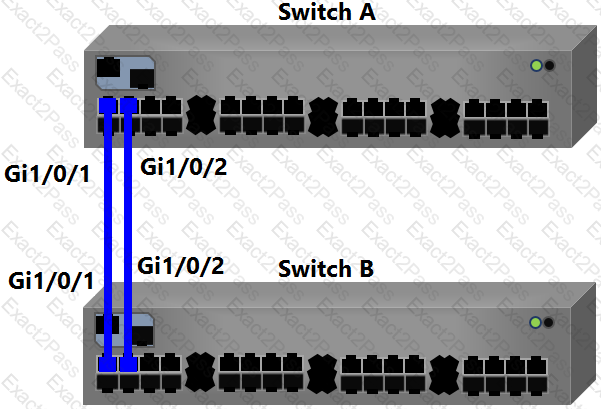
Switch A and Switch B are connected to each other. Both switches use interfaces Gi1/0/1 and Gi1/0/2. Switch A has a Spanning Tree priority of 8192 and Switch B has the default priority. Which interface becomes the root port?
You recently joined a company as a junior-level network administrator. You have been tasked with designing the IPv4 scheme for five networks that will be used for training classrooms. These networks need to support no more than 28 devices each. Due to the existing network design, the senior-level network administrator has asked you to work on network 192.168.40.0/24.
If all networks must be made to logically start with the lowest numbered network and end with the largest numbered network, what is the network ID for the third network?
Which message is sent by a router when TTL expires?
On Switch A, a static route has been redistributed into OSPF. Which type of OSPF router will this process make Switch A?
What accurately describes the comparison between stacking and VLT?
Which formula is used for calculating OSPF interface costs?

