Exact2Pass

Last Update 13 hours ago Total Questions : 47
The Fortinet NSE 6 - LAN Edge 7.6 Architect content is now fully updated, with all current exam questions added 13 hours ago. Deciding to include FCSS_LED_AR-7.6 practice exam questions in your study plan goes far beyond basic test preparation.
You'll find that our FCSS_LED_AR-7.6 exam questions frequently feature detailed scenarios and practical problem-solving exercises that directly mirror industry challenges. Engaging with these FCSS_LED_AR-7.6 sample sets allows you to effectively manage your time and pace yourself, giving you the ability to finish any Fortinet NSE 6 - LAN Edge 7.6 Architect practice test comfortably within the allotted time.
What is the expected behavior when enabling auto TX power control on a FortiAP interface?
Refer to the exhibits.
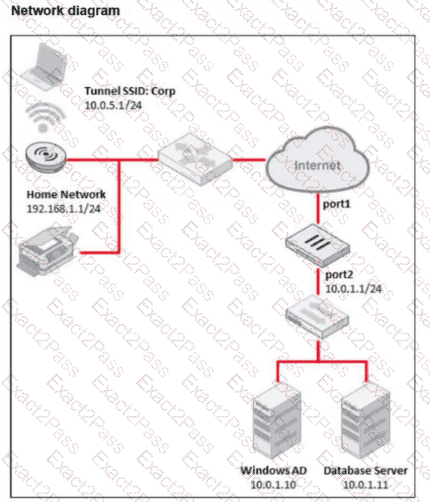
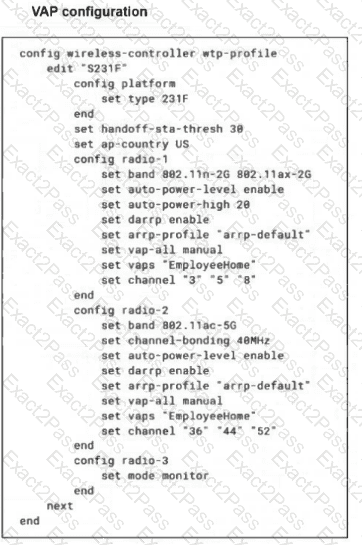
The exhibits show the WTP profile and VAP CLI configurations on FortiGate managing a remote AP. The AP is designed to grant a remote employee access to company network resources, including the database and AD servers. The employee can reach company resources but is unable to access a local printer at home. What two solutions are required to fix this issue? (Choose two answers)
Refer to the exhibits to analyze a network topology and SSID settings.
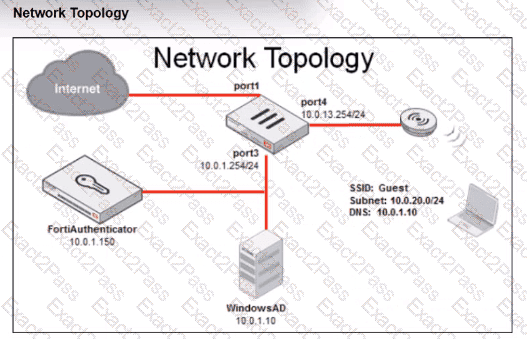
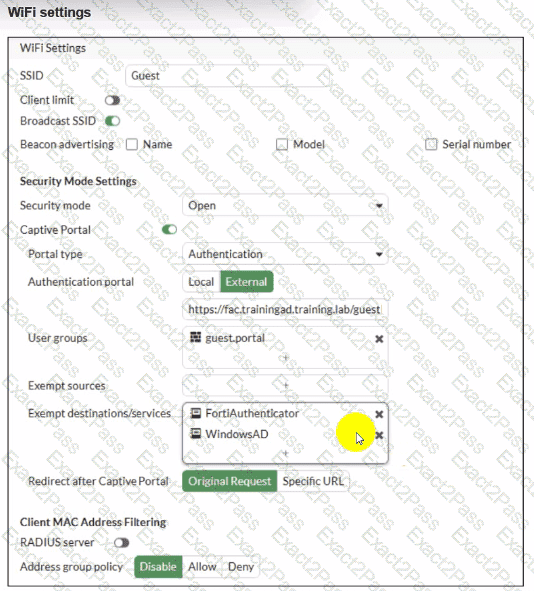
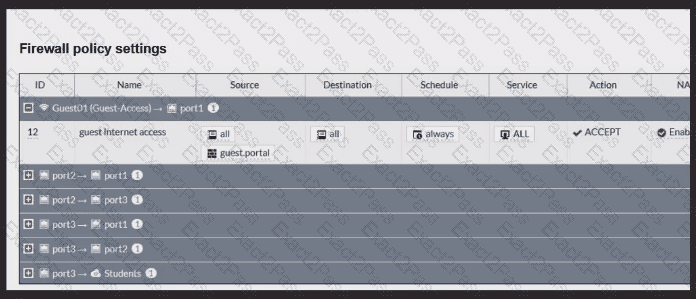
FortiGate is configured to use an external captive portal for authentication to grant access to a wireless network. Testing detected that users attempting to access the SSID are not able to access the captive portal login page. Which configuration change should fix this issue?
Which FortiGuard licenses are required for FortiLink device detection to enable device identification and vulnerability detection?
Refer to the exhibit.
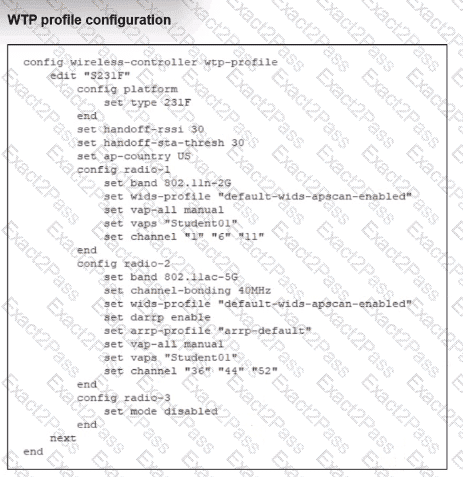
Which shows the WTP profile configuration.
The AP profile is assigned to two FAP-231F APs that are installed in an open plan area.
The first AP has 32 clients associated with the 5 GHz radios and 22 clients associated with the 2.4 GHz radio. The second AP has 12 clients associated with the 5 GHz radios and 20 clients associated with the 2.4 GHz radio.
A dual-band-capable client enters the area near the first AP and the first AP measures the new client at - 3 3 dBm signal strength. The second AP measures the new client at -43 dBm signal strength.
If the new client attempts to conned to the student 01 wireless network, which AP radio will the client be associated with?
Refer to the exhibits.
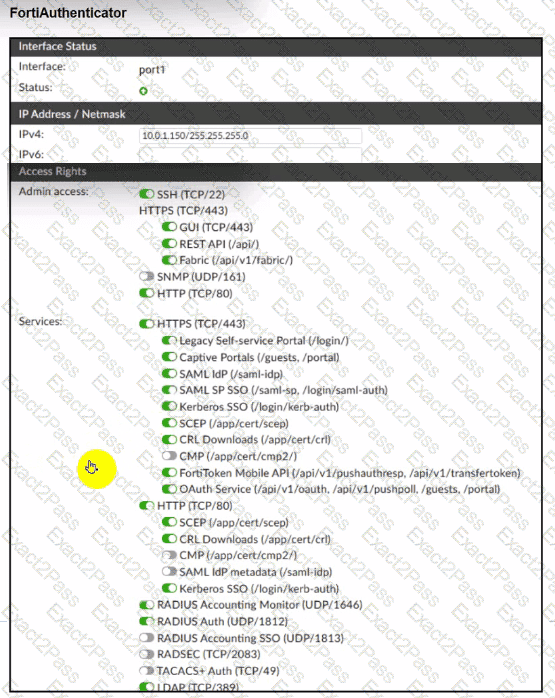
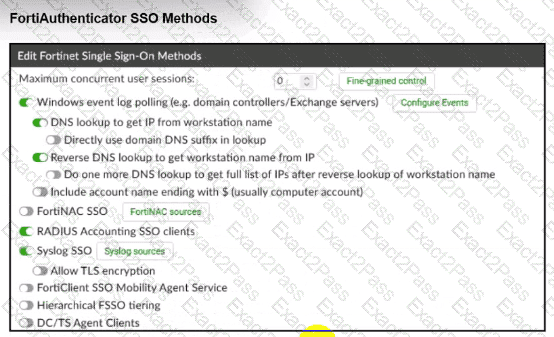
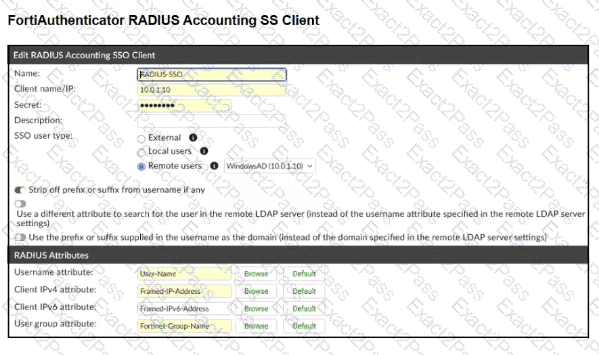
A company has multiple FortiGate devices deployed and wants to centralize user authentication and authorization. The administrator decides to use FortiAuthenticator to convert RSSO messages to FSSO, allowing all FortiGate devices to receive user authentication updates.
After configuring FortiAuthenticator to receive RADIUS accounting messages, users can authenticate, but FortiGate does not enforce the correct policies based on user groups. Upon investigation, the administrator discovers that FortiAuthenticator is receiving RADIUS accounting messages from the RADIUS server and successfully queries LDAP for user group information. But, FSSO updates are not being sent to FortiGate devices and FortiGate firewall policies based on FSSO user groups are not being applied.
What is the most likely reason FortiGate is not receiving FSSO updates?
What is the primary function of FortiLink NAC in a LAN environment?
In a Windows environment using AD machine authentication, how does FortiAuthenticator ensure that a previously authenticated device is maintaining its network access once the device resumes operating after sleep or hibernation?
Refer to the exhibits.
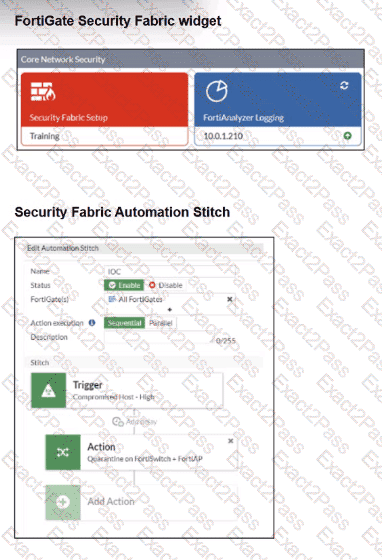
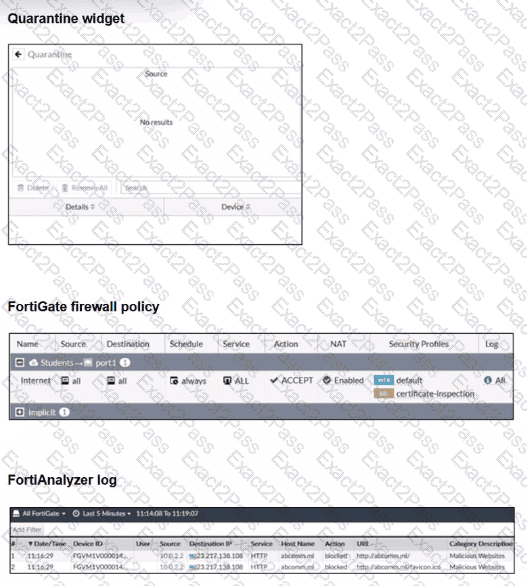
Examine the FortiGate configuration, FortiAnalyzer logs, and FortiGate widget shown in the exhibits.
Security Fabhc quarantine automation has been configured to isolate compromised devices automatically. FortiAnalyzer has been added to the Security Fabric, and an automation stitch has been configured to quarantine compromised devices.
To test the setup, a device with the IP address 10.0.2.1 that is connected through a managed FortiSwitch attempts to access a malicious website. The logs on FortiAnalyzer confirm that the event was recorded, but the device does not appear in the FortiGate quarantine widget.
Which two reasons could explain why FortiGate is not quarantining the device? (Choose two.)
Connectivity tests are being performed on a newly configured VLAN. The VLAN is configured on a FortiSwitch device that is managed by FortiGate. During testing, it is observed that devices
within the VLAN can successfully ping FortiGate. and FortiGate can also ping these devices.
Inter-VLAN communication is working as expected. However, devices within the same VLAN are unable to communicate with each other.
What could be causing this issue?

