Summer Sale Special Limited Time 70% Discount Offer - Ends in 0d 00h 00m 00s - Coupon code: buysanta

Exact2Pass Menu

HCIE-WLAN (Written) V1.0

Last Update 9 hours ago Total Questions : 163

The HCIE-WLAN (Written) V1.0 content is now fully updated, with all current exam questions added 9 hours ago. Deciding to include H12-351_V1.0 practice exam questions in your study plan goes far beyond basic test preparation.

You'll find that our H12-351_V1.0 exam questions frequently feature detailed scenarios and practical problem-solving exercises that directly mirror industry challenges. Engaging with these H12-351_V1.0 sample sets allows you to effectively manage your time and pace yourself, giving you the ability to finish any HCIE-WLAN (Written) V1.0 practice test comfortably within the allotted time.

Question # 11

Which of the following statements is false about weak-signal coverage evaluation on Campuslnsight?

A.

Choose Issue Analysis > Weak-Signal Coverage > Original Issue List to view information about all APs affected by weak-signal coverage issues in the current time window.

B.

Collect signal strength statistics of access clients on each AP. If the majority of access clients on an AP suffer from weak signal strength for a long period, a weak-coverage issue is detected.

C.

Display the overview and distribution of APs affected by weak-signal coverage issues, including the number of affected APs and clients.

D.

Through client journey playback, you can check whether a weak-signal coverage issue occurs when a client connects to an AP.

Question # 12

During a project lifecycle, the______ document needs to be output after the high level design be output after the low level design is complete. (Enter the acronyms in capital letters.)

Question # 13

Which of the followings is not a roaming optimization solution?

A.

Proactive roaming

B.

Smart roaming

C.

Fast roaming using PMK caching

D.

802.11r roaming

Question # 14

When calculating the number of APs, you can divide the total required bandwidth by the maximum bandwidth of a single AP.

A.

True

B.

False

Question # 15

Assume that two sites are 3 km away from each other in a project To implement data backhaul between the two sites, which of the following information needs to be collected by engineers?

A.

Use of 2.4 GHz channels between the two sites

B.

Use of 5 GHz channels between the two sites

C.

Bandwidth requirement

D.

Information about obstacles between the sites

Question # 16

Sticky STAs stick to the initially associated APs. Even if the STAs are far away from the currently associated AP, have weak signals, or have low rates, they will not roam to neighboring APs with better signals.

A.

TRUE

B.

FALSE

Question # 17

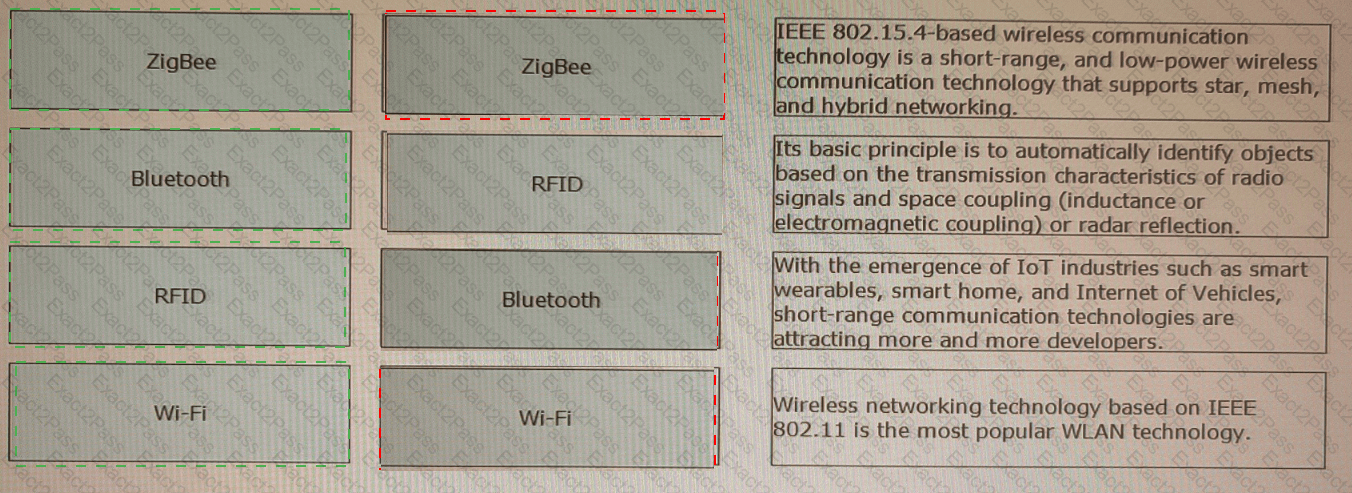
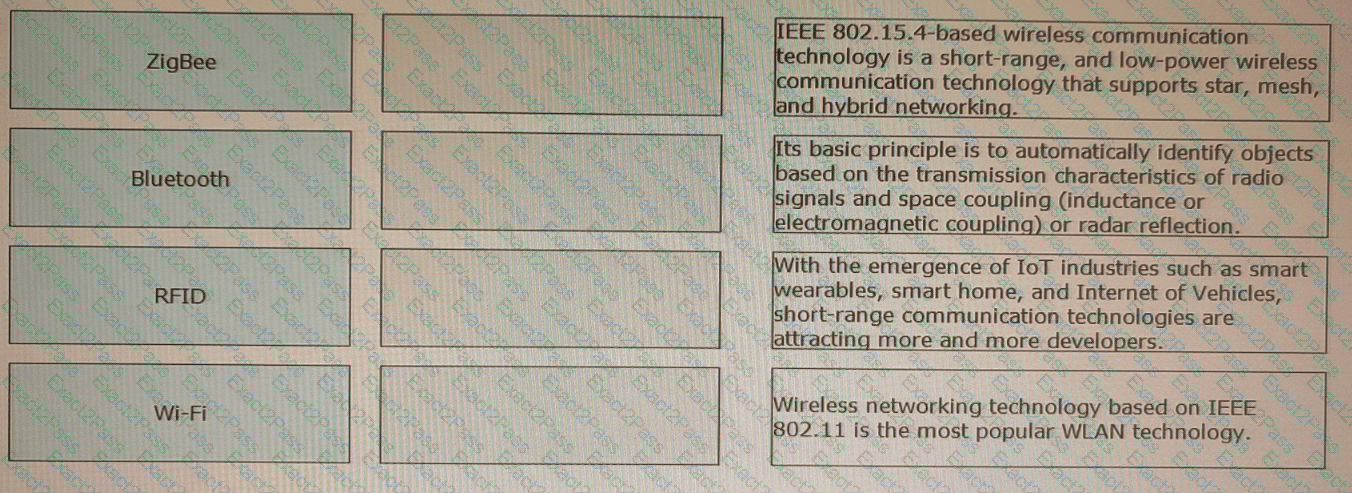
Drag the short-range wireless IoT technologies on the left to their corresponding descriptions on the right.
Question # 18

Which of the following statements are true about the WLAN site survey In different typical scenarios? (Select All that Apply)

A.

In a classroom scenario. If the walls are made of reinforced concrete, the signal attenuation Is high. In this case, you are advised to test the attenuation during the site survey. Additionally, pay attention to the locations of ELV rooms in the teaching building.

B.

In an office scenario, the load-bearing columns and partitions affect the signal coverage. If an integrated ceiling is used, deploy APs near maintenance entrances. If a metal ceiling is used, mount APs on the ceiling or wall.

C.

In a ward-round scenario, high requirements are posed on the coverage field strength, roaming effect, and bandwidth. Determine the interference of medical equipment and the areas where Wi-Fi signals are not allowed.

D.

In a stadium scenario, the onsite environment is complex and cabling is difficult. Therefore, confirm with the property management company about ELV rooms and cabling. If the transmission distance is too long, consider deploying more switches. During the survey, focus on the interference between APs and AP mounting modes.

Question # 19

In 802. IX authentication using port-based access control, once a user is authenticated successfully on a port, subsequent users on this port can access the network without authentication. When the authenticated user goes offline, all other users are denied access to the network.

A.

True

B.

False

Question # 20

Which of the following types of non-Wi-R devices can be identified by Huawei APs? (Select All that Apply)


A.

Bluetooth device

B.

ZigBee device

C.

Game controller

D.

2.4 GHz wireless video and audio transmitter

Go to page: