Exact2Pass

Last Update 1 hour ago Total Questions : 163
The HCIE-WLAN (Written) V1.0 content is now fully updated, with all current exam questions added 1 hour ago. Deciding to include H12-351_V1.0 practice exam questions in your study plan goes far beyond basic test preparation.
You'll find that our H12-351_V1.0 exam questions frequently feature detailed scenarios and practical problem-solving exercises that directly mirror industry challenges. Engaging with these H12-351_V1.0 sample sets allows you to effectively manage your time and pace yourself, giving you the ability to finish any HCIE-WLAN (Written) V1.0 practice test comfortably within the allotted time.
Which of the following statements are true about network optimization measures?
When planning a WLAN using the WLAN Planner, which of the following properties can be set for interference sources?
Which of the following statements are true about wireless configuration synchronization in Huawei ' s WAC backup solutions?
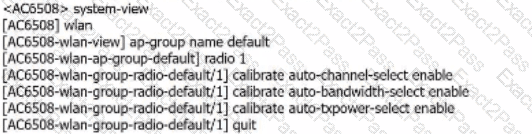
An engineer configures the following radio calibration commands on a Huawei WAC. Which of the following statements are true about these commands?
When Huawei WLAN Planner is used for network planning, which of the following are included in the network planning report?
On a WLAN, if PoE+ + power supply is used, the distance between a PoE switch and an AP can exceed 100 m.
In an 802.1X authentication system, the client, access device, and authentication server exchange information using the Extensible Authentication Protocol (EAP).
After built-in Portal authentication is configured on a Huawei WAC. the Portal authentication page can be displayed but Portal authentication cannot be performed. What are the possible causes?
Which of the following methods are used in IPsec to ensure secure transmission of service data on the network through encryption and authentication?
Deploying user authentication points at the access layer achieves fine-grained permission management and high network security. However, as the network scale is rapidly expanding, problems arise, such as heavy configuration workloads and high O & M difficulties. To mitigate these problems, user authentication points can be moved upward from the access layer to the aggregation or core layer. In this way, authentication information across the entire network is centralized and the number of user authentication points is decreased, thereby reducing the configuration and maintenance workload.

