
Spring Sale Special Limited Time 70% Discount Offer - Ends in 0d 00h 00m 00s - Coupon code: buysanta

Exact2Pass Menu

Huawei Certified ICT Professional - Constructing Infrastructure of Security Network

Last Update 20 hours ago Total Questions : 217

The Huawei Certified ICT Professional - Constructing Infrastructure of Security Network content is now fully updated, with all current exam questions added 20 hours ago. Deciding to include H12-721 practice exam questions in your study plan goes far beyond basic test preparation.

You'll find that our H12-721 exam questions frequently feature detailed scenarios and practical problem-solving exercises that directly mirror industry challenges. Engaging with these H12-721 sample sets allows you to effectively manage your time and pace yourself, giving you the ability to finish any Huawei Certified ICT Professional - Constructing Infrastructure of Security Network practice test comfortably within the allotted time.

Question # 11

What are the three elements of an abnormal flow cleaning solution?

A.

cleaning center

B.

Testing Center

C.

Management Center

D.

Collection Center

Question # 12

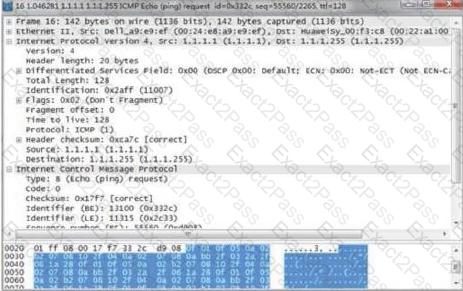
When an attack occurs, the result of packet capture on the attacked host (1.1.1.1) is as shown in the figure. What kind of attack is this attack?
A.

Smurf attack

B.

Land attack

C.

WinNuke attack

D.

Ping of Death attack

Question # 13

Connecting the internal network interface address from the firewall By pinging the internal network address of the peer, the IPSec tunnel can be successfully triggered. The internal PC cannot trigger the tunnel establishment. What are the possible reasons?

A.

IKE proposal configuration problem

B.

IPSec proposal configuration problem

C.

interested traffic ACL source network segment does not include the PC

D.

packet filtering (inter-domain policy) configuration problem

Question # 14

Which of the following is correct about the configuration of the firewall interface bound to the VPN instance?

A.

ip binding vpn-instance vpn-id

B.

ip binding vpn-instance vpn-instance-name

C.

ip binding vpn-id

D.

ip binding vpn-id vpn-instance-name

Question # 15

When the firewall works in the dual-system hot backup load balancing environment, if the upstream and downstream routers are working in the routing mode, you need to adjust the OSPF cost based on HRP.

A.

TRUE

B.

FALSE

Question # 16

The ip-link sends a probe packet to the specified IP address. By default, after 3 probe failures, the link to this IP address is considered faulty.

A.

TRUE

B.

FALSE

Question # 17

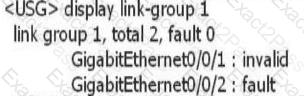
After the link-group is configured on the device, use the display link-group 1 command to obtain the following information. What information can I get?
A.

GigabitEthernet 0/0/2 interface has failed.

B.

GigabitEthernet 0/0/1 has failed.

C.

GigabitEthernet 0/0/2 is forcibly converted to fault state because other interfaces in the group are faulty.

D.

GigabitEthernet 0/0/1 is forcibly converted to fault state because other interfaces in the group are faulty.

Question # 18

What is the correct statement about the binding of local users to VPN instances?

A.

local user can be bound to a VPN instance by using the local-user user-name vpn-instance vpn-instance-name command.

B.

By default, the binding between a local user and a VPN instance is implemented.

C.

. After a local user is bound to a VPN instance, the local user can manage the entire firewall.

D.

Local users cannot be bound to VPN instances.

Question # 19

Site to Site IPSec VPN Tunnel Negotiation Fails. How do I view the establishment and configuration of the IKE Phase 2 security association?

A.

display ike sa

B.

display ipsec sa brief

C.

display ipsec policy

D.

display interface

Question # 20

Which of the following does the virtual firewall technical feature not include?

A.

provides multi-instance, multi-instance, multi-instance, multi-instance, and multi-instance VPN. The application is flexible and can meet multiple networking requirements.

B.

Each virtual firewall can independently support four security zones: Trust, Untrust, DMZ, and Local. The interfaces are flexibly divided and allocated.

C.

technically guarantees that each virtual system and a separate firewall are identical in implementation, and very secure, and can be directly accessed between virtual systems.

D.

Provide independent administrator privileges for each virtual system

Go to page:
