Summer Sale Special Limited Time 70% Discount Offer - Ends in 0d 00h 00m 00s - Coupon code: buysanta

Exact2Pass Menu

Aruba Certified ClearPass Expert Written Exam

Last Update 21 hours ago Total Questions : 60

The Aruba Certified ClearPass Expert Written Exam content is now fully updated, with all current exam questions added 21 hours ago. Deciding to include HPE6-A81 practice exam questions in your study plan goes far beyond basic test preparation.

You'll find that our HPE6-A81 exam questions frequently feature detailed scenarios and practical problem-solving exercises that directly mirror industry challenges. Engaging with these HPE6-A81 sample sets allows you to effectively manage your time and pace yourself, giving you the ability to finish any Aruba Certified ClearPass Expert Written Exam practice test comfortably within the allotted time.

Question # 1

There is an Aruba Controller configured to stand Guest AAA requests to ClearPass If the customer would likt tht most effective way to ensure the lowest license usage counts, how should the controller be configured?

A.

Aruba Controller will send stop messages only if EAP termination and Interim accounting are enabled.

B.

Configure EAP Termination on the Aruba Controller and the client will send a stop message.

C.

Aruba Controller will send stop messages if RADIUS Accounting Server Group is defined in the authentication profile.

D.

Aruba Controller will send stop messages only if both accounting and Interim accounting are enabled.

Question # 2

While configuring the service rule conditions which NAS-Port-Type value should be used to differentiate the service for wired and wireless authentication?

A.

Ethernet (5) and Wireless-802 11 (9)

B.

Ethernet (15) and Wireless-802 II (19)

C.

Ethernet (O)and W.reless-802 11 (1)

D.

Ethernet (19) and Wireless-802 11(18)

Question # 3

A customer has two different geographical sites deployed with two ClearPass servers in each site. Site A has the Publisher (CPPM1) and a subscriber (CPPM2) and Site B has two subscribers (CPPM3 S CPPM4) All wired and wireless authentication requests from the respective sites are handled by respective CPPMs deployed in the sites When both the CPPM servers in Site B are lost, the authentications from Site B is handled by Site A subscriber (CPPM2). To control the Multi-Master Cache flush and reduce the amount of inter-site traffic, the customer also created a new Policy Manager Zone (Zone1) The Site B CPPM3 & CPPM4 are part of Zone! and Site A CPPM2 is also mapped to Zone1 as it will act as the backup RADIUS server for Site B The corporate laptops are installed with Persistent agent to run the OnGuard check and the OnGuard settings are also mapped to the Zones The Site A corporate user subnets are mapped to default zone and the Site 6 corporate user subnets are mapped to Zone1. The customer has the following issue in the setup: The corporate clients from Site A authenticating against the CPPM2 as their Primary RADIUS server assigns Quarantine enforcement profile even though the user s health status is Healthy.

What is the cause of this issue?

A.

Multi-master cache also contains the roles and posture of the associated and unassociated clients and is shared with all members part of that Policy Manager Zone. CPPM2 belongs to Zone1 and the OnGuard setting for Site A is part of the default zone and the system health validation information is sent to one of the nodes that are part of its home zone As Posture cache for Site A hi not available with CPPMZ. it fails to apply the enforcement

B.

Multi-master cache also contains the roles and posture of the connected clients and is shared only with the members part of that Policy Manager Zone. CPPM2 belongs to Zone1 and the OnGuard setting for Site A is part of the default zone and the OnGuard system health validation information is sent to one of the nodes that are part of its home zone only. As Posture cache for Site A is not available with CPPM2. it fails to apply the enforcement

C.

Multi-master cache also contains the roles and posture of the connected clients and is shared across all members part of the cluster. The OnGuard setting for Site A is part of only the default zone and the system health validation information is sent to one of the nodes that are part of its home zone only As the OnGuard setting of the Site A corporate user subset is not mapped with default as well as Zone1. CPPM2 fails to apply the enforcem

D.

Multi-master cache also contains the roles and posture of the connected clients and is shared across all members part of the cluster. The OnGuard setting for Site A is part of only the default zone and the OnGuard system health validation information is sent to one of the nodes that is part of its home zone only. As the CPPM2 is also not mapped to the default zone as well as Zone1, CPPM2 fails to apply the enforcement profile based on corre

Question # 4

Refer to the exhibit.

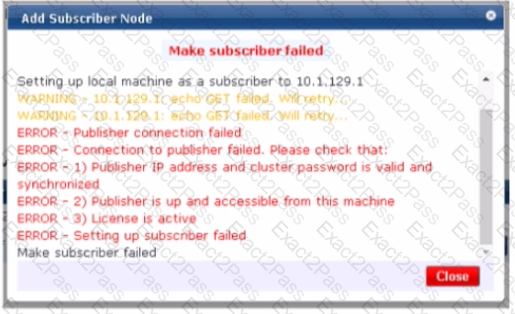
A customer is doing a new ClearPass installation and is setting up clustering between two ClearPass servers running a 6.8.6 version. The ClearPass server failed to add the subscriber node. The customer was able to login to the console of the ClearPass server with the same CLI password used during the cluster setup. The customer has sent you the screenshots seeking your support Why did an attempt to add a subscriber node failed showing that error?

A.

The data and time in the subscriber was not synchronized with the NTP server

B.

The subscriber server is running with a default self -signed HTTPS certificate

C.

The default database certificate used in the publisher server is not a valid certificate

D.

The subscriber server is running with a public signed and trusted HTTPS certificate

Question # 5

Refer to the exhibit.

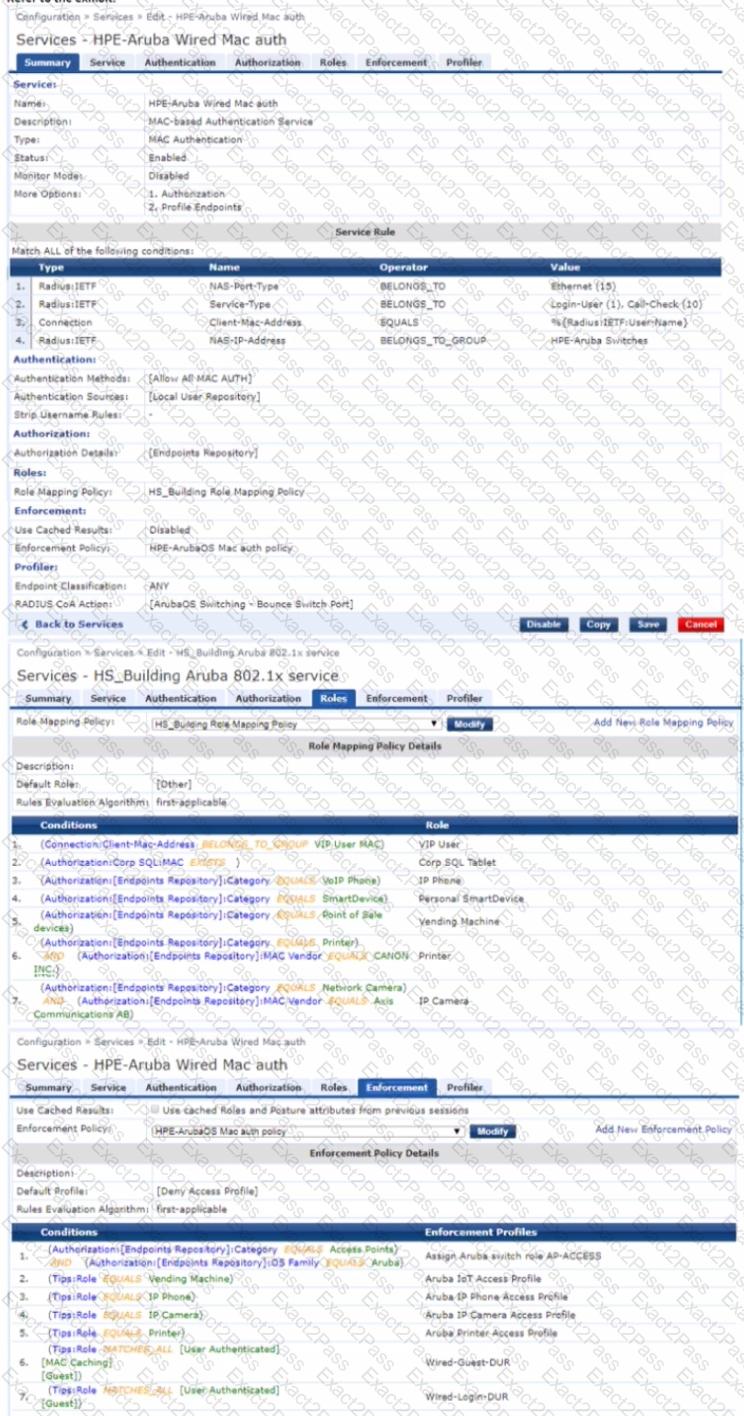
You configured the Wired MAC - Auth service enforcement conditions with the Endpoint profiling data When mac-auth based clients connect to the network, ClearPass assigns Deny access profile. The customer has sent you the above screenshots How would you resolve the issue?

A.

Change the Rules evaluation algorithm in the Enforcement policy of HPE ArubaOS Mac auth policy as " select all matches " and add the CoA action as HPE Bounce switch port in the profiler tab.

B.

Create a new condition in last position with Type and operator as Tips:Role EQUALS [User Authenticated] with action as Allow access profile permitting any services and any ports to do profiling.

C.

Create a new condition in first position with Type and operator as Authorization (Endpoint Repository]:Category NOT_EXISTS with action as Limited access profile allowing only DHCP service.

D.

Create a new condition in the first position with Type and operator as Authorization [Endpoint Repository] Category NOT_EXISTS with action as Limited access profile and ArubaOS wireless terminate session

Question # 6

Refer to the exhibit.

The users connecting to a wireless SSIO " secure-HS-5007 " were being processed by an incorrect 802.1 X service created for VIP access and the user gets deny access. The customer has sent you the screenshot to get your support to resolve the issue What changes will you suggest to fix it?

A.

To the HS_Building 802.1 X service, add another service rule condition with VIP access Aruba-Essid-Name and leave it in same position

B.

In the HS_Building 802.1X service, remove the service rule condition with Aruba controller location name and leave it in same position

C.

Delete the HSBuilding 802 IX service, odd VIP access Aruba-Essid-Name as fourth condition to WSBuilding Aruba 802 1X service

D.

In the HSBuilding 802. IXservice. change the Authentication method for AMCAuth for VIP access and leave it in same position

Question # 7

Which statements art true about controller-initiated and server-initiated login method? (Select two)

A.

Controller-initiated login method should be used if the guest user ' s network login will be handled by the controller-based AP to perform the HTTP post when the user attempts a login.

B.

Controller-initiated login method should be used of the guest user ' s network login will be handled by the guest browser to perform the HTTP port when the user attempts a login

C.

server-in it will login method should be used if the guest user s network login will be handled by the wired switch by standing the authentication request to (PPM when the user attempts a login

D.

server-initiated login method should be used if the guest user’s network login will be handled by ClearPass by sending the authentication request to itself when the user attempts a login

E.

server-initiated login method should be used if the guest users network login will be handled by the ClearPass by standing a CoA after authentication request is posted to itself when the user attempts a login

Question # 8

Refer to the exhibit.

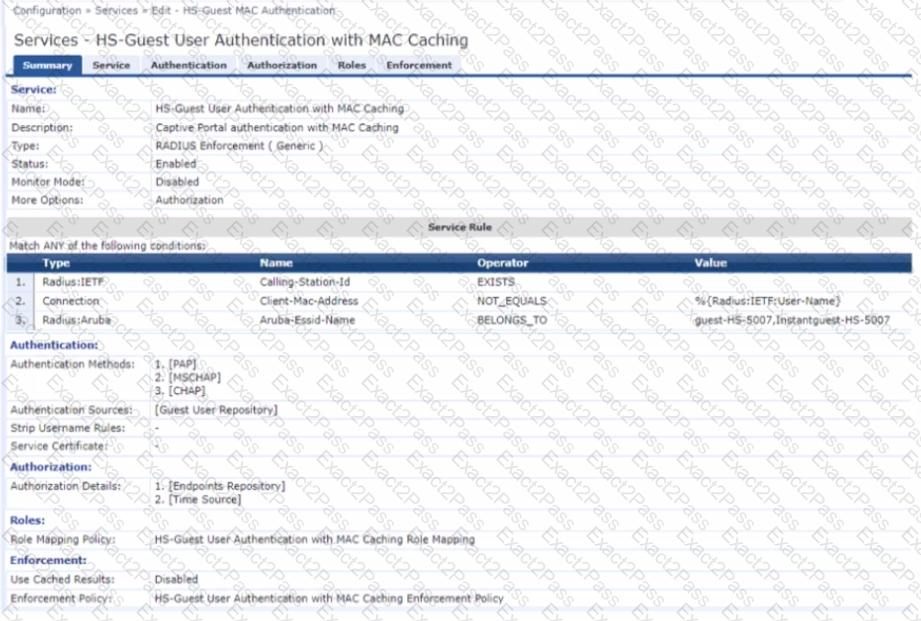
You have set up a home lab for ACCX exam preparation with Aruba Clear Pass integrated with Aruba Controller and Instant Access Point Guest Mac Caching functionality is configured only for Aruba Controller ' s guest SSID and a common Web Login page is configured for both NAD devices You tested and verified the mac caching functionality for a client by connecting it to the Aruba Controller ' s guest SSID.

What will happen when you disconnect the client from Aruba Controller ' s guest SSID and connect it to Instant APs guest SSID?

A.

The client will bypass the captive portal authentication by completing the MAC authentication.

B.

The client will fail the mac authentication and will be redirected to the captive portal page.

C.

The client does not have to complete any authentication as the re-connection was immediate.

D.

The client will be redirected to the captive portal page to complete the web authentication.

Question # 9

A customer has acquired another company that has its own Active Directory infrastructure. The 802 1X PEAP authentication works with the customer ' s original Active Directory servers but the customer would like to authenticate users from the acquired company as well.

What steps are required, in regards to the Authentication Sources, in order to support this request? (Select two.)

A.

Create a new Authentication Source, type Active Directory.

B.

Create a new Authentication Source, type Generic LDAP.

C.

Add the new AD server(s) as backup into the existing Authentication Source.

D.

There is no need to join ClearPass to the new AD domain.

E.

Join the ClearPass server(s) to the new AD domain.

Question # 10

Refer to the exhibit.

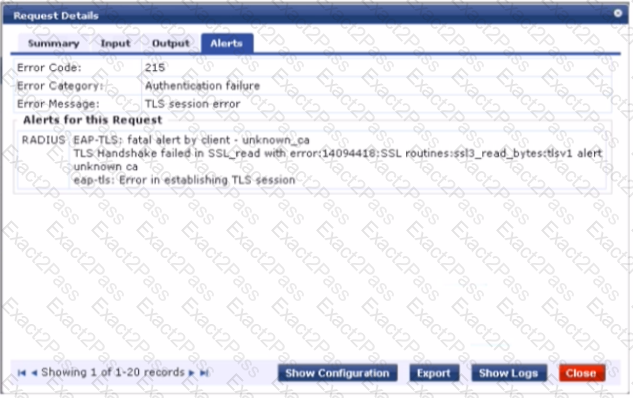
A customer has configured Onboard in a cluster with two nodes. All devices were onboarded in the network through node1 but those clients fail to authenticate through node2 with the error shown What steps would you suggest to make provisioning and authentication work across the entire cluster? (Select three)


A.

Configure the Network Settings in Onboard to trust the Policy Manager EAP certificate.

B.

Have all of the BYOO clients disconnect and reconnect to the network.

C.

Configure the Onboard Root CA to trust the Policy Manager EAP certificate root.

D.

Make sure that the EAP certificates on both nodes are issued by one common root Certificate Authority (CA).

Go to page: