Exact2Pass

Last Update 1 hour ago Total Questions : 60
The Aruba Certified Network Security Expert Written Exam content is now fully updated, with all current exam questions added 1 hour ago. Deciding to include HPE6-A84 practice exam questions in your study plan goes far beyond basic test preparation.
You'll find that our HPE6-A84 exam questions frequently feature detailed scenarios and practical problem-solving exercises that directly mirror industry challenges. Engaging with these HPE6-A84 sample sets allows you to effectively manage your time and pace yourself, giving you the ability to finish any Aruba Certified Network Security Expert Written Exam practice test comfortably within the allotted time.
How does Aruba Central handle security for site-to-site connections between AOS 10 gateways?
Refer to the scenario.
# Introduction to the customer
You are helping a company add Aruba ClearPass to their network, which uses Aruba network infrastructure devices.
The company currently has a Windows domain and Windows CA. The Window CA issues certificates to domain computers, domain users, and servers such as domain controllers. An example of a certificate issued by the Windows CA is shown here.
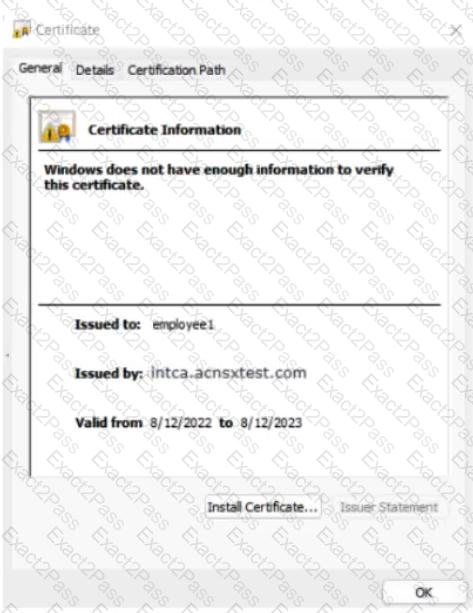
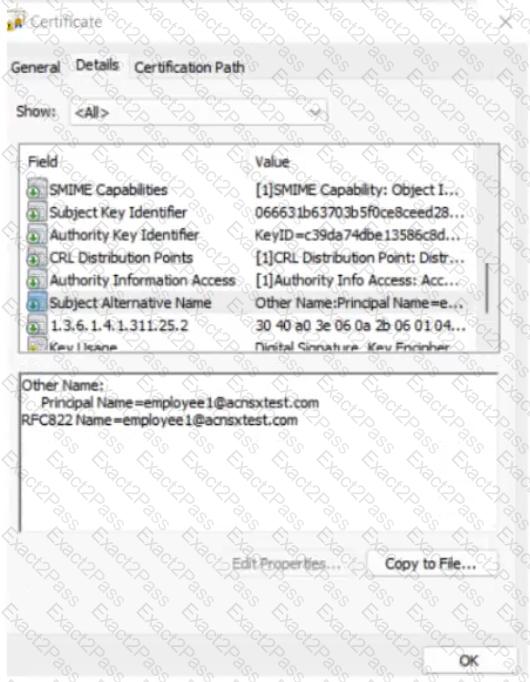
The company is in the process of adding Microsoft Endpoint Manager (Intune) to manage its mobile clients. The customer is maintaining the on-prem AD for now and uses Azure AD Connect to sync with Azure AD.
# Requirements for issuing certificates to mobile clients
The company wants to use ClearPass Onboard to deploy certificates automatically to mobile clients enrolled in Intune. During this process, Onboard should communicate with Azure AD to validate the clients. High availability should also be provided for this scenario; in other words, clients should be able to get certificates from Subscriber 2 if Subscriber 1 is down.
The Intune admins intend to create certificate profiles that include a UPN SAN with the UPN of the user who enrolled the device.
# Requirements for authenticating clients
The customer requires all types of clients to connect and authenticate on the same corporate SSID.
The company wants CPPM to use these authentication methods:
 EAP-TLS to authenticate users on mobile clients registered in Intune
 TEAR, with EAP-TLS as the inner method to authenticate Windows domain computers and the users on them
To succeed, EAP-TLS (standalone or as a TEAP method) clients must meet these requirements:
 Their certificate is valid and is not revoked, as validated by OCSP
 The client’s username matches an account in AD
# Requirements for assigning clients to roles
After authentication, the customer wants the CPPM to assign clients to ClearPass roles based on the following rules:
 Clients with certificates issued by Onboard are assigned the “mobile-onboarded” role
 Clients that have passed TEAP Method 1 are assigned the “domain-computer” role
 Clients in the AD group “Medical” are assigned the “medical-staff” role
 Clients in the AD group “Reception” are assigned to the “reception-staff” role
The customer requires CPPM to assign authenticated clients to AOS firewall roles as follows:
 Assign medical staff on mobile-onboarded clients to the “medical-mobile” firewall role
 Assign other mobile-onboarded clients to the “mobile-other” firewall role
 Assign medical staff on domain computers to the “medical-domain” firewall role
 All reception staff on domain computers to the “reception-domain” firewall role
 All domain computers with no valid user logged in to the “computer-only” firewall role
 Deny other clients access
# Other requirements
Communications between ClearPass servers and on-prem AD domain controllers must be encrypted.
# Network topology
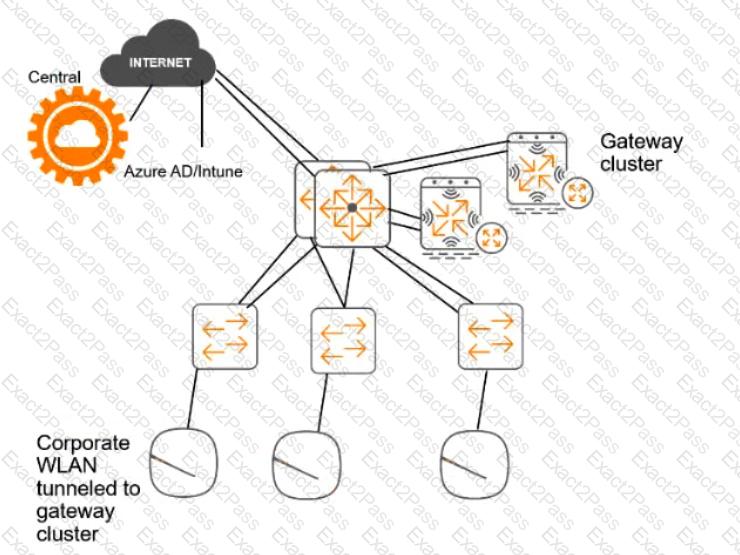
For the network infrastructure, this customer has Aruba APs and Aruba gateways, which are managed by Central. APs use tunneled WLANs, which tunnel traffic to the gateway cluster. The customer also has AOS-CX switches that are not managed by Central at this point.
# ClearPass cluster IP addressing and hostnames
A customer’s ClearPass cluster has these IP addresses:
 Publisher = 10.47.47.5
 Subscriber 1 = 10.47.47.6
 Subscriber 2 = 10.47.47.7
 Virtual IP with Subscriber 1 and Subscriber 2 = 10.47.47.8
The customer’s DNS server has these entries
 cp.acnsxtest.com = 10.47.47.5
 cps1.acnsxtest.com = 10.47.47.6
 cps2.acnsxtest.com = 10.47.47.7
 radius.acnsxtest.com = 10.47.47.8
 onboard.acnsxtest.com = 10.47.47.8
The customer has now decided that it needs CPPM to assign certain mobile-onboarded devices to a “nurse-call” AOS user role. These are mobile-onboarded devices that are communicating with IP address 10.1.18.12 using port 4343.
What are the prerequisites for fulfilling this requirement?
A customer has an AOS 10-based solution, including Aruba APs. The customer wants to use Cloud Auth to authenticate non-802.1X capable IoT devices.
What is a prerequisite for setting up the device role mappings?
Refer to the scenario.
A customer requires these rights for clients in the “medical-mobile” AOS firewall role on Aruba Mobility Controllers (MCs):
 Permitted to receive IP addresses with DHCP
 Permitted access to DNS services from 10.8.9.7 and no other server
 Permitted access to all subnets in the 10.1.0.0/16 range except denied access to 10.1.12.0/22
 Denied access to other 10.0.0.0/8 subnets
 Permitted access to the Internet
 Denied access to the WLAN for a period of time if they send any SSH traffic
 Denied access to the WLAN for a period of time if they send any Telnet traffic
 Denied access to all high-risk websites
External devices should not be permitted to initiate sessions with “medical-mobile” clients, only send return traffic.
The exhibits below show the configuration for the role.
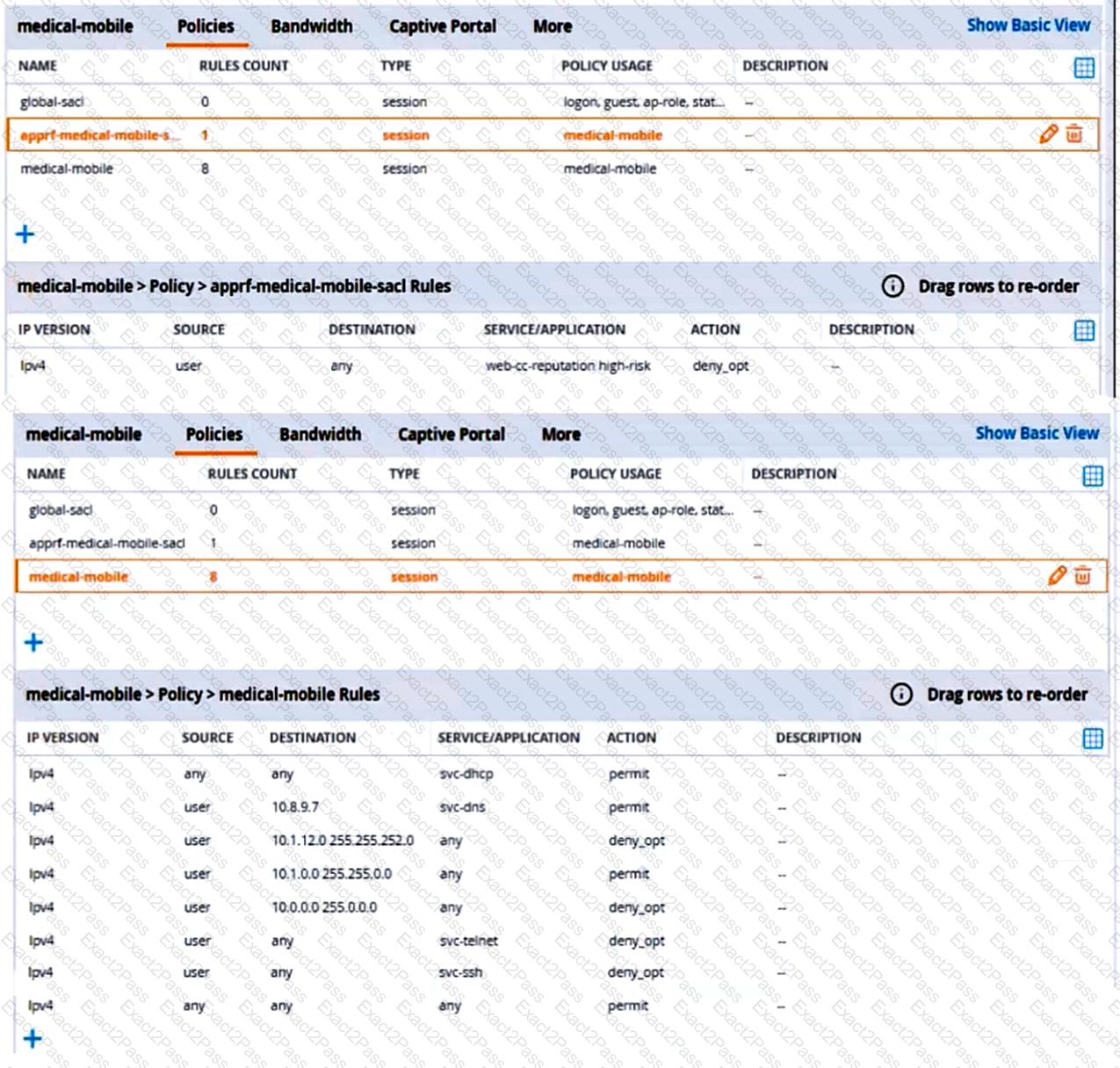
There are multiple issues with this configuration. What is one change you must make to meet the scenario requirements? (In the options, rules in a policy are referenced from top to bottom. For example, “medical-mobile” rule 1 is “ipv4 any any svc-dhcp permit,” and rule 8 is “ipv4 any any any permit”.)
Refer to the scenario.
A customer requires these rights for clients in the “medical-mobile” AOS firewall role on Aruba Mobility Controllers (MCs):
 Permitted to receive IP addresses with DHCP
 Permitted access to DNS services from 10.8.9.7 and no other server
 Permitted access to all subnets in the 10.1.0.0/16 range except denied access to 10.1.12.0/22
 Denied access to other 10.0.0.0/8 subnets
 Permitted access to the Internet
 Denied access to the WLAN for a period of time if they send any SSH traffic
 Denied access to the WLAN for a period of time if they send any Telnet traffic
 Denied access to all high-risk websites
External devices should not be permitted to initiate sessions with “medical-mobile” clients, only send return traffic.
The exhibits below show the configuration for the role.
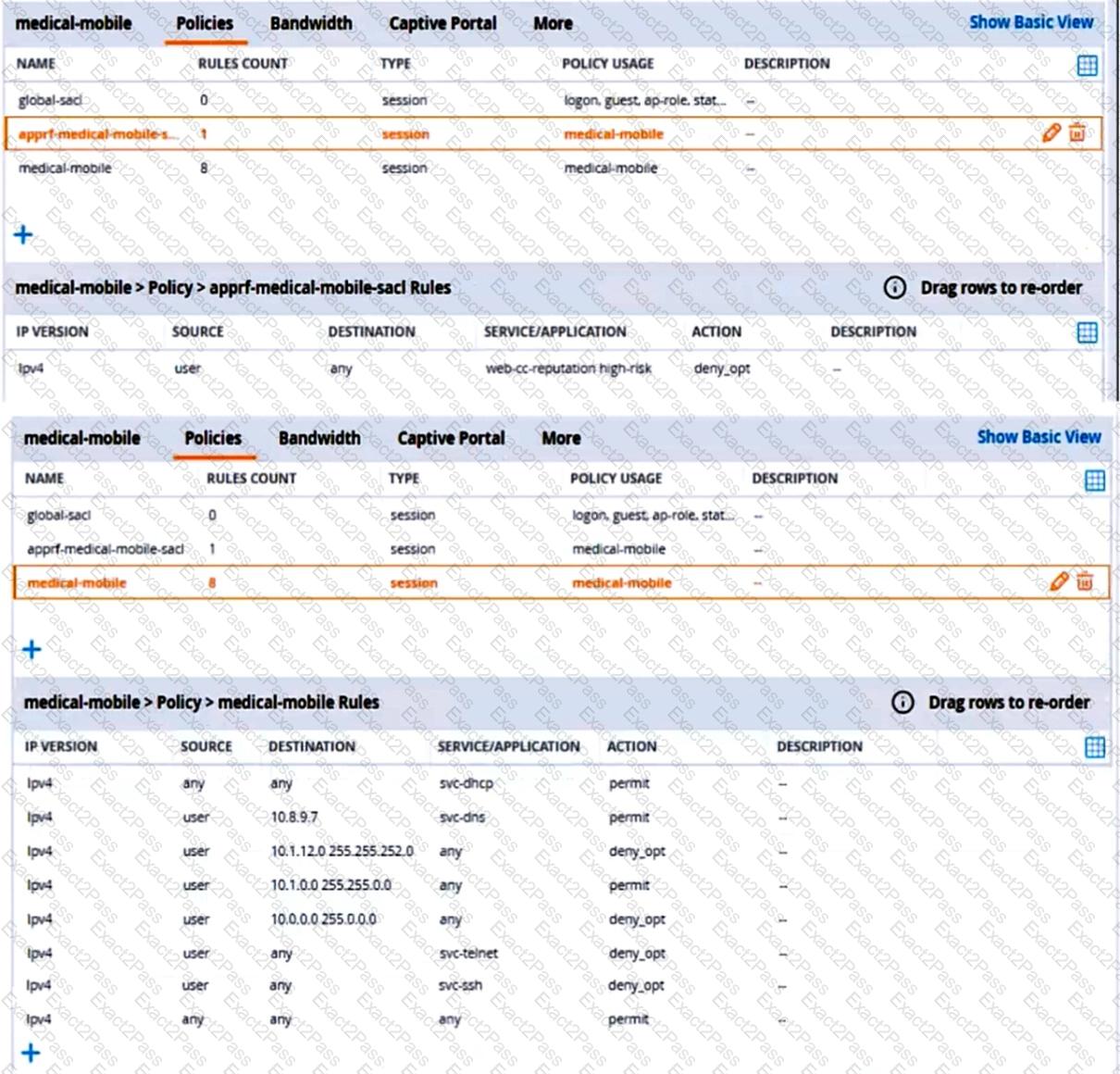
There are multiple issues with the configuration.
What is one of the changes that you must make to the policies to meet the scenario requirements? (In the options, rules in a policy are referenced from top to bottom. For example, “medical-mobile” rule 1 is “ipv4 any any svc-dhcp permit,” and rule 8 is “ipv4 any any any permit’.)
Refer to the scenario.
A customer is migrating from on-prem AD to Azure AD as its sole domain solution. The customer also manages both wired and wireless devices with Microsoft Endpoint Manager (Intune).
The customer wants to improve security for the network edge. You are helping the customer design a ClearPass deployment for this purpose. Aruba network devices will authenticate wireless and wired clients to an Aruba ClearPass Policy Manager (CPPM) cluster (which uses version 6.10).
The customer has several requirements for authentication. The clients should only pass EAP-TLS authentication if a query to Azure AD shows that they have accounts in Azure AD. To further refine the clients’ privileges, ClearPass also should use information collected by Intune to make access control decisions.
Assume that the Azure AD deployment has the proper prerequisites established.
You are planning the CPPM authentication source that you will reference as the authentication source in 802.1X services.
How should you set up this authentication source?
Refer to the exhibit.
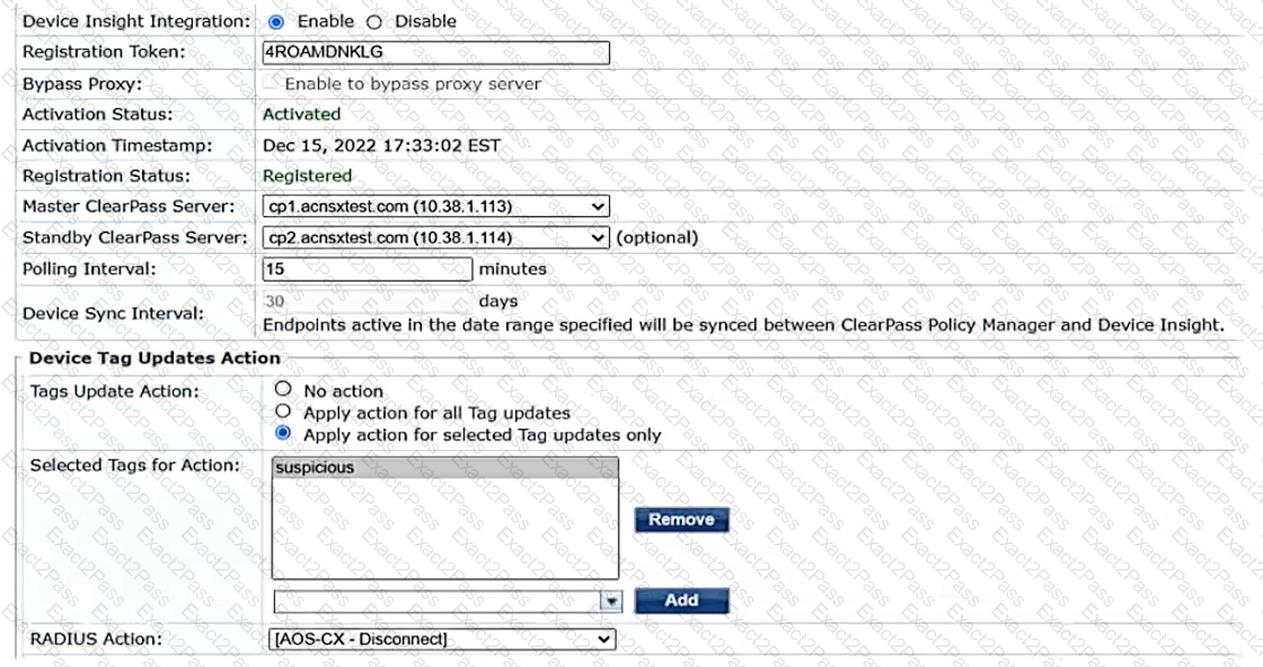
Aruba ClearPass Policy Manager (CPPM) is using the settings shown in the exhibit. You reference the tag shown in the exhibit in enforcement policies related to NASes of several types, including Aruba APs, Aruba gateways, and AOS-CX switches.
What should you do to ensure that clients are reclassified and receive the correct treatment based on the tag?
Refer to the scenario.
An organization wants the AOS-CX switch to trigger an alert if its RADIUS server (cp.acnsxtest.local) rejects an unusual number of client authentication requests per hour. After some discussions with other Aruba admins, you are still not sure how many rejections are usual or unusual. You expect that the value could be different on each switch.
You are helping the developer understand how to develop an NAE script for this use case.
You are helping a customer define an NAE script for AOS-CX switches. The script will monitor statistics from a RADIUS server defined on the switch. You want to future proof the script by enabling admins to select a different hostname or IP address for the monitored RADIUS server when they create an agent from the script.
What should you recommend?

