Spring Sale Special Limited Time 70% Discount Offer - Ends in 0d 00h 00m 00s - Coupon code: buysanta

Exact2Pass Menu

Advanced HPE Storage Architect Written Exam

Last Update 18 hours ago Total Questions : 60

The Advanced HPE Storage Architect Written Exam content is now fully updated, with all current exam questions added 18 hours ago. Deciding to include HPE7-J01 practice exam questions in your study plan goes far beyond basic test preparation.

You'll find that our HPE7-J01 exam questions frequently feature detailed scenarios and practical problem-solving exercises that directly mirror industry challenges. Engaging with these HPE7-J01 sample sets allows you to effectively manage your time and pace yourself, giving you the ability to finish any Advanced HPE Storage Architect Written Exam practice test comfortably within the allotted time.

Question # 11

What will occur when a new node is added to an existing HPE Alletra MP X10000 storage array?

A.

An automatic cluster upgrade is supported across all releases of the operating systems and models.

B.

The expanded capacity is immediately available in the shared pool.

C.

Additional drives can be used to increase drive protection beyond the default limit of three drives.

D.

An automatic rebalancing across JBOFs occurs as soon as a new drive or an additional JBOF is added.

Question # 12

A company with 2484 VMs and 300 servers needs to implement a file, object, and block storage solution. What are the minimum requirements for this solution?

A.

One HPE Alletra MP B10000 and one HPE Alletra MP X10000

B.

One HPE Alletra MP B10000 and two HPE Alletra MP X10000s

C.

Two HPE Alletra MP B10000s and one HPE Alletra MP X10000

D.

Three HPE Alletra MP X10000s

Question # 13

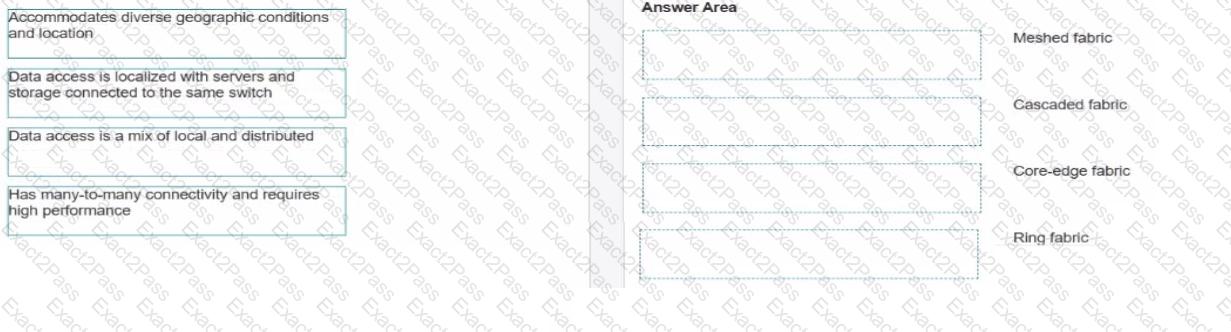
Match the fibre channel topology to its use case. Each answer will be used once.
Question # 14

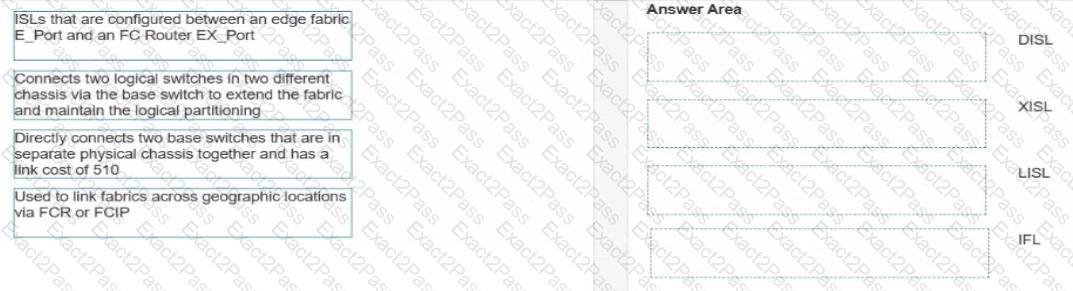
Match the Brocade virtual fabric term with its description.
Question # 15

A customer purchased an HPE GreenLake for File Storage solution and implemented the replication feature. Which statement is correct regarding this feature?

A.

Client hardware has read-write access to both the source and destination replication arrays.

B.

Data reduction, including deduplication, is performed between the storage arrays.

C.

N:1 and 1:N replication is supported, with snapshots taken at the directory level.

D.

Two protected paths configured on the same path can be used to replicate to the same peer.

Question # 16

An HPE customer purchased an HPE B-Series SN7000B SAN fabric switch. QoS is currently not enabled. Which two statements are correct regarding buffer-to-buffer (BB) credits and the operation of the switch? (Choose two.)

A.

BB credits can be adjusted for specific applications or operating environments, but they must be agreed upon among all switches to allow the formation of the fabric.

B.

The default window size for fibre channel (FC) frame transmission is 1, but can be increased to 8 or 16, depending on the switch model.

C.

Each user port reserves eight buffer credits when online or offline.

D.

BB credits are based on link speed and frame size.

E.

By default, all BB credits are reserved.

Question # 17

A customer is concerned about the long distances between their data centers and significant latencies that might exist between the SAN fabrics at the two data centers. Since SCSI write operations can involve multiple handshake messages between the target and initiator, which Brocade feature should be used to double the recommended distance, but maintain the same latency as a shorter haul link?

A.

FastWrite

B.

FCIP trunking

C.

Write Acceleration

D.

Leave Fast

Question # 18

A company bought an HPE StoreOnce solution as part of its data protection solution. The company has various Oracle installations that need to be backed up to StoreOnce. How should the company ' s administrator best implement the data protection strategy within the HPE StoreOnce user interface (UI)?


A.

Under Data Services, create a Catalyst Store and select the Oracle RMAN option.

B.

From the System Dashboard, click Catalyst Store then specify the Oracle RMAN option and the respective database server.

C.

From the System Dashboard, click Databases, click Create Library, then specify the Oracle RMAN option and the respective database servers.

D.

Under Data Services, create a Catalyst Store and install the Oracle RMAN plug-in on the Oracle database server.

Go to page: