Exact2Pass

We have coached hundreds of corporate health and safety managers, compliance officers, risk managers, and independent management systems consultants through this intensive PECB global milestone. Let's look honestly at the modern international compliance and regulatory auditing landscape. The safety professionals who fall short on this rigorous, 180-minute professional-tier evaluation are almost always those who leaned heavily on low-quality, linear test sheets—those flat, context-stripped answer repositories floating around unverified business forums. Those static, unverified materials simply cannot prepare you for live audit evidence collection or the intricate root-cause evaluations tested on the real exam. Candidates frequently spend months looking for high-yield iso 45001 lead auditor exam questions online, trying to source realistic pecb certified ohsms expert tests to measure their analytical capability, or tracking down an updated iso-45001-lead-auditor study guide that breaks down Clause 8 operational controls. They quickly discover that rote memorization fails completely when faced with complex, scenario-based worker consultation gaps and unexpected regulatory non-compliance issues during field verification trails.
At Exact2Pass, our framework targets the underlying structural logic, the ISO 19011 auditing guidelines, and the plan-do-check-act (PDCA) lifecycle of the active ISO 45001:2018 standard instead. Our premium preparation platform delivers comprehensive regulatory and methodology breakdowns for every evidence-gathering track and opening meeting scenario. You will master actual production-grade core compliance verification patterns instead of leaning on short-sighted memorization shortcuts. We map out hazard identification matrices, worker participation enforcement rules, legal registries verification, and audit program risk-based management parameters step by step. Our learning material is designed from the ground up by active, certified principal OHSMS lead auditors who direct and execute enterprise-scale safety audits daily across heavy industrial sectors. Because of that, we completely avoid mindless, repetitive question repositories. Instead, our software acts as an active administrative simulation that forces you to evaluate audit notes, resolve conflicting stakeholder testimonials, and classify non-conformities like a veteran lead auditor. You will learn the exact reason why a specific piece of audit evidence or corrective action plan succeeds or fails to meet international registration standards. That is how you build real confidence before logging into your official PECB account to launch your proctored evaluation workspace. Our adaptive simulation tools develop deep, practical environment judgment that transfers perfectly to enterprise risk environments, helping you pass on your very first try.
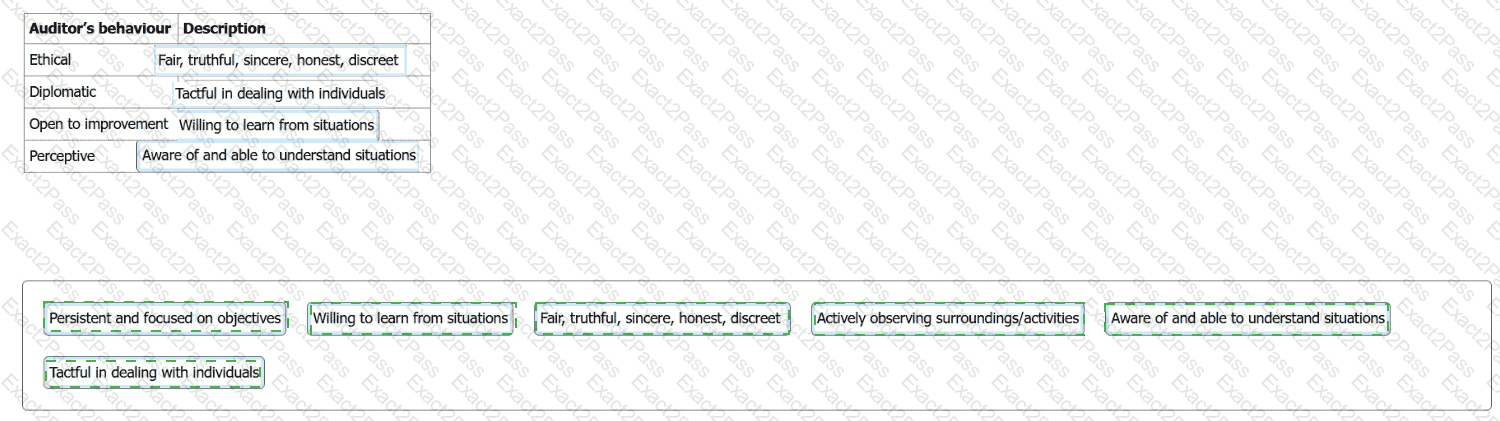
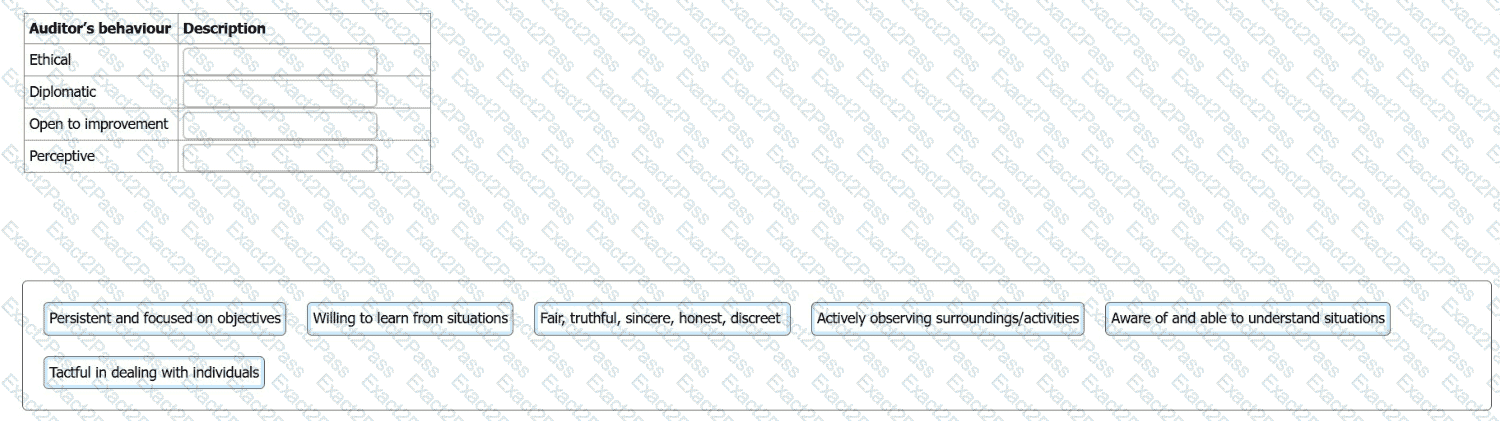
An auditor ' s personal behaviour during an audit is key to ensuring that the audit objectives are achieved. Match each of the descriptions to the correct type of behaviour.
To complete the table click on the blank section you want to complete so it is highlighted in red and then click on the applicable text from the options below. Alternatively, drag and drop each of the following descriptions.
You are auditing a site of Street Eats, a restaurant chain. In the kitchen area, you notice a half-filled open drum sitting in a pool of liquid, which is dribbling across a work area. You ask the Head Chef what is in the drum and are told it is waste oil from the frying process. When you ask why it is kept there, you are told that it is not normally kept there, but it is not a problem, and he says that he will arrange for it to be moved to a storeroom and will give the floor a good clean.
Looking around the kitchen, you observe knives and cleavers lying around on worktops, staff wearing no protective gloves and a large pot of boiling water with nobody near it. There is no evidence of any fire extinguishers or fire blankets within sight.
Select two of the options that would give you cause for concern in relation to conformance to ISO 45001.
Which three of the following ISO 45001 activities require the organisation to emphasise non-managerial workers ' participation?
Showitoff is an organisation spcialising in the design and production of wall decorating material for the domestic market. During an ISO 45001 certification audit of the site, the auditor comes across an open, walled area just outside the maintenance department. It contains various scraps of wood and metal as well as several rusty components. Several heavy concrete beams are learning against a thin brick wall in which cracks are visible. When asked about it, the OHS Manager states that he presume that the material come from maintenance work, so it is the Maintenance Manager’s responsibility.
The auditor interviews the Maintenance Manager in his department. He asks about the area outside and is told that it contains some excess materials that the Manager likes to keep in case they come in handy at some stage. The auditor points out that the wall appears to be unstable collapse at any moment. The Maintenance Manager is not aware of such a situation.
Which three statement represent good audit practice?
What does ISO 45001 say are the hazards that have to be considered when planning a health and safety management system? Select the ONE best answer.
Select the two options which represent an advantage of using a sampling plan for the audit.
You are auditing the purchasing process of Shelf-Fit, an organisation that designs, manufactures and installs interiors for retail stores. They always employ subcontractors for the installation work.
As an audit team member, you ask the Purchase Manager about the identification of health and safety hazards for contractors on site. Having previously reviewed the hazards list (HZD-21/11 Rev.3), you found that various health and safety hazards were listed but none were associated with contractors working on site.
When you ask about the use of contractors, the response is, " We know that contractors use chemicals, such as glues, paints and varnishes. We trust them since they know more than we do about safe handling of such issues " .
The auditor made the same enquiry to an accompanying member of the health and safety team and was told that chemical safety had never been a problem with the installation process.
You raise a nonconformance against clause 8.1.4.2 of ISO 45001.
At the closing meeting, the audit team leader presents the findings of the audit and comes to the above nonconformity. The OHS Manager presents the auditors with an email from all the current contractors confirming that they always carried out a site risk assessment. He asks that the nonconformity be withdrawn.
Which two of the following responses of the audit team leader would be acceptable?
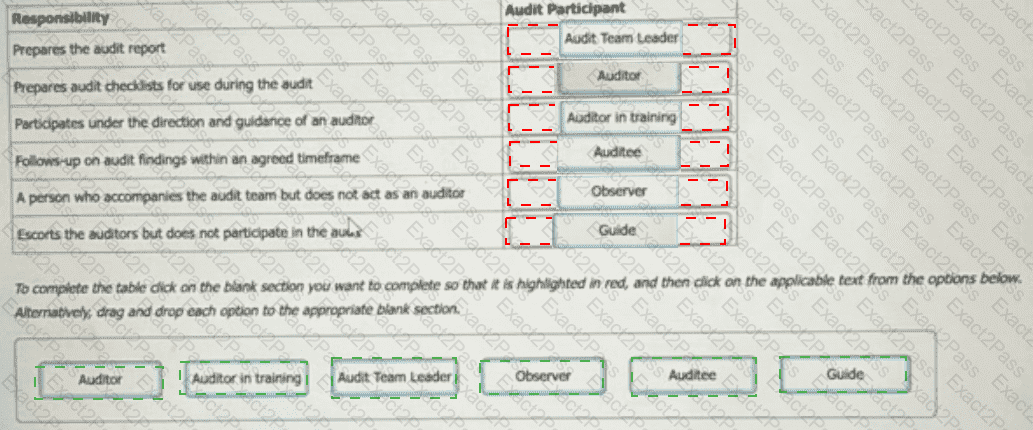
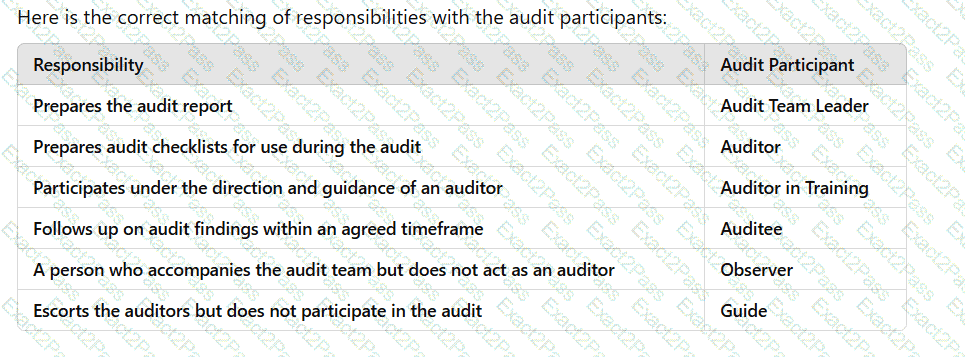
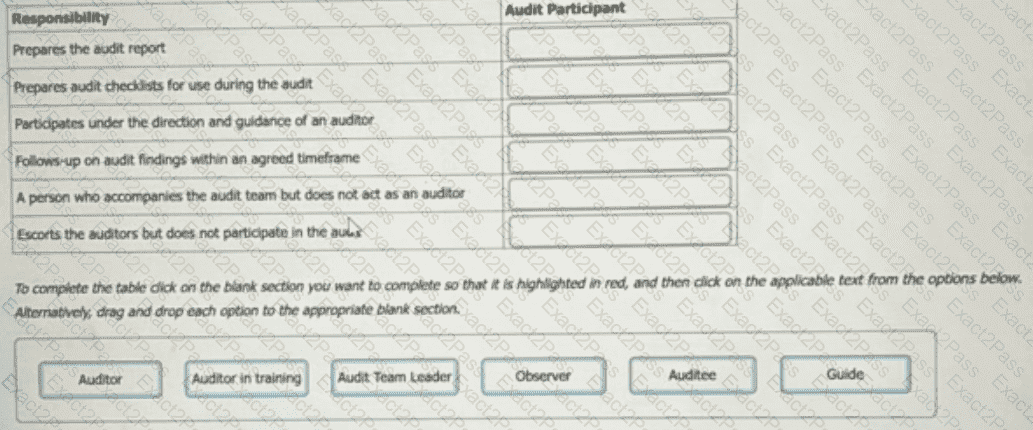
Match the correct responsibility with each participant of a second-party audit:
Which one of the following statements best describes audit resources?
Which three of the following statements about closing meetings are true?