Exact2Pass

Last Update 6 hours ago Total Questions : 152
The MuleSoft Certified Platform Architect - Level 1 content is now fully updated, with all current exam questions added 6 hours ago. Deciding to include MCPA-Level-1 practice exam questions in your study plan goes far beyond basic test preparation.
You'll find that our MCPA-Level-1 exam questions frequently feature detailed scenarios and practical problem-solving exercises that directly mirror industry challenges. Engaging with these MCPA-Level-1 sample sets allows you to effectively manage your time and pace yourself, giving you the ability to finish any MuleSoft Certified Platform Architect - Level 1 practice test comfortably within the allotted time.
A retail company with thousands of stores has an API to receive data about purchases and insert it into a single database. Each individual store sends a batch of purchase data to the API about every 30 minutes. The API implementation uses a database bulk insert command to submit all the purchase data to a database using a custom JDBC driver provided by a data analytics solution provider. The API implementation is deployed to a single CloudHub worker. The JDBC driver processes the data into a set of several temporary disk files on the CloudHub worker, and then the data is sent to an analytics engine using a proprietary protocol. This process usually takes less than a few minutes. Sometimes a request fails. In this case, the logs show a message from the JDBC driver indicating an out-of-file-space message. When the request is resubmitted, it is successful. What is the best way to try to resolve this throughput issue?
Refer to the exhibit.
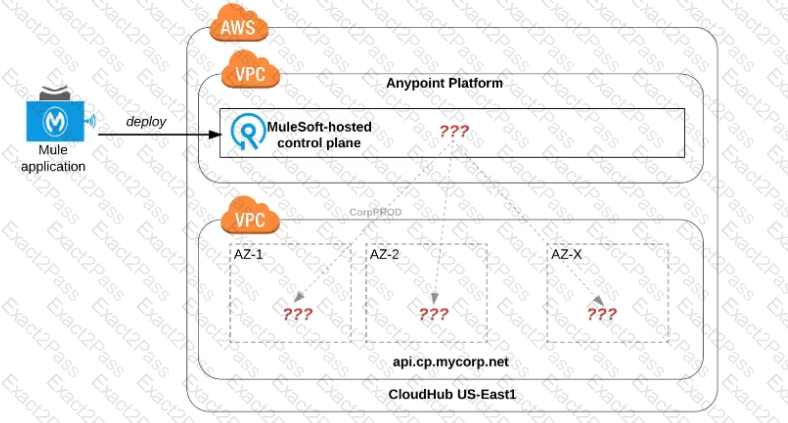
An organization uses one specific CloudHub (AWS) region for all CloudHub deployments.
How are CloudHub workers assigned to availability zones (AZs) when the organization ' s Mule applications are deployed to CloudHub in that region?
A TemperatureSensors API instance is defined in API Manager in the PROD environment of the CAR_FACTORY business group. An AcmelemperatureSensors Mule
application implements this API instance and is deployed from Runtime Manager to the PROD environment of the CAR_FACTORY business group. A policy that requires a valid
client ID and client secret is applied in API Manager to the API instance.
Where can an API consumer obtain a valid client ID and client secret to call the AcmeTemperatureSensors Mule application?
A European company has customers all across Europe, and the IT department is migrating from an older platform to MuleSoft. The main requirements are that the
new platform should allow redeployments with zero downtime and deployment of applications to multiple runtime versions, provide security and speed, and utilize Anypoint MQ
as the message service.
Which runtime plane should the company select based on the requirements without additional network configuration?
Select the correct Owner-Layer combinations from below options
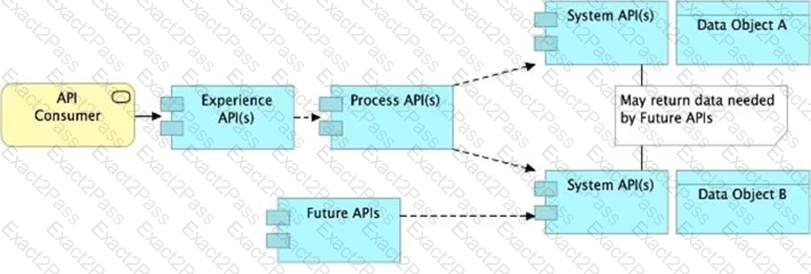
Refer to the exhibit.
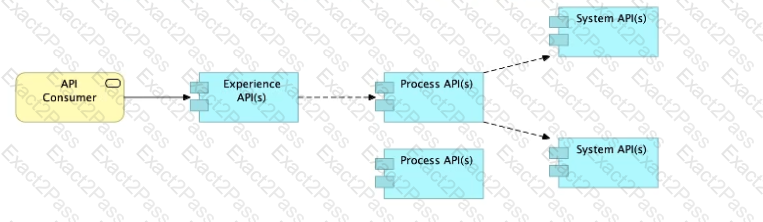
What is the best way to decompose one end-to-end business process into a collaboration of Experience, Process, and System APIs?
A) Handle customizations for the end-user application at the Process API level rather than the Experience API level
B) Allow System APIs to return data that is NOT currently required by the identified Process or Experience APIs
C) Always use a tiered approach by creating exactly one API for each of the 3 layers (Experience, Process and System APIs)
D) Use a Process API to orchestrate calls to multiple System APIs, but NOT to other Process APIs
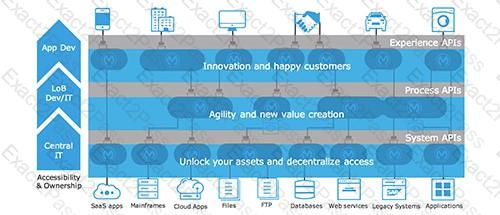
What is the main change to the IT operating model that MuleSoft recommends to organizations to improve innovation and clock speed?
A developer from the Central IT team has created an initial version of the RAML definition in Design Center for an OAuth 2.0-protected System API and published it
to Exchange. Another developer from LoB IT discovered the System API in Exchange and would like to leverage it in the Process API.
What is the MuleSoft-recommended approach for Process API to invoke the System API?
A circuit breaker strategy is planned in order to meet the goal of improved response time and demand on a downstream API.
* Circuit Open: More than 10 errors per minute for three minutes
* Circuit Half-Open: One error per minute
* Circuit Closed: Less than one error per minute for five minutes
Out of several proposals from the engineering team, which option will meet this goal?
When using CloudHub with the Shared Load Balancer, what is managed EXCLUSIVELY by the API implementation (the Mule application) and NOT by Anypoint Platform?