Exact2Pass

Last Update 22 hours ago Total Questions : 152
The Salesforce Certified MuleSoft Platform Architect (Mule-Arch-201) content is now fully updated, with all current exam questions added 22 hours ago. Deciding to include MuleSoft-Platform-Architect-I practice exam questions in your study plan goes far beyond basic test preparation.
You'll find that our MuleSoft-Platform-Architect-I exam questions frequently feature detailed scenarios and practical problem-solving exercises that directly mirror industry challenges. Engaging with these MuleSoft-Platform-Architect-I sample sets allows you to effectively manage your time and pace yourself, giving you the ability to finish any Salesforce Certified MuleSoft Platform Architect (Mule-Arch-201) practice test comfortably within the allotted time.
A company deploys Mule applications with default configurations through Runtime Manager to customer-hosted Mule runtimes. Each Mule application is an API
implementation that exposes RESTful interfaces to API clients. The Mule runtimes are managed by the MuleSoft-hosted control plane. The payload is never used by any Logger
components.
When an API client sends an HTTP request to a customer-hosted Mule application, which metadata or data (payload) is pushed to the MuleSoft-hosted control plane?
Refer to the exhibit. An organization is running a Mule standalone runtime and has configured Active Directory as the Anypoint Platform external Identity Provider. The organization does not have budget for other system components.
What policy should be applied to all instances of APIs in the organization to most effecuvelyKestrict access to a specific group of internal users?
In an organization, the InfoSec team is investigating Anypoint Platform related data traffic.
From where does most of the data available to Anypoint Platform for monitoring and alerting originate?
An API client calls one method from an existing API implementation. The API implementation is later updated. What change to the API implementation would require the API client ' s invocation logic to also be updated?
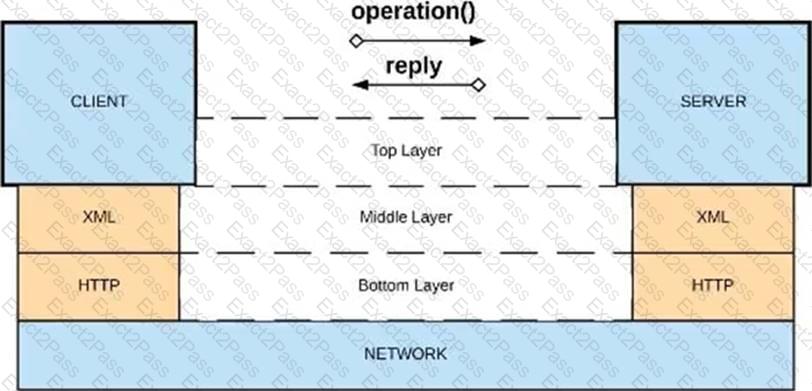
Refer to the exhibit.
What is a valid API in the sense of API-led connectivity and application networks?
A) Java RMI over TCP
B) Java RMI over TCP
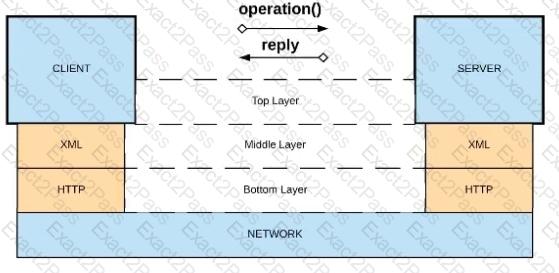
C) CORBA over HOP
D) XML over UDP
A company wants to move its Mule API implementations into production as quickly as possible. To protect access to all Mule application data and metadata, the company requires that all Mule applications be deployed to the company ' s customer-hosted infrastructure within the corporate firewall. What combination of runtime plane and control plane options meets these project lifecycle goals?
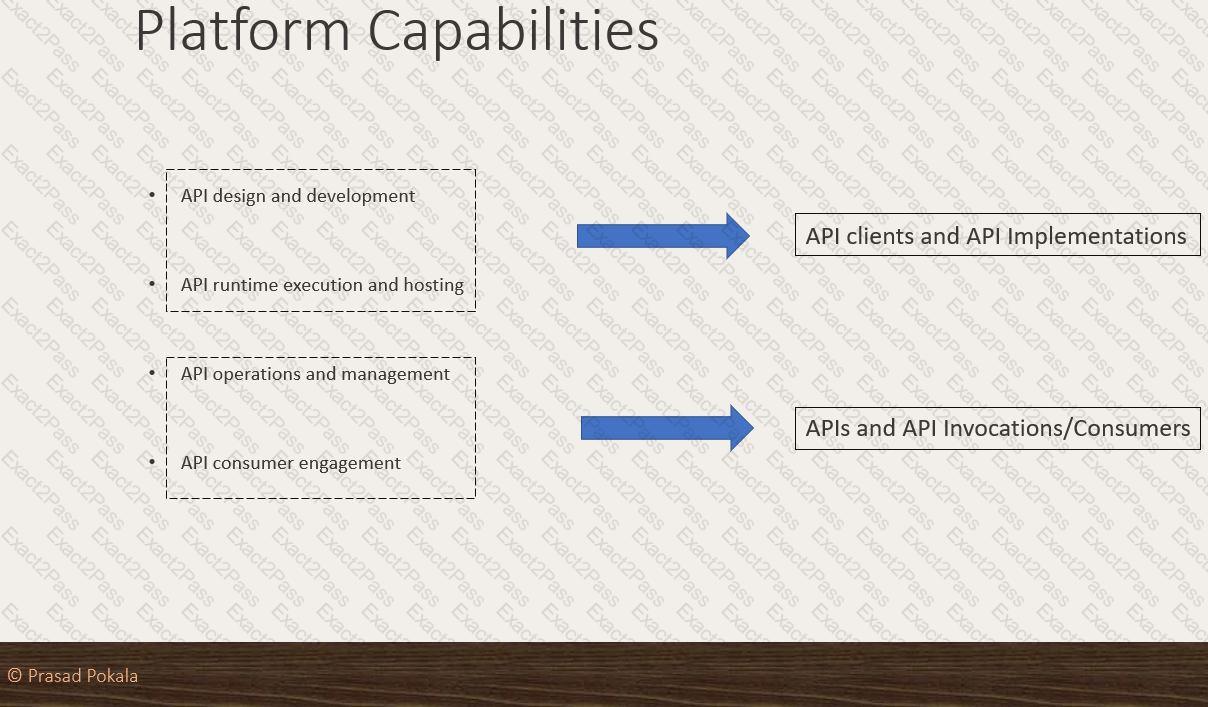
What are 4 important Platform Capabilities offered by Anypoint Platform?
Which component monitors APIs and endpoints at scheduled intervals, receives reports about whether tests pass or fail, and displays statistics about API and endpoint
performance?
Which three tools automate the deployment of Mule applications?
Choose 3 answers
An application updates an inventory running only one process at any given time to keep the inventory consistent. This process takes 200 milliseconds (.2 seconds) to
execute; therefore, the scalability threshold of the application is five requests per second.
What is the impact on the application if horizontal scaling is applied, thereby increasing the number of Mule workers?