
Summer Sale Special Limited Time 70% Discount Offer - Ends in 0d 00h 00m 00s - Coupon code: buysanta

Exact2Pass Menu

Salesforce Certified MuleSoft Platform Architect (Mule-Arch-201)

Last Update 1 day ago Total Questions : 152

The Salesforce Certified MuleSoft Platform Architect (Mule-Arch-201) content is now fully updated, with all current exam questions added 1 day ago. Deciding to include MuleSoft-Platform-Architect-I practice exam questions in your study plan goes far beyond basic test preparation.

You'll find that our MuleSoft-Platform-Architect-I exam questions frequently feature detailed scenarios and practical problem-solving exercises that directly mirror industry challenges. Engaging with these MuleSoft-Platform-Architect-I sample sets allows you to effectively manage your time and pace yourself, giving you the ability to finish any Salesforce Certified MuleSoft Platform Architect (Mule-Arch-201) practice test comfortably within the allotted time.

Question # 21

Which scenario is suited for MUnit tests instead of integration tests?

A.

For read-only interactions to any dependencies (such as other web APIs)

B.

When testing does not require knowledge of implementation details

C.

When no mocking is permissible

D.

For tests that are implemented using SoapUI

Question # 22

A set of tests must be performed prior to deploying API implementations to a staging environment. Due to data security and access restrictions, untested APIs cannot be granted access to the backend systems, so instead mocked data must be used for these tests. The amount of available mocked data and its contents is sufficient to entirely test the API implementations with no active connections to the backend systems. What type of tests should be used to incorporate this mocked data?

A.

Integration tests

B.

Performance tests

C.

Functional tests (Blackbox)

D.

Unit tests (Whitebox)

Question # 23

An API experiences a high rate of client requests (TPS) vwth small message paytoads. How can usage limits be imposed on the API based on the type of client application?

A.

Use an SLA-based rate limiting policy and assign a client application to a matching SLA tier based on its type

B.

Use a spike control policy that limits the number of requests for each client application type

C.

Use a cross-origin resource sharing (CORS) policy to limit resource sharing between client applications, configured by the client application type

D.

Use a rate limiting policy and a client ID enforcement policy, each configured by the client application type

Question # 24

An Anypoint Platform organization has been configured with an external identity provider (IdP) for identity management and client management. What credentials or token must be provided to Anypoint CLI to execute commands against the Anypoint Platform APIs?

A.

The credentials provided by the IdP for identity management

B.

The credentials provided by the IdP for client management

C.

An OAuth 2.0 token generated using the credentials provided by the IdP for client management

D.

An OAuth 2.0 token generated using the credentials provided by the IdP for identity management

Question # 25

A developer from the Central IT team has created an initial version of the RAML definition in Design Center for an OAuth 2.0-protected System API and published it

to Exchange. Another developer from LoB IT discovered the System API in Exchange and would like to leverage it in the Process API.

What is the MuleSoft-recommended approach for Process API to invoke the System API?

A.

The Process API needs to import an CAuth 2.0 module from Exchange first and update it with OAuth 2.0 credentials before the System API can be invoked

B.

The Process API uses property YAML files to store the System API URLs and uses the HTTP Request Connector to invoke the Systerm API

C.

The Process APL uses the REST Connect Connector autogenerated in Exchange for the System API

D.

The Process API manually updates the Process API POM file to include the System API as a dependency

Question # 26

A Mule 4 API has been deployed to CloudHub and a Basic Authentication - Simple policy has been applied to all API methods and resources. However, the API is still accessible

by clients without using authentication.

How is this possible?

A.

The APE Router component is pointing to the incorrect Exchange version of the APT

B.

The Autodiscovery element is not present, in the deployed Mule application

C.

No… for client applications have been created of this API

D.

One of the application’s CloudHub workers restarted

Question # 27

What is typically NOT a function of the APIs created within the framework called API-led connectivity?

A.

They provide an additional layer of resilience on top of the underlying backend system, thereby insulating clients from extended failure of these systems.

B.

They allow for innovation at the user Interface level by consuming the underlying assets without being aware of how data Is being extracted from backend systems.

C.

They reduce the dependency on the underlying backend systems by helping unlock data from backend systems In a reusable and consumable way.

D.

They can compose data from various sources and combine them with orchestration logic to create higher level value.

Question # 28

A client has several applications running on the Salesforce service cloud. The business requirement for integration is to get daily data changes from Account and Case

Objects. Data needs to be moved to the client ' s private cloud AWS DynamoDB instance as a single JSON and the business foresees only wanting five attributes from the

Account object, which has 219 attributes (some custom) and eight attributes from the Case Object.

What design should be used to support the API/ Application data model?

A.

Create separate entities for Account and Case Objects by mimicking all the attributes in SAPI, which are combined by the PAPI and filtered to provide JSON output containing 13 attributes.

B.

Request client’s AWS project team to replicate all the attributes and create Account and Case JSON table in DynamoDB. Then create separate entities for Account and Case Objects by mimicking all the attributes in SAPI to transfer ISON data to DynamoD for respective Objects

C.

Start implementing an Enterprise Data Model by defining enterprise Account and Case Objects and implement SAPI and DynamoDB tables based on the Enterprise Data Model,

D.

Create separate entities for Account with five attributes and Case with eight attributes in SAPI, which are combined by the PAPI to provide JSON output containing 13 attributes.

Question # 29

Which APIs can be used with DataGraph to create a unified schema?
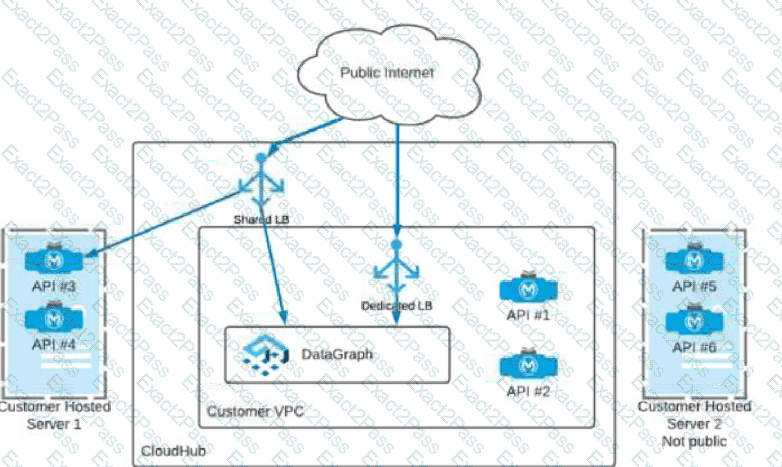
A.

APIs 1, 3, 5

B.

APIs 2, 4 ,6

C.

APIs 1, 2, s5, 6

D.

APIs 1, 2, 3, 4

Question # 30

When designing an upstream API and its implementation, the development team has been advised to NOT set timeouts when invoking a downstream API, because that downstream API has no SLA that can be relied upon. This is the only downstream API dependency of that upstream API.

Assume the downstream API runs uninterrupted without crashing. What is the impact of this advice?


A.

An SLA for the upstream API CANNOT be provided

B.

The invocation of the downstream API will run to completion without timing out

C.

A default timeout of 500 ms will automatically be applied by the Mule runtime in which the upstream API implementation executes

D.

A toad-dependent timeout of less than 1000 ms will be applied by the Mule runtime in which the downstream API implementation executes

Go to page: