Exact2Pass

Last Update 22 hours ago Total Questions : 152
The Salesforce Certified MuleSoft Platform Architect (Mule-Arch-201) content is now fully updated, with all current exam questions added 22 hours ago. Deciding to include MuleSoft-Platform-Architect-I practice exam questions in your study plan goes far beyond basic test preparation.
You'll find that our MuleSoft-Platform-Architect-I exam questions frequently feature detailed scenarios and practical problem-solving exercises that directly mirror industry challenges. Engaging with these MuleSoft-Platform-Architect-I sample sets allows you to effectively manage your time and pace yourself, giving you the ability to finish any Salesforce Certified MuleSoft Platform Architect (Mule-Arch-201) practice test comfortably within the allotted time.
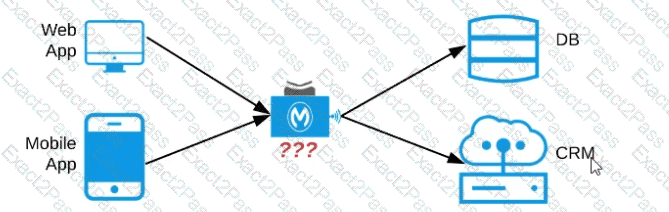
Refer to the exhibit. An organization needs to enable access to their customer data from both a mobile app and a web application, which each need access to common fields as well as certain unique fields.
The data is available partially in a database and partially in a 3rd-party CRM system.
What APIs should be created to best fit these design requirements?
A) A Process API that contains the data required by both the web and mobile apps, allowing these applications to invoke it directly and access the data they need thereby providing the flexibility to add more fields in the future without needing API changes
B) One set of APIs (Experience API, Process API, and System API) for the web app, and another set for the mobile app
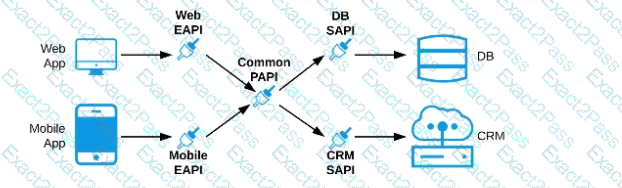
C) Separate Experience APIs for the mobile and web app, but a common Process API that invokes separate System APIs created for the database and CRM system
D) A common Experience API used by both the web and mobile apps, but separate Process APIs for the web and mobile apps that interact with the database and the CRM System
What API policy would be LEAST LIKELY used when designing an Experience API that is intended to work with a consumer mobile phone or tablet application?
An organization wants to make sure only known partners can invoke the organization ' s APIs. To achieve this security goal, the organization wants to enforce a Client ID Enforcement policy in API Manager so that only registered partner applications can invoke the organization ' s APIs. In what type of API implementation does MuleSoft recommend adding an API proxy to enforce the Client ID Enforcement policy, rather than embedding the policy directly in the application ' s JVM?
A business process is being implemented within an organization ' s application network. The architecture group proposes using a more coarse-grained application
network design with relatively fewer APIs deployed to the application network compared to a more fine-grained design.
Overall, which factor typically increases with a more coarse-grained design for this business process implementation and deployment compared with using a more fine-grained
design?
True or False. We should always make sure that the APIs being designed and developed are self-servable even if it needs more man-day effort and resources.
An Order API must be designed that contains significant amounts of integration logic and involves the invocation of the Product API.
The power relationship between Order API and Product API is one of " Customer/Supplier " , because the Product API is used heavily throughout the organization and is developed by a dedicated development team located in the office of the CTO.
What strategy should be used to deal with the API data model of the Product API within the Order API?
Due to a limitation in the backend system, a system API can only handle up to 500 requests per second. What is the best type of API policy to apply to the system API to avoid overloading the backend system?
An enterprise is embarking on the API-led digital transformation journey, and the central IT team has started to define System APIs. Currently there is no Enterprise
Data Model being defined within the enterprise, and the definition of a clean Bounded Context Data Model requires too much effort.
According to MuleSoft ' s recommended guidelines, how should the System API data model be defined?
What is true about the technology architecture of Anypoint VPCs?
An IT Security Compliance Auditor is assessing which nonfunctional requirements (NFRs) are already being implemented to meet security measures.
* The Web API has Rate-Limiting SLA
* Basic Authentication - LDAP
* JSON Threat Protection
* TP Allowlist policies applied
Which two NFRs-are enforced?