Exact2Pass

Last Update 22 hours ago Total Questions : 44
The Fortinet NSE 5 - FortiSASE and SD-WAN 7.6 Core Administrator content is now fully updated, with all current exam questions added 22 hours ago. Deciding to include NSE5_SSE_AD-7.6 practice exam questions in your study plan goes far beyond basic test preparation.
You'll find that our NSE5_SSE_AD-7.6 exam questions frequently feature detailed scenarios and practical problem-solving exercises that directly mirror industry challenges. Engaging with these NSE5_SSE_AD-7.6 sample sets allows you to effectively manage your time and pace yourself, giving you the ability to finish any Fortinet NSE 5 - FortiSASE and SD-WAN 7.6 Core Administrator practice test comfortably within the allotted time.
What is a key use case for FortiSASE Secure Internet Access (SIA) in an agentless deployment? (Choose one answer)
The IT team is wondering whether they will need to continue using MDM tools for future FortiClient upgrades.
What options are available for handling future FortiClient upgrades?
A FortiGate device is in production. To optimize WAN link use and improve redundancy, you enable and configure SD-WAN.
What must you do as part of this configuration update process? (Choose one answer)
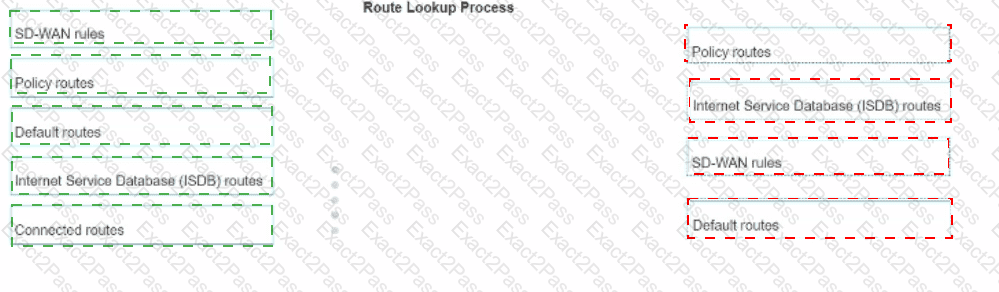
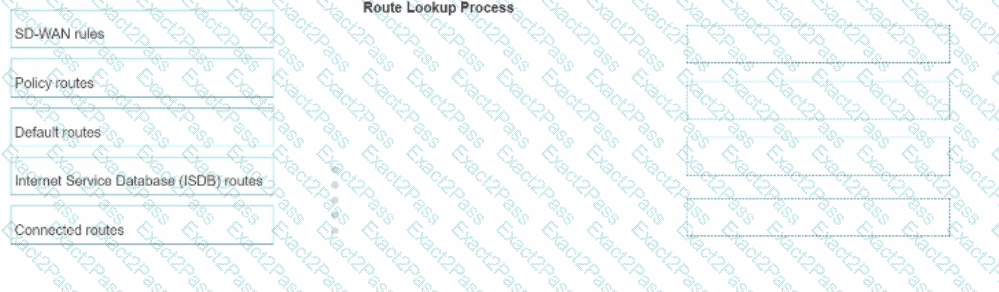
In which order does a FortiGate device consider the following elements shown in the left column during the route lookup process?
Select the element in the left column, hold and drag it to a blank position in the column on the right. Place the four correct elements in order, placing the first element in the first position at the top of the column. Once you place an element, you can move it again if you want to change your answer before moving to the next question. You need to drop four elements in the work area.
Select and drag the screen divider to change the viewable area of the source and work areas.
You have a FortiGate configuration with three user-defined SD-WAN zones and one or two members in each of these zones. One SD-WAN member is no longer used in health-check and SD-WAN rules. This member is the only member of its zone. You want to delete it.
What happens if you delete the SD-WAN member from the FortiGate GUI?
Refer to the exhibit.
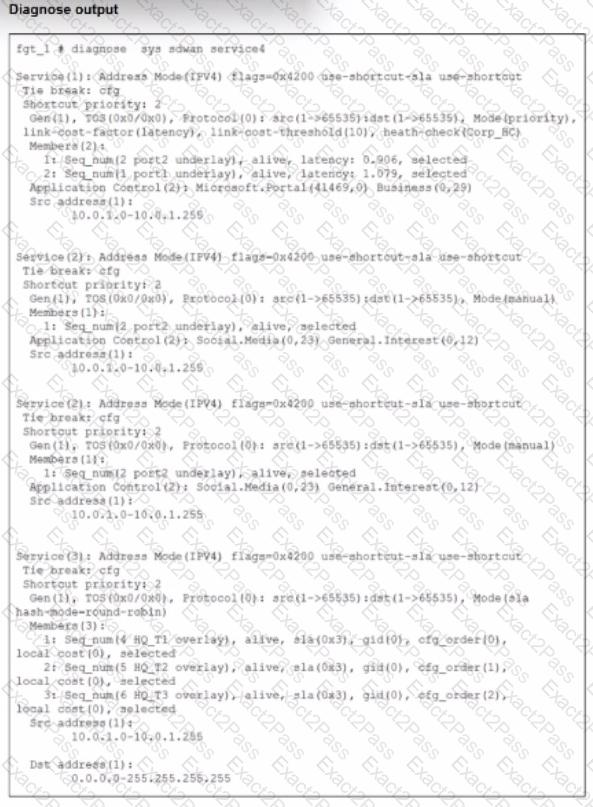
The exhibit shows output of the command diagnose sys sdwan service collected on a FortiGate device.
The administrator wants to know through which interface FortiGate will steer traffic from local users on subnet 10.0.1.0/255.255.255.192 and with a destination of the social media application Facebook.
Based on the exhibits, which two statements are correct? (Choose two.)
Refer to the exhibit.
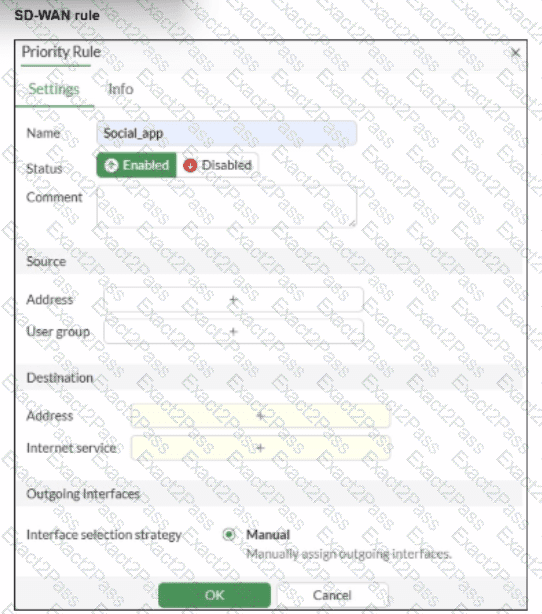
You configure SD-WAN on a standalone FortiGate device. You want to create an SD-WAN rule that steers traffic related to Facebook and LinkedIn through the less costly internet link. What must you do to set Facebook and LinkedIn applications as destinations from the GUI?
Which statement is true about FortiSASE supported deployment?
Which configuration is a valid use case for FortiSASE features in supporting remote users?
Which secure internet access (SIA) use case minimizes individual endpoint configuration? (Choose one answer)