
Summer Sale Special Limited Time 70% Discount Offer - Ends in 0d 00h 00m 00s - Coupon code: buysanta

Exact2Pass Menu

Google Certified Professional - Cloud Developer

Last Update 11 hours ago Total Questions : 265

The Google Certified Professional - Cloud Developer content is now fully updated, with all current exam questions added 11 hours ago. Deciding to include Professional-Cloud-Developer practice exam questions in your study plan goes far beyond basic test preparation.

You'll find that our Professional-Cloud-Developer exam questions frequently feature detailed scenarios and practical problem-solving exercises that directly mirror industry challenges. Engaging with these Professional-Cloud-Developer sample sets allows you to effectively manage your time and pace yourself, giving you the ability to finish any Google Certified Professional - Cloud Developer practice test comfortably within the allotted time.

Question # 51

You want to upload files from an on-premises virtual machine to Google Cloud Storage as part of a data

migration. These files will be consumed by Cloud DataProc Hadoop cluster in a GCP environment.

Which command should you use?

A.

gsutil cp [LOCAL_OBJECT] gs://[DESTIN ATION_BUCKET_NAME] /

B.

gcloud cp [LOCAL_OBJECT] gs://[DESTINATION_BUCKET_NAME] /

C.

hadoop fs cp [LOCAL_OBJECT] gs://[DESTINATION_BUCKET_NAME] /

D.

gcloud dataproc cp [LOCAL_OBJECT] gs://[DESTINATION_BUCKET_NAME] /

Question # 52

Your existing application keeps user state information in a single MySQL database. This state information is

very user-specific and depends heavily on how long a user has been using an application. The MySQL

database is causing challenges to maintain and enhance the schema for various users.

Which storage option should you choose?

A.

Cloud SQL

B.

Cloud Storage

C.

Cloud Spanner

D.

Cloud Datastore/Firestore

Question # 53

Your company’s corporate policy states that there must be a copyright comment at the very beginning of all source files. You want to write a custom step in Cloud Build that is triggered by each source commit. You need the trigger to validate that the source contains a copyright and add one for subsequent steps if not there. What should you do?

A.

Build a new Docker container that examines the files in /workspace and then checks and adds a copyright for each source file. Changed files are explicitly committed back to the source repository.

B.

Build a new Docker container that examines the files in /workspace and then checks and adds a copyright for each source file. Changed files do not need to be committed back to the source repository.

C.

Build a new Docker container that examines the files in a Cloud Storage bucket and then checks and adds a copyright for each source file. Changed files are written back to the Cloud Storage bucket.

D.

Build a new Docker container that examines the files in a Cloud Storage bucket and then checks and adds a copyright for each source file. Changed files are explicitly committed back to the source repository.

Question # 54

Your analytics system executes queries against a BigQuery dataset. The SQL query is executed in batch and passes the contents of a SQL file to the BigQuery CLI. Then it redirects the BigQuery CLI output to another process. However, you are getting a permission error from the BigQuery CLI when the queries are executed. You want to resolve the issue. What should you do?

A.

Grant the service account BigQuery Data Viewer and BigQuery Job User roles.

B.

Grant the service account BigQuery Data Editor and BigQuery Data Viewer roles.

C.

Create a view in BigQuery from the SQL query and SELECT* from the view in the CLI.

D.

Create a new dataset in BigQuery, and copy the source table to the new dataset Query the new dataset and table from the CLI.

Question # 55

You are a developer at a large organization. You are deploying a web application to Google Kubernetes Engine (GKE). The DevOps team has built a CI/CD pipeline that uses Cloud Deploy to deploy the application to Dev Test, and Prod clusters in GKE. After Cloud Deploy successfully deploys the application to the Dev cluster you want to automatically promote it to the Test Cluster. How should you configure this process following Google-recommended best practices?

A.

1 Create a Cloud Build trigger that listens for SUCCEEDED Pub/Sub messages from the clouddeploy-operations topic.

2 Configure Cloud Build to include a step that promotes the application to the Test cluster

B.

1 Create a Cloud Function that calls the Google Cloud Deploy API to promote the application to the Test cluster

2 Configure this function to be triggered by SUCCEEDED Pub/Sub messages from the cloud-builds topic

C.

1 Create a Cloud Function that calls the Google Cloud Deploy API to promote the application to the Test cluster

2 Configure this function to be triggered by SUCCEEDED Pub/Sub messages from the clouddeploy operations topic

D.

1 Create a Cloud Build pipeline that uses the gke-deploy builder

2 Create a Cloud Build trigger that listens to SUCCEEDED Pub/Sub messages from the cloud-builds topic

3 Configure this pipeline to run a deployment step to the Test cluster

Question # 56

Your API backend is running on multiple cloud providers. You want to generate reports for the network latency of your API.

Which two steps should you take? (Choose two.)

A.

Use Zipkin collector to gather data.

B.

Use Fluentd agent to gather data.

C.

Use Stackdriver Trace to generate reports.

D.

Use Stackdriver Debugger to generate report.

E.

Use Stackdriver Profiler to generate report.

Question # 57

You are running a web application on Google Kubernetes Engine that you inherited. You want to determine whether the application is using libraries with known vulnerabilities or is vulnerable to XSS attacks. Which service should you use?

A.

Google Cloud Armor

B.

Debugger

C.

Web Security Scanner

D.

Error Reporting

Question # 58

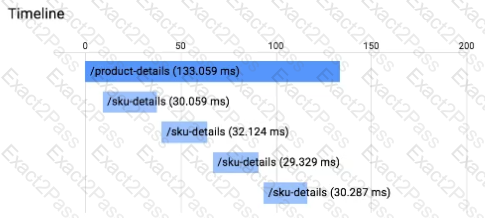
You have an application running in App Engine. Your application is instrumented with Stackdriver Trace. The /product-details request reports details about four known unique products at /sku-details as shown below. You want to reduce the time it takes for the request to complete. What should you do?

A.

Increase the size of the instance class.

B.

Change the Persistent Disk type to SSD.

C.

Change /product-details to perform the requests in parallel.

D.

Store the /sku-details information in a database, and replace the webservice call with a database query.

Go to page:
