Exact2Pass

Last Update 22 hours ago Total Questions : 160
The PV Installation Professional (PVIP) Board Certification content is now fully updated, with all current exam questions added 22 hours ago. Deciding to include PVIP practice exam questions in your study plan goes far beyond basic test preparation.
You'll find that our PVIP exam questions frequently feature detailed scenarios and practical problem-solving exercises that directly mirror industry challenges. Engaging with these PVIP sample sets allows you to effectively manage your time and pace yourself, giving you the ability to finish any PV Installation Professional (PVIP) Board Certification practice test comfortably within the allotted time.
A PV system is designed with a 48V battery bank and a 5 kW inverter. The load requires 20 kWh/day, and the system must have 2 days of autonomy with a maximum depth of discharge (DoD) of 50%. What is the minimum battery capacity required in Ah?
A homeowner is concerned that a 6kWdc PV system might be experiencing a performance issue. The homeowner has noticed what appears to be declining production. The installer analyzes the following data acquisition system (DAS) results for each year since the installation:
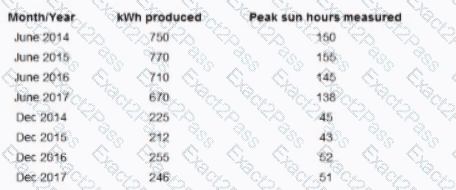
Given the data, which is the MOST likely conclusion to draw?
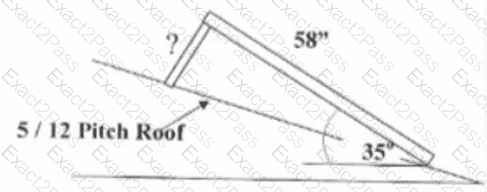
A PV array with 58 in. X 38 in modules in portrait orientation is to be mounted at a 35 tiit angle on a shingle roof that has a 5:12 pitch. Assuming the support leg is attached to the top of the modules and is perpendicular to its face, what is the length of the support leg for the modules?
When performing a system checkout after completing the installation, what is the SAFEST sequence of tasks to detect installation errors before closing any disconnects to the inverter, charge controller, or batteries?
According to the NEC, if the PV system disconnect and the building service disconnect are at different locations, there MUST be a/an:
A racking system is designed for a wind speed of 120 mph. The site’s design wind speed increases to 130 mph. What is the percentage increase in wind pressure?
An installer is using ½ in lag boits to secure roof-monitoring hardware to rafters through a roof deck. Which of the following should the installer predrill?
When doing initial inspections on a PV system that was installed using racking that is not compliant with UL.2703, an inspector should pay special attention to which electrical attribute?
During a site assessment, an installer identifies a 100-foot-tall tree 150 feet south of a proposed PV array. The site latitude is 40°N. Will this tree cause shading on December 21st between 9 AM and 3 PM solar time?
A module’s Isc is 9A at STC. At 600 W/m² irradiance, what is the expected Isc?

