Exact2Pass

Last Update 13 hours ago Total Questions : 387
The Financial Risk and Regulation (FRR) Series content is now fully updated, with all current exam questions added 13 hours ago. Deciding to include 2016-FRR practice exam questions in your study plan goes far beyond basic test preparation.
You'll find that our 2016-FRR exam questions frequently feature detailed scenarios and practical problem-solving exercises that directly mirror industry challenges. Engaging with these 2016-FRR sample sets allows you to effectively manage your time and pace yourself, giving you the ability to finish any Financial Risk and Regulation (FRR) Series practice test comfortably within the allotted time.
Which one of the four following aspects of legal risk is NOT included in the Basel II Accord?
Bank Alpha is making a decision about lending 10-year loans in a sector that is fairly illiquid and is looking at various options to fund the loans. Which of the following options to fund the loans exhibits the most exogenous liquidity risk?
Which of the following about the ratios between various Tiers of capital is not a requirement of the Basel Committee?
Samuel Teng owns a portfolio of bonds and is trying to compute the convexity of his portfolio. Which of the following choices equals the convexity of Samuel's portfolio?
Which one of the following financial instruments is subject to implied volatility price risk?
A portfolio consists of two floating rate bonds and one fixed rate bond.
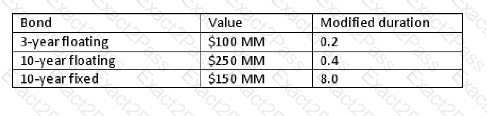
Based on the information below, modified duration of this portfolio is
Which of the following bank events could stress the bank's liquidity position?
I. Obligations to fund assets like mortgages
II. Unusually large depositor withdrawals
III. Counterparty collateral calls
IV. Nonperforming assets
An asset and liability manager for a large financial institution has to recognize that retail products ___ include embedded options, which are often not rationally exercised, while wholesale products ___ carry penalties for repayment or include rights to terminate wholesale contracts on very different terms than are common in retail products.
Bank Omega is using futures contracts on a well capitalized exchange to hedge its market risk exposure. Which of the following could be reasons that expose the bank to liquidity risk?
I. The bank may not be able to unwind the futures contracts before expiration.
II. Prices may move such that a loss results on the hedge.
III. Since futures require margins which are settled every day, the bank could find itself scrambling for funds.
IV. Exchange margin requirements could change unexpectedly.
Which of the following statements explains how securitization makes retail assets highly liquid and the balance sheet easier to manage?
I. The bank can raise capital by selling the securitized bonds.
II. Any need to diversify credit risk can be achieved by selling the bank’s own securitized bonds and buying other bonds that increase diversification.
III. The value of the securitization is linked to the credit rating of the bank and hence is easy to include in medium-term financial plans.
IV. Securitizations can be used to hedge credit risk by using limited market instruments.

