Exact2Pass

Last Update 13 hours ago Total Questions : 90
The Professional VMware vRealize Automation 8.3 content is now fully updated, with all current exam questions added 13 hours ago. Deciding to include 2V0-31.21 practice exam questions in your study plan goes far beyond basic test preparation.
You'll find that our 2V0-31.21 exam questions frequently feature detailed scenarios and practical problem-solving exercises that directly mirror industry challenges. Engaging with these 2V0-31.21 sample sets allows you to effectively manage your time and pace yourself, giving you the ability to finish any Professional VMware vRealize Automation 8.3 practice test comfortably within the allotted time.
An administrator is trying to create a new set of image mappings that will map to vSphere templates that have been added to an existing vCenter Server cloud account. When the administrator tries to select the Windows Server 2016 image, nothing appears on the list. The administrator has confirmed that the vSphere template exists in the correct location within vCenter Server.
Which action should the administrator take to be able to create the new image mapping? (Choose the best answer.)
Which type of tag docs vRealize Automation Cloud Assembly automatically apply during provisioning to some deployments to support the analysis, monitoring, and grouping of deployed resources?
Refer to the exhibit.
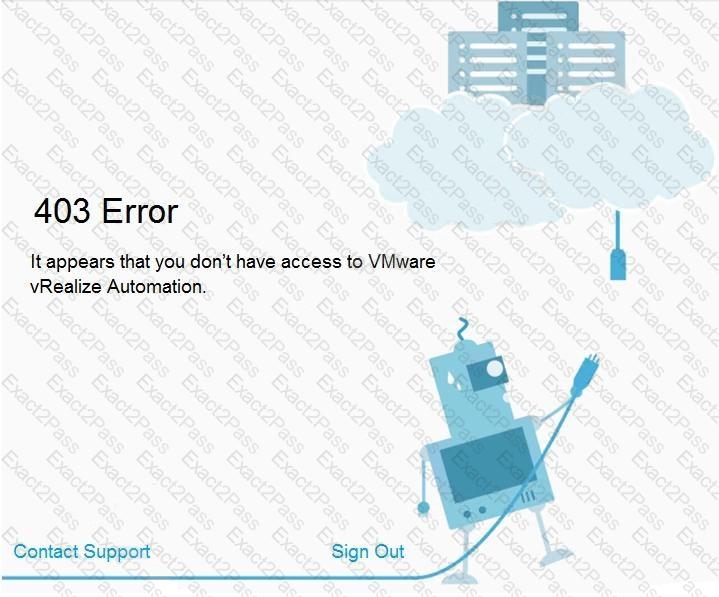
An administrator successfully deploys vRealize Automation (vRA) and configures a new directory in vRealize Suite Lifecycle Manager for the App-Dev team. The Add-Dev team needs to request catalog items and manage the subsequent deployments. The company security policy requires that users be granted the least privileges necessary to fulfill their role.
The administrator is assigned a ticket to address the issue that when the App-Dev members log into vRA, they receive the error shown in the exhibit. Based on initial investigation, all of the users experiencing the issue are members of the same Active Directory Group: App-Dev-Users. Upon review from within vRA Identity & Access Management, all of the users reporting the issue appear under the Active Users tab.
Which two actions should the administrator take within Identity & Access Management to resolve the reported issue while adhering to the security policy? (Choose two.)
Which two components can be used to add a directory for identity and access management? (Choose two.)
Which vRealize Automation service is a development- and process-automation platform that supports extensibility and Anything-as-a-Service (XaaS) features in vRealize Automation?
An administrator must restrict the amount of memory resources available for a specific group of users. On which component would the administrator configure this?
An administrator successfully creates a new cloud template in Cloud Assembly for the DevOps project. The administrator is ready to publish the cloud template so that the DevOps team can use the catalog for self-service requests.
The administrator is trying to import the cloud template into Service Broker through the correct content source type. After creating the content source, the administrator cannot find the new cloud template listed in order to import it.
What might be the cause of this issue? (Choose the best answer.)
An administrator creates a content source and would like to share all the imported cloud templates dynamically with the project members.
Which content sharing option should the administrator select to achieve this? (Choose the best answer.)
What capability enables provider administrators to allocate infrastructure resources to tenants in a multi-organization vRealize Automation environment? (Choose the best answer.)
An administrator is preparing to install vRealize Automation using the standard deployment option. For which three components must the administrator create a DNS record? (Choose three.)

