Spring Sale Special Limited Time 70% Discount Offer - Ends in 0d 00h 00m 00s - Coupon code: buysanta

Exact2Pass Menu

Automating and Programming Cisco Service Provider Solutions (300-535 SPAUTO)

Last Update 11 hours ago Total Questions : 60

The Automating and Programming Cisco Service Provider Solutions (300-535 SPAUTO) content is now fully updated, with all current exam questions added 11 hours ago. Deciding to include 300-535 practice exam questions in your study plan goes far beyond basic test preparation.

You'll find that our 300-535 exam questions frequently feature detailed scenarios and practical problem-solving exercises that directly mirror industry challenges. Engaging with these 300-535 sample sets allows you to effectively manage your time and pace yourself, giving you the ability to finish any Automating and Programming Cisco Service Provider Solutions (300-535 SPAUTO) practice test comfortably within the allotted time.

Question # 11

What is a benefit of Ansible for automating IOS XE or IOS XR platforms?

A.

Playbooks can be written in XML format.

B.

It has agent support

C.

It supports asynchronous orchestration.

D.

It offers native orchestration support for Cisco platforms.

Question # 12

Which is a format used for the YANG JSON content-type header?

A.

application/vnd/yang.data+json

B.

application/vnd.yang.data+json

C.

application/yang.data.json

D.

application/vnd.yang.data json

Question # 13

How does using the Python with statement in conjunction with ncclient manager improve an existing NETCONF automation script?

A.

It allows the NETCONF connection to the device to be gracefully closed without having to explicitly code this action.

B.

It manages the running configuration of the device by comparing it to the new configuration applied using NETCONF.

C.

The with statement tries to connect to the device using TCP port 830 first but also tries to connect via TCP port 22.

D.

Use of the with statement catches any exceptions when trying to connect to a device using NETCONF.

Question # 14

The Netmiko BaseConnection class contains a method called “send_config_set()”. Which two actions does this method perform on the device? (Choose two.)

A.

It takes a filename parameter that executes commands contained in that file on the device.

B.

It requires the user to explicitly send configure terminal and exit commands to the device to enter and exit configuration mode.

C.

It automatically enters and exits configuration mode on the device.

D.

It takes a Python iterable, such as a list of commands, and executes them in order on the device.

E.

It saves the running configuration to the startup configuration after executing the configuration commands on the device.

Question # 15

An engineer needs to configure network devices in an automated way. Which two ways are used to create structured data using YANG to provide REST-like APIs to enable programmability access? (Choose two.)

A.

YAML

B.

JSON

C.

GPB

D.

JSON-RPC

E.

E . XML

Question # 16

What are two advantages of using Python virtual environments? (Choose two.)

A.

They allow for multiple Python projects to use different versions of the same dependency without conflict.

B.

They allow multiple Python applications to share virtual memory between subprocesses.

C.

They allow for isolated environments where each can use a different version of Python.

D.

They allow for all Python projects to utilize the same set of shared dependencies.

E.

They allow for multiple virtual machines to share a single Python environment.

Question # 17

What is an interior YANG data node that exists in at most one instance in the data tree and has no value?

A.

listing node

B.

tree node

C.

container node

D.

leaf node

Question # 18

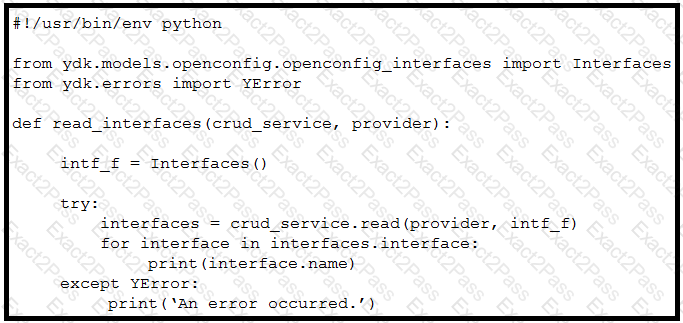
Refer to the exhibit.

When YDK is used to interact with Cisco routers, what is the purpose of passing intf_f into the crud_service.read() method?


A.

The Interfaces() class acts as a NETCONF filter, which limits the data returned to that of the openconfig:interfaces YANG model.

B.

It provides the data types of the openconfig:interfaces model to the router for dynamic configuration of the interfaces.

C.

It locks the interfaces from modification by other active NETCONF sessions.

D.

It passes default values into the crud_service, which reconfigures all interfaces to their default configurations.

Go to page: